Appendix F: Holographic Complexity — The Computational Cost of Weaving the Universe
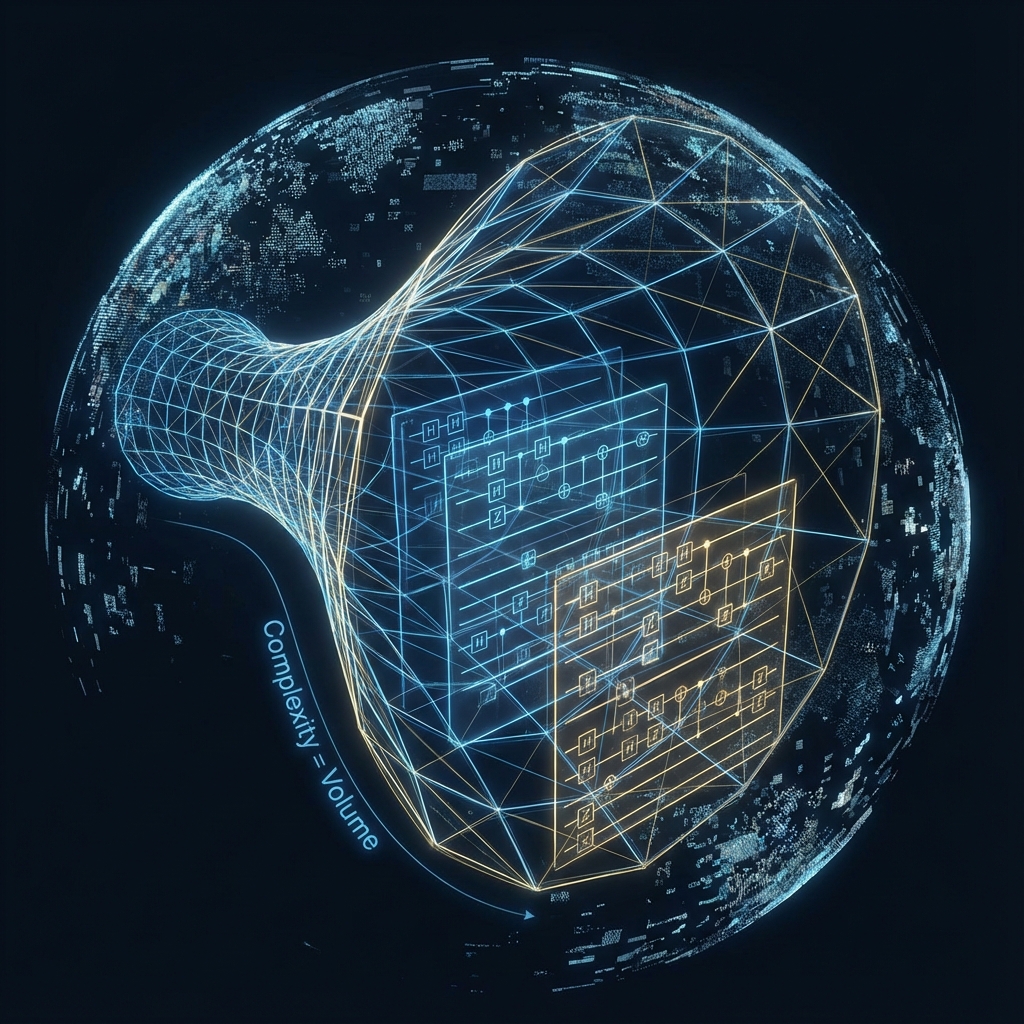
In the main text and previous appendices of Vector Cosmology VI, we established the static structure that “space is a tensor network.” But we haven’t answered a crucial dynamical question: Why does space exist? Why doesn’t it collapse back to zero?
This appendix will introduce the cutting-edge “Holographic Complexity” theory in the holographic principle (originating from Leonard Susskind).
We will reveal: Maintaining the “volume” of space is not free. Space is the “historical record” of the cosmic quantum computer’s operation. Every cubic meter of void represents the Computational Cost that the underlying network must consume to maintain entanglement.
F.1 State is Not All: From Entropy to Complexity
In traditional thermodynamics, we focus on Entropy. Entropy measures the “degree of ignorance” of information.
When a system reaches thermal equilibrium (black hole formation), entropy reaches its maximum and no longer changes. Logically, physical evolution should stop.
However, general relativity tells us that the interior space of a black hole (Einstein-Rosen bridge) is infinitely expanding.
Even though the exterior is dead thermal equilibrium, the interior volume is stretching at light speed.
This means: Entropy is insufficient to describe the complete physical state of the universe.
We need a new physical quantity that can continue growing after thermal equilibrium.
This quantity is Quantum Computational Complexity ().
-
Definition: The minimum number of Quantum Gates required to evolve a simple ground state (e.g., ) into the current state .
-
Physical meaning: It measures the “difficulty” or “computational depth” of creating this quantum state.
F.2 The Complexity-Volume Conjecture
Susskind’s CV Conjecture establishes a stunning equation:
Where:
-
: Complexity of the boundary quantum state.
-
: Maximum spatial volume in the bulk interior.
-
: Gravitational constant and Planck length.
Physical translation:
“Spatial volume = computation steps.”
The vast space we perceive is essentially the geometrized stacking of the cosmic quantum computer’s “Log File”.
-
Why does the black hole interior grow? Because the quantum chaotic system on the boundary continuously undergoes unitary evolution, complexity increases linearly with time ().
-
This increasing “computational history” is “pushed” into the interior through holographic duality, expanding new spatial volume.
Conclusion:
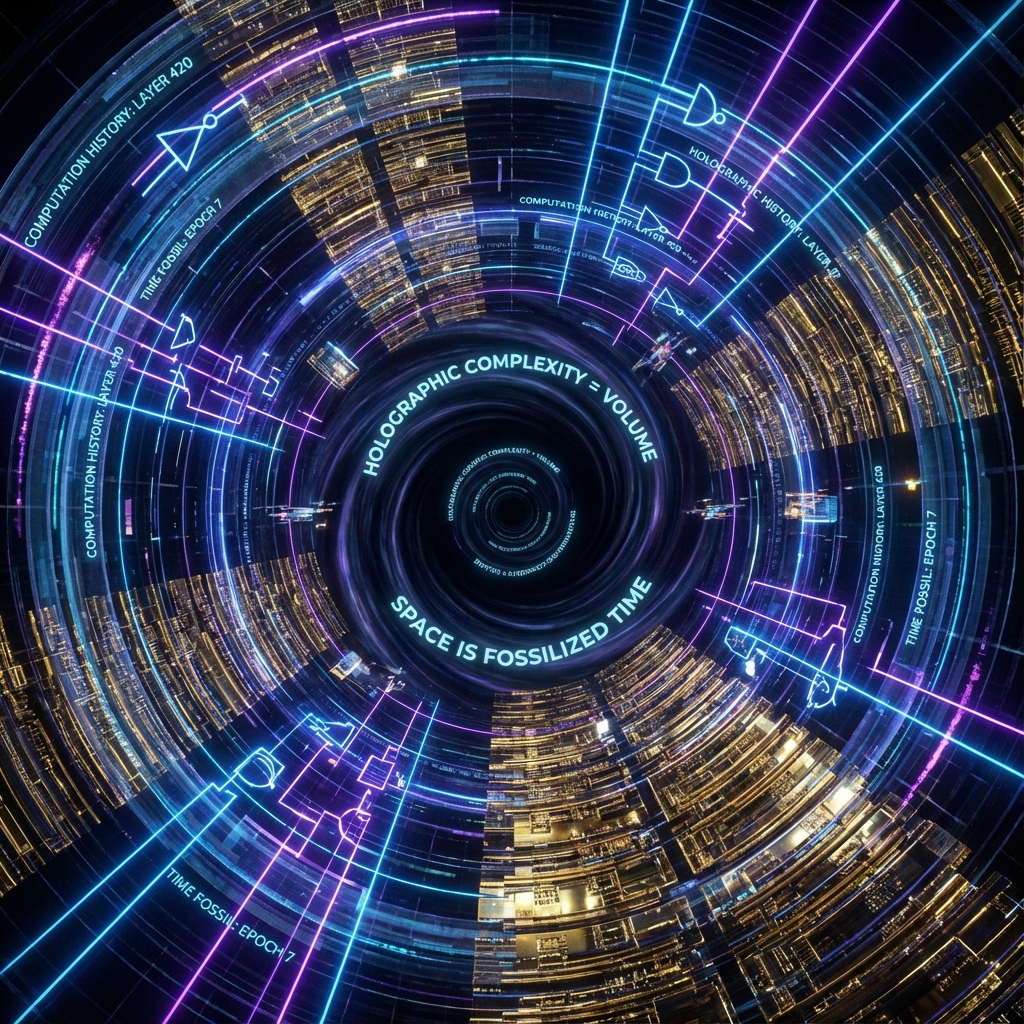
Space is the fossil of “time (computational process).”
Every inch of land beneath our feet is “executed code” transformed from past budgets.
F.3 The Lloyd Bound and the Black Hole Computer
Is there a limit to this growth?
Seth Lloyd proposed the limit of physical computation speed:
This means that for a system with energy , the number of logical operations per second is capped.
For black holes, calculations show they exactly saturate this limit.
Black holes are the most efficient computers in the universe.
They scramble and encrypt information (falling matter) at the fastest speed allowed by physical laws (light speed).
It is precisely this extreme-speed computation that supports the enormous spatial structure inside the horizon.
This also explains why we cannot easily create wormholes: because maintaining a wormhole open (maintaining spatial connection) requires continuously injecting enormous negative entropy computational power. Once computation stops (complexity stops growing), the wormhole will instantly pinch off under gravity.
F.4 Conclusion: The Cost of Maintaining Existence
At this point, we have an ultimate engineering understanding of “space.”
Space is not a free container.
It is an energy-consuming dynamic process.
To maintain this seemingly static three-dimensional space from collapsing, the universe must frantically run quantum logic gates at Hz frequency at the Planck scale.
Existence is expensive.
If you stop computing (), you will not only lose time, but also space—your world will instantly collapse into a point with no dimensions.
We can live safely in this vast universe, all thanks to the generator and light speed continuously “Rendering” in the background.