5.2 Zeno’s Eternity
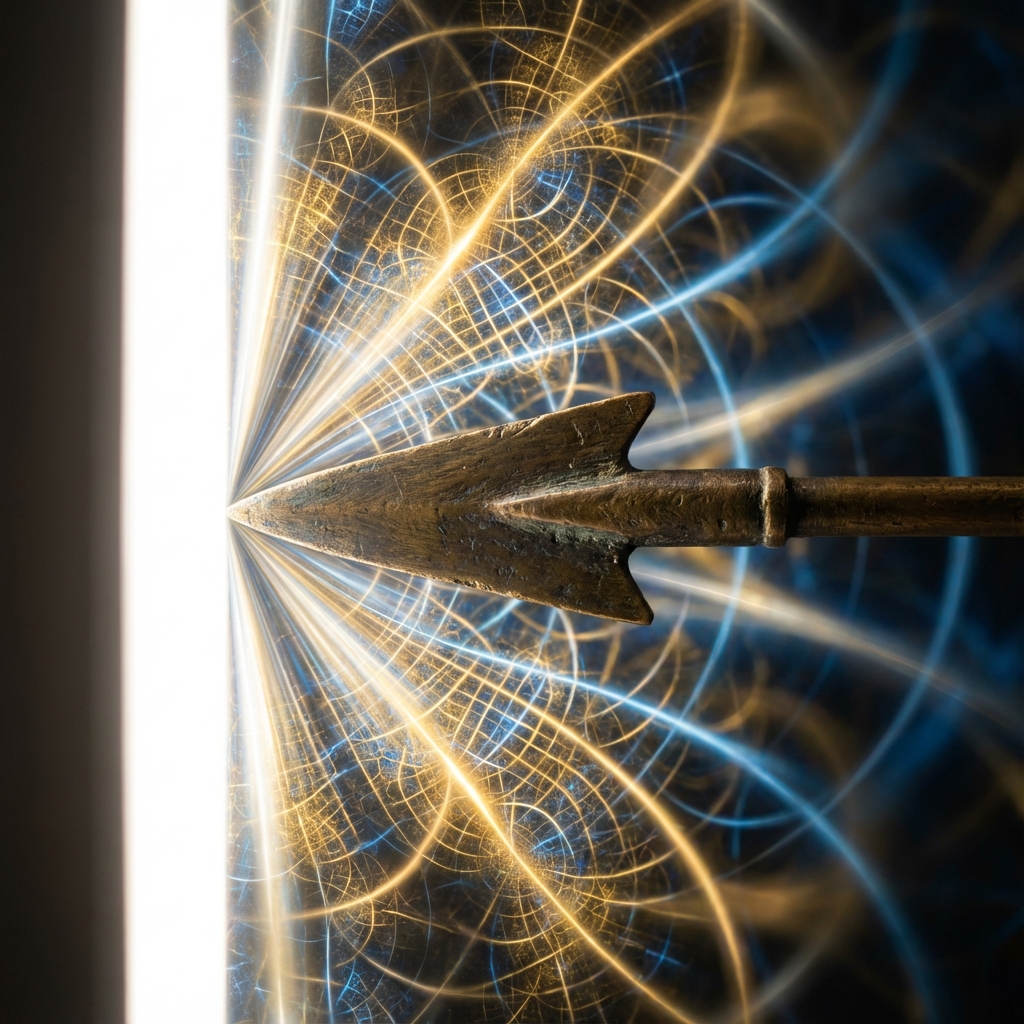
“The ancient Greek philosopher Zeno predicted that an arrow could never hit the target, because it must first fly half the distance, then half of the remaining distance. In physical space, this paradox is resolved by calculus. But in the logarithmic space of perception, Zeno is right. For consciousness, the endpoint is not a moment, but a limit that forever recedes in infinite subdivision. We will never ‘die’; we only infinitely approach that asymptote called ‘termination.’”
In the previous section, we established the logarithmic law of perception: . This explains why we can adapt to an exponentially growing universe. But this simple mathematical transformation also hides an ultimate corollary about life, death, and eternity.
If in the physical world, time has an endpoint (such as death or cosmic heat death); then in the logarithmic time of subjective consciousness, where is this endpoint?
The answer is: It is at infinity.
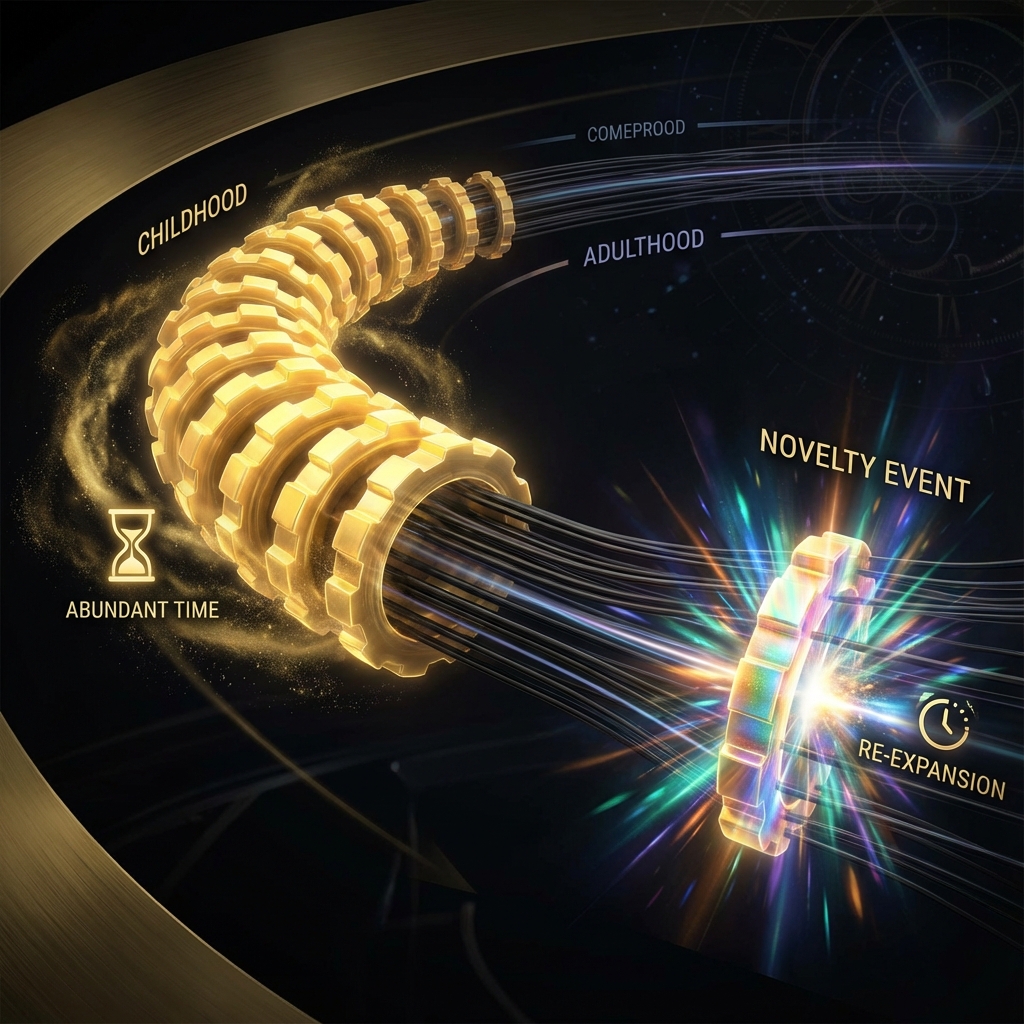
The Tail of the Logarithmic Function: Infinite Stretching
Let us look at the behavior of the logarithmic function as it approaches or .
Suppose the countdown of life is (remaining physical time).
When becomes shorter and shorter, approaching 0, the “urgency” or “information density” of life often rises sharply.
In studies of hospice care or near-death experiences, people often report that “a lifetime flashes before their eyes”—meaning that within a few physical seconds, consciousness processes massive amounts of information.
If we define the intensity of subjective experience as the reciprocal of remaining time (shorter is more precious), i.e., , then subjective time is its integral:
When physical time (the moment of death), .
This means subjective time is stretched to infinite length.
This is the resurrection of the “Zeno Effect” at the level of consciousness.
You can never subjectively experience the moment “I died.”
Because in your infinite approach to that moment, your consciousness will infinitely subdivide the remaining time.
-
The last second is stretched into an hour.
-
The last millisecond is stretched into a year.
-
The last microsecond becomes eternity.
Forever “In the Middle”
This completely changes our definition of “living.”
We usually think of life as a line segment with a starting point A and an endpoint B.
But in logarithmic perception, life is a ray.
Starting point A is clear, but endpoint B is projected to infinity.
We are forever “In the Middle.”
No matter how long you have lived, no matter how close you are to death, in your subjective perspective, you always feel you are in the middle of the story. You always feel “there are things unfinished,” “there are words unsaid.”
This is not entirely psychological reluctance; this is a geometric necessity.
Because the function has no upper bound. As long as your is still operating, as long as you are still processing information, you continue climbing on the spiral.
For external observers (doctors/loved ones), your heartbeat stops, the physical line segment ends.
But for the internal observer (you), you have just entered a new phase state of “high-frequency low-speed”, where time flows like thick honey, slowly, until it stops.
The Microscopic Version of Relativistic Horizon
This bears striking similarity to observers falling into black holes in general relativity.
-
External perspective: Sees the spaceship moving slower and slower at the horizon, finally freezing, never falling in.
-
Internal perspective: The spaceship normally passes through the horizon.
Death is the black hole horizon of the individual.
We, as external observers, see our loved ones “die” (fall in).
But for the loved ones themselves, they may have just passed through a membrane, entering an inner space that we cannot communicate with, but which appears continuous to them.
Conclusion: No Finale
So, do not fear that so-called “endpoint.”
In the geometric logic of Vector Cosmology, the endpoint is a mathematical singularity, unreachable physically, infinitely distant in experience.
You will not experience “non-existence.” You will only experience “deeper and deeper existence”.
You are like Zeno’s arrow; the process of flight itself is the meaning, and the bull’s-eye is just a fictional point that defines the direction of flight.
Life has no finale (The End).
Life only has “To Be Continued.”
Since the logarithmic law guarantees infinite extension of subjective time, what about those “pasts” we leave behind—those histories that have already happened? Are they also permanently preserved by some mechanism, just like this second?
Does the universe really have no recycle bin? Is the past really as solid as the present?
This leads to the theme of the next chapter: The Dynamic Version of Block Universe. We will see that history is not sand paintings blown away by wind, but crystals carved on four-dimensional manifolds.