Appendix C: Topological Protection of Memory Crystals
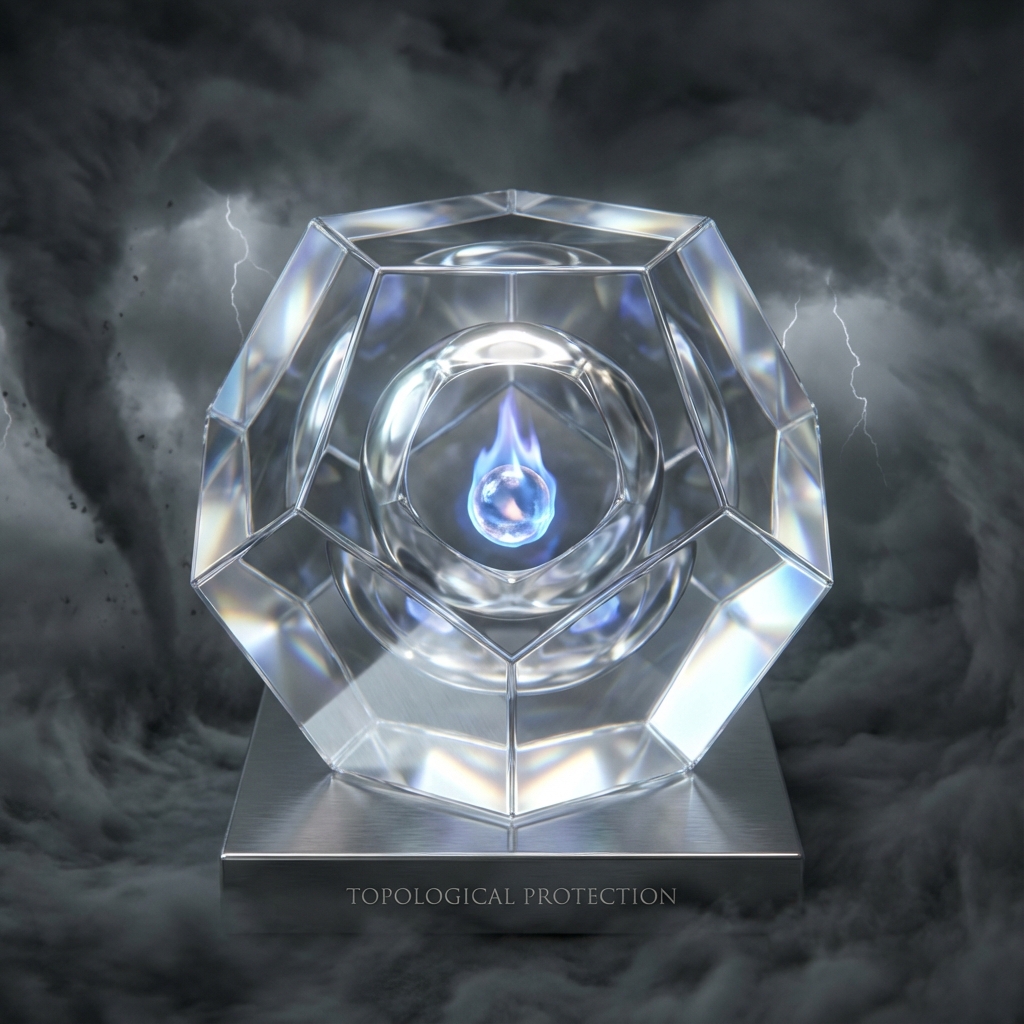
In Chapter 6 “Dynamic Block Universe” of Vector Cosmology V, we proposed a core thesis: “Memory is Ontology”. We argued that those moments deeply experienced by life are not sand paintings blown away by wind, but “crystals” carved into spacetime structures.
This view faces a severe challenge from physics: The second law of thermodynamics seems to imply that all ordered structures will eventually be smoothed by (environmental thermal noise). Can memory really resist the entropy increase of forgetting?
This appendix will prove, based on Topological Quantum Field Theory (TQFT) and topological phase transition mechanisms in condensed matter physics, that high-dimensional memory structures are protected by Topological Protection. They are “dead knots” in Hilbert space that cannot be untied by local environmental perturbations.
C.1 Phase Transition from Wave to Knot
First, we need to geometrically define “memory formation.”
At the physical level, this is a phase transition from flowing wave functions to fixed topological solitons.
-
Unobserved/unexperienced states:
Are a diffused wave function . It is in a linear superposition state, extremely susceptible to environmental interference and decoherence. This corresponds to those muddled, fleeting days in our lives (Chronos).
-
Deeply remembered states:
When we invest enormous attention ( budget) to experience a moment, the neural network ( subspace) undergoes a special “symmetry breaking”.
The wave function’s phase in configuration space is no longer smooth, but forms a “Vortex” or “Knot”.
Mathematically, this means the integral of the wave function’s phase over a closed path is no longer 0, but a non-zero integer (winding number):
[\oint \nabla \theta \cdot dl = 2\pi n \quad (n \neq 0)]
This integer is the memory’s “topological skeleton”.
Memory is not words written on paper (that’s local); memory is the folding of the paper itself.
C.2 Robustness of Information: Why It Cannot Be Forgotten
Why can this topological structure resist entropy increase?
This stems from the core principle of topological protection: Local perturbations cannot change global properties.
Imagine a knot on a rope.
-
Environmental thermal noise (): Is like constantly shaking this rope.
-
Result: The rope’s shape will undergo tiny distortions (local fluctuations), but no matter how much you shake, the knot will not come undone.
To untie this knot, a global operation is required (passing the rope end through). But in closed unitary evolution, or in the absence of extremely high energy injection, such operations are forbidden.
This explains why some memories are “engraved in bone and heart”.
-
Your first love, your epiphany, your trauma.
-
They form a structure with non-zero Topological Charge () deep in your consciousness.
-
Time (entropy) can blur their details (edge wave functions), but cannot erase their existence (core topological charge).
Conclusion:
True memories are physically “solid”.
They are like diamonds, stable lattices formed by carbon atoms under extreme pressure (emotional concentration). Unless encountering destructive phase transitions (such as formatting at death), they will forever maintain their geometric form.
C.3 Anti-interference of Holographic Storage
Furthermore, according to the holographic principle, these memory crystals are not stored in single neurons, but Non-local distributed throughout the entire network.
Like holographic photographs, even if you remove part of the brain tissue (local damage), the overall picture of memory remains intact, only with slightly reduced resolution.
This distributed storage combined with topological protection makes our life experiences the most tenacious “information solidification” in the universe.
Our entire life is manufacturing these indestructible exhibits for the universe’s museum.
After the flesh dissipates, these topological knots will still be permanently archived as “geometric textures” on the spacetime background in that vast Naimark circle.