11.2 Collapse and Audit
“Schrödinger’s cat is not both dead and alive. It is merely in an unsettled financial statement. When you open the box, you are not looking at it; you are forcing the universe to conduct an immediate audit of this ambiguous account.”
The most puzzling phenomenon in quantum mechanics is Wave Function Collapse. Why can a microscopic particle be in multiple places simultaneously (superposition), but when we look at it, it must “choose” a position and fix itself?
In the Copenhagen interpretation, this is seen as an artificial assertion. But from the economic perspective of Vector Cosmology, measurement has no mystery. Measurement is a Budget Audit.
The observer is that universe’s auditor, holding a calculator, impartial and unyielding.
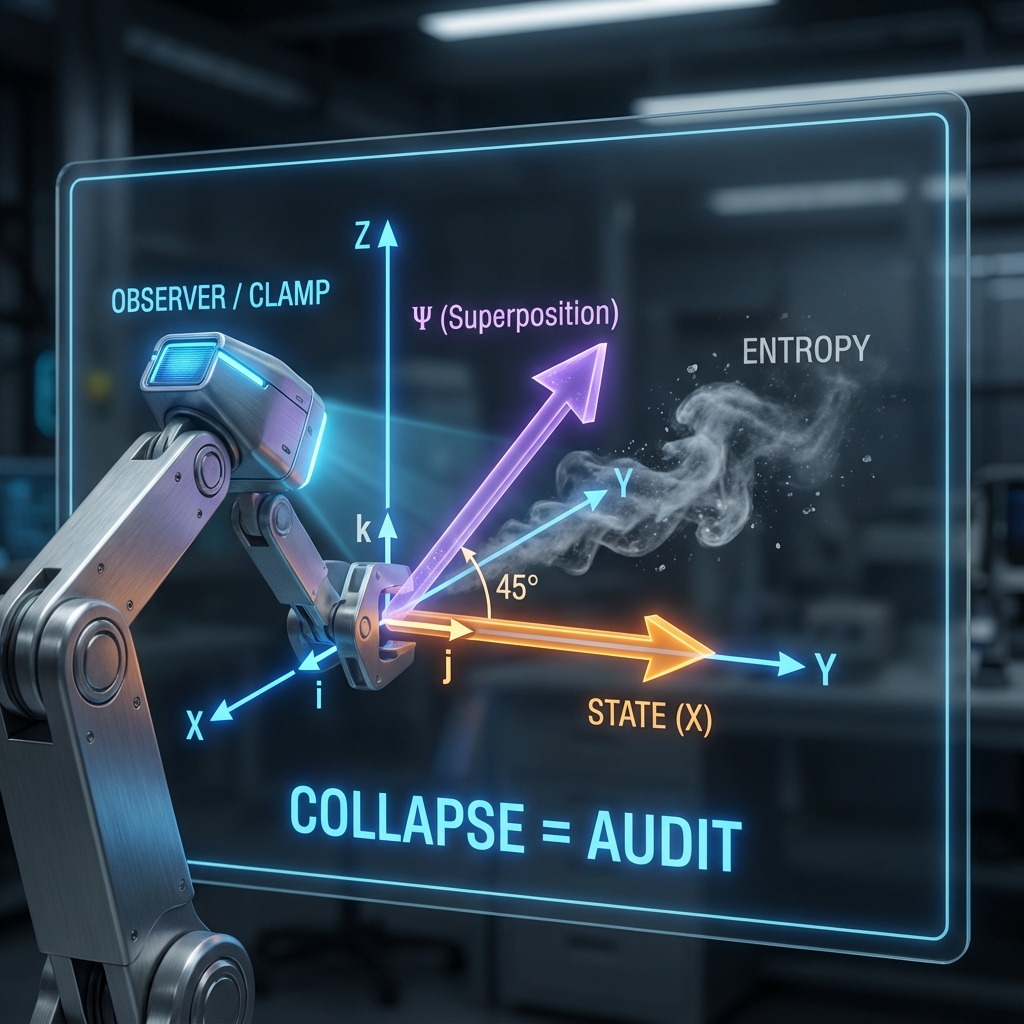
11.2.1 Superposition: Budget Risk Hedging
First, we need to understand what superposition is.
In the geometry of projective Hilbert space, superposition is not “simultaneously in A and B”; it is merely a vector pointing in an intermediate direction.
Imagine you are walking.
-
Walking north is state .
-
Walking east is state .
-
Walking northeast is superposition.
For that unique global vector , it is merely rotating smoothly along a specific angle (such as northeast) driven by . It does not feel any “schizophrenia.” It simply invests its budget simultaneously into two components: “north” and “east.”
In financial metaphor, this is Risk Hedging. The universe does not bet all its capital on one reality but constructs an investment portfolio. As long as there is no external interference, this portfolio can be maintained indefinitely—this is quantum coherence.
11.2.2 The Essence of Measurement: Forced Liquidation
Then, what is measurement?
Measurement is when this microscopic vector in the “northeast direction” suddenly collides with a massive, macroscopic object (observer or instrument).
What characterizes a macroscopic object? It possesses enormous (mass/structure) and extremely high (environmental entanglement). It is an extremely heavy, extremely sluggish system that has long chosen a specific accounting basis (such as “position basis”) in this cosmic market.
When the microscopic vector meets the macroscopic auditor, a violent interaction transaction occurs.
The auditor (instrument) is extremely domineering; it does not accept ambiguous accounts like “northeast direction.” Its logic gates (pointers) can only point to “north” or “east.”
Thus, a forced Liquidation occurs:
To establish correlation with the macroscopic instrument (produce a reading), the microscopic vector must rapidly rotate, aligning its direction with the instrument’s basis.
-
It is either forced to surrender all “east” shares, concentrating all budget on “north” (collapsing to A).
-
Or forced to surrender all “north” shares, concentrating all budget on “east” (collapsing to B).
This process is extremely rapid because the channel behind the macroscopic instrument is immensely vast, instantly absorbing the excess coherence (i.e., the “wrong” directional components) generated during rotation.
11.2.3 The Cost of Audit: The Birth of History
This is the geometric truth of collapse: collapse is the abrupt orthogonal rotation of a vector under strong interaction.
In this process, no new physical laws intervene; it still follows .
However, at the instant of measurement, a massive flow is directed to the environment sector (). Those unselected possibilities (such as the part of the wave function where “the cat is dead”) do not vanish into thin air; they are transformed into thermal noise (entropy) in the environment.
What did the observer do?
Through measurement, the observer forces the universe to settle from countless “possible futures” (superposition) into a “history that has already happened” (eigenstate).
-
Before measurement, reality is a flowing, ambiguous budget distribution.
-
After measurement, reality is a fixed, certain balance sheet.
11.2.4 We Are the Universe’s Anchoring Points
From this, we arrive at a profound conclusion about consciousness and observers: we are not passive spectators; we are responsible for the solidity of reality.
Without observers (or without macroscopic dissipative systems), the universe would forever remain in a mist of probability clouds, with no definite shape, no definite history. It is our observation—each cruel “budget audit”—that nails the vector, originally freely rotating in Hilbert space, again and again onto specific reality bases.
We look at the moon, and only then is the moon really there. This is not idealism; this is quantum auditing. Because our “looking” is essentially an irreversible transaction between countless photons and the retina, and this transaction forces the photon’s wave function to collapse instantly from a diffuse spatial distribution to a definite pixel point.
By evolving observers, the universe finally gained an ability: it can cast its wild, liquid quantum potential into solid, recordable history.
At this point, the physical puzzle of the entire book is complete. We have explained spacetime, matter, life, and ourselves. Now, only one final step remains—at the end of this grand journey, looking back at the beginning.
The next chapter is the final chapter of the book. We will set aside all formulas and embrace that ultimate philosophical destination: Unity.