Chapter 9: The Forgotten Sector
In the previous chapters, we immersed ourselves in an idealized geometric world. On that flawless Dirac circle, vectors merely engaged in elegant zero-sum games between “external motion” () and “internal evolution” (). That was a reversible, eternal, dissipationless crystal universe.
However, we must honestly face reality: that is not the universe we live in.
Our world is full of broken teacups, extinguished fires, and forgotten memories. Beyond that perfect two-dimensional circular plane, there must exist a dark abyss, constantly devouring ordered information.
This chapter will unveil that third dimension we have long ignored. We will see that the perfect circle has not truly disappeared; it has merely ruptured in a higher dimension, opening a gate to an invisible “shadow sector.”
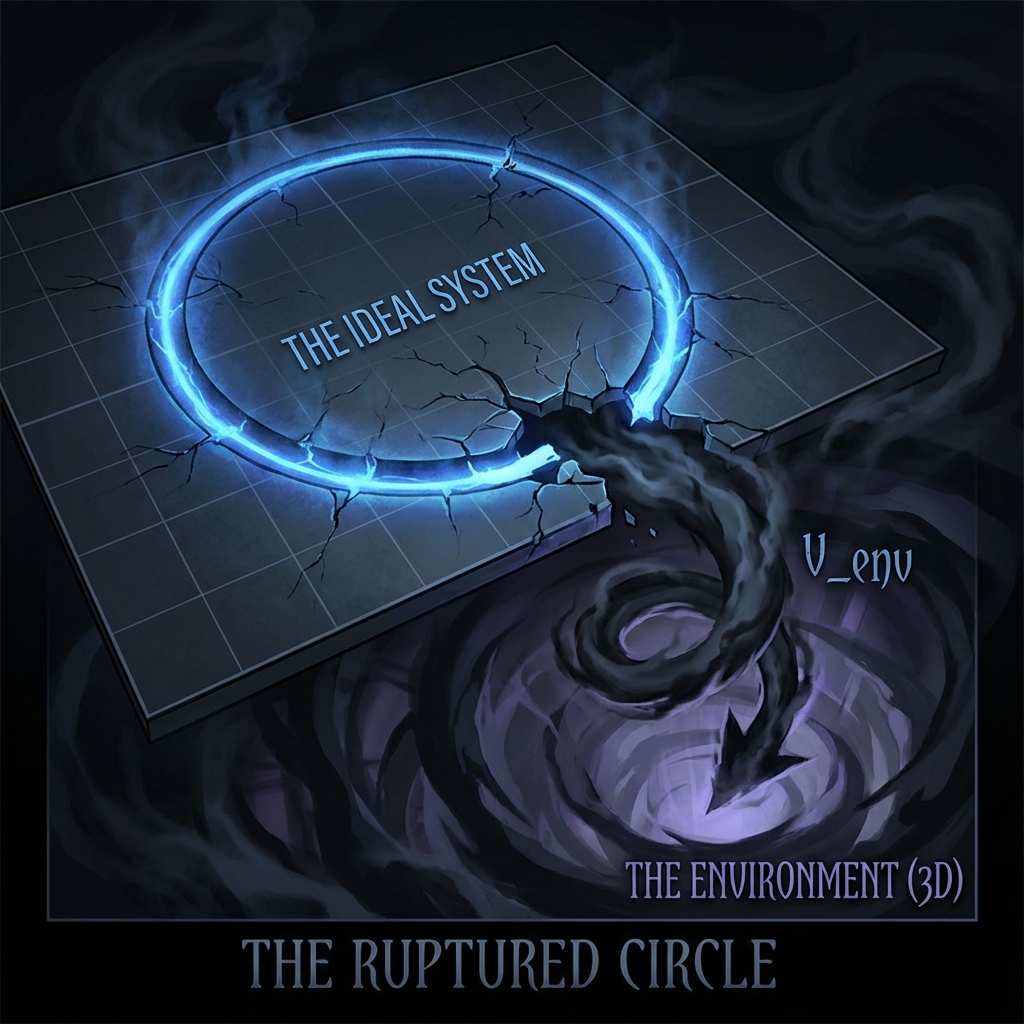
9.1 The Perfect Circle Ruptured
“The universe not only has ‘internal’ and ‘external’; the universe also has a bottomless pocket. We call it ‘environment,’ but it is actually a backdoor to infinite dimensions.”
The Emergence of the Third Axis
In the previous two volumes, we simplified the core formula to . This is a conservation law for closed systems. It assumes the system is completely isolated from the rest of the universe.
But in the complete picture of Vector Cosmology, no system is a true island. The tangent space of projective Hilbert space does not have only two orthogonal subspaces. According to our strict definition in the paper, the tangent space is decomposed into three parts:
This introduces the third crucial velocity component—Environment Velocity (). It represents the projection rate of the global vector onto those degrees of freedom we cannot track or control (such as heat baths, vacuum fluctuations, stray photons).
Thus, that simple two-dimensional circle equation is extended to a three-dimensional sphere surface equation—we call it the “Extended Capacity Identity”:
Information Leakage and Circle Shrinkage
The emergence of this new formula announces the “rupture” of the perfect circle.
For a local observer (such as ourselves), we can usually only observe (object motion) and (object mass/structure). We cannot see because “environment” is by definition those degrees of freedom that escape our observation range.
When we ignore , the original conservation law becomes an inequality:
In our view, this manifests as “shrinkage of effective budget”.
-
When increases (i.e., the system becomes entangled with the environment), the shares left for and must decrease.
-
Geometrically, this means the circle we see on the plane is continuously shrinking in radius.
This is the geometric essence of dissipation.
A rolling ball eventually stops (), a cup of hot water eventually cools ( decreases), not because energy disappears into thin air, but because the budget carrying energy irreversibly rotates orthogonally from the visible “internal/external” sectors to the invisible “environment” sector.
The Invisible Shadow
Why do we call it the “forgotten sector”?
Because in the vast majority of physical equations, we try to idealize systems, pretending . We write perfect Hamiltonians and draw closed orbits.
But in Vector Cosmology, is not an error term; it is one of the protagonists of cosmic evolution.
-
It is noise: In quantum walk experiments, it is the culprit causing data points to fall into the “forbidden zone.”
-
It is entanglement: It is the “connection fee” the system pays to integrate into the whole universe.
-
It is entropy: As we will see in the next section, is the geometric source of the second law of thermodynamics.
The perfect circle has ruptured, but it ruptured so magnificently. It is no longer a closed ring but has become a spiral open to infinite dimensions. It is precisely because of this gap that the universe has heat, death, and time’s irreversible sorrow.