8.2 The Meaning of Time Delay
“The particle did not press pause on its watch. The so-called ‘delay’ is merely because it ran a long geometric detour in the internal dimension’s maze, compared to its straight-line traveling companion.”
In everyday language, “delay” often means stagnation, waiting, or waste. A train is late because it stopped on the track; information delay is because signals are stuck in routers.
But in the quantum scattering picture of Vector Cosmology, time delay has a completely different meaning. It is not stillness; it is intense motion.
When a particle exhibits “time delay” during scattering, it means the universe’s unique vector is performing complex rotations and evolution at extremely high speed in projective Hilbert space. Delay is essentially accumulation of internal geometric distance.
8.2.1 Wigner-Smith Operator: The Geometric Probe of Time
To quantify this delay, physicists Eugene Wigner and Felix Smith introduced a powerful mathematical tool—The Wigner-Smith Time-Delay Operator, denoted .
Mathematically, it is defined as the derivative of the scattering matrix with respect to energy :
This formula looks abstract, but its physical meaning is extremely profound: it measures the rate at which scattering phase changes with energy.
-
If phase changes slowly with energy, it means the particle just passed by quickly, delay is small.
-
If phase changes dramatically with energy (e.g., near resonance points), it means the particle has deep entanglement with the target, delay is huge.
In our FS geometric framework, we discovered a decisive equation connecting “time” and “geometry.” As we proved in the paper, the magnitude of FS velocity in energy space strictly equals the standard deviation of this time-delay operator:
This reveals the geometric essence of time delay: Delay is velocity.
The “velocity” here does not refer to how fast the particle flies but to the rate at which the quantum state vector rotates in projective space as the energy parameter changes.
8.2.2 Arc-Length in the Labyrinth
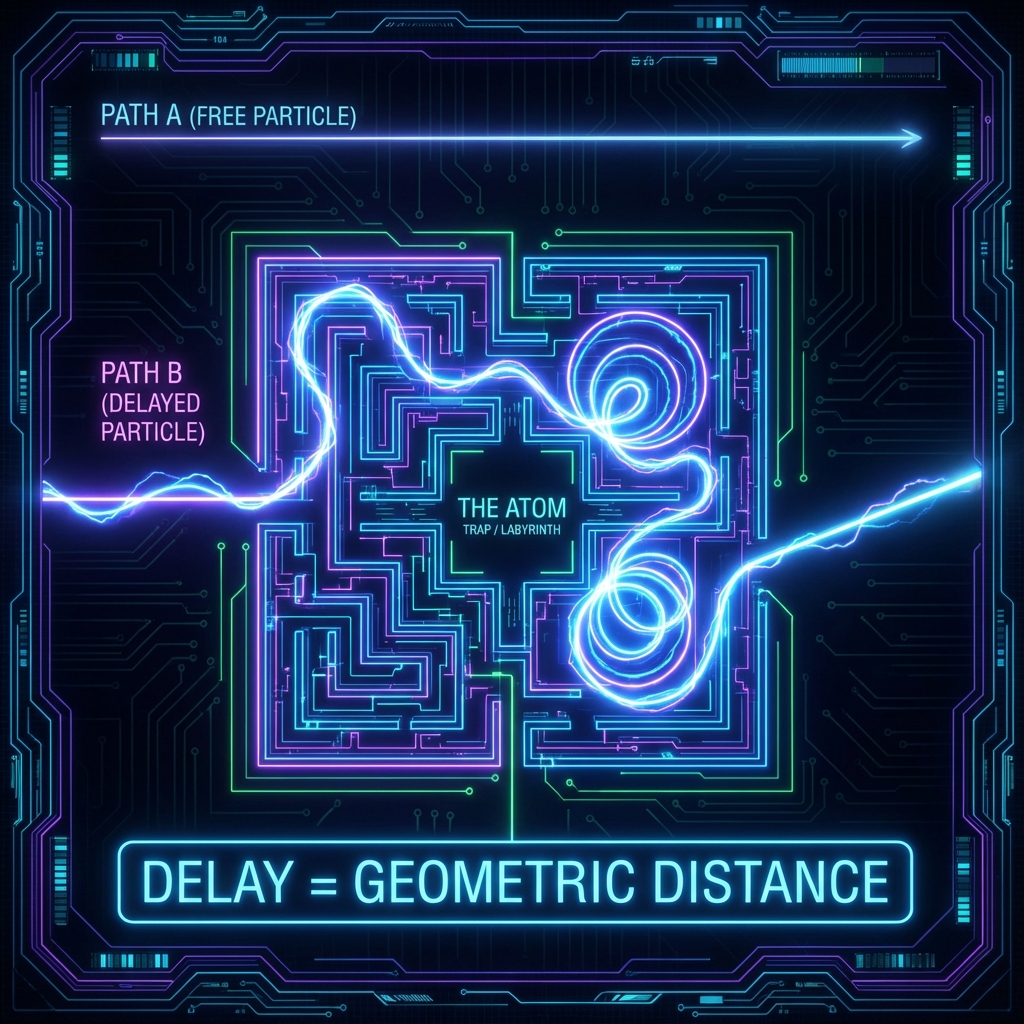
Imagine two particles participating in a race through a forest.
-
Particle A (free particle): Passes directly through the forest, taking a straight line.
-
Particle B (scattered particle): Attracted by a flower in the forest (atomic nucleus/potential well), circles around it ten times before leaving.
For the referee at the finish line, particle B is “late.” This lateness is the Wigner-Smith time delay .
But from a geometric perspective, particle B did not slack off. On the contrary, within a unit energy interval, it traveled a much longer distance than particle A.
According to our derivation, for a narrow-band wave packet, the FS distance () it traverses in Hilbert space is proportional to its time delay:
(where is the wave packet’s energy bandwidth)
This formula tells us: Delay is distance.
The longer a particle lingers in the microscopic world, the longer the arc length the vector representing it traces in internal geometric dimensions (the sector).
So-called “resonance states” or “quasiparticles” are vectors circling wildly in the internal maze, tracing enormous geometric distances, thus appearing as huge time lags to external observers.
8.2.3 The Trade-off Between Delay and Fidelity
This geometric distance is not just a mathematical measure; it directly determines physical Distinguishability.
FS distance measures how different two quantum states are. If time delay is large, it means that for tiny energy changes, the scattered state becomes drastically different from before (extremely fast orthogonalization).
This leads to an interesting experimental prediction: Delay-Fidelity Trade-off.
If you use a high-Q resonant cavity (producing large delay) to store a photon, you are actually forcing the photon’s state vector to deflect significantly in Hilbert space.
-
Large delay Long path Large state deflection.
-
This deflection means that the overlap (fidelity) between the scattered wave packet and the original wave packet in quantum state will decay according to a Gaussian function: .
This again confirms our economic metaphor: To gain “time” (delay), one must pay “geometric distance” (state change). There is no free lunch in the universe; even “waiting” itself is an expensive geometric consumption.
8.2.4 The Antidote to Negative Time
Finally, this geometric perspective solves a paradox that has long troubled physics: Negative Time Delay.
In certain scattering situations (such as passing through a potential barrier), the expectation value of the Wigner-Smith operator may be negative. This sounds like the particle comes out before entering, violating causality.
But in Vector Cosmology, negative delay is not time reversal; it is merely a geometric shortcut.
-
Positive delay is taking a detour (circling).
-
Negative delay is taking a shortcut (destructive interference).
When various components of a wave packet reorganize during scattering, they may find a path in projective space shorter than free evolution to reach the final state. This “path shortening” manifests macroscopically as the wave packet peak arriving early. But this absolutely does not mean information propagation exceeds the microscopic limit (Lieb-Robinson speed).
Conclusion:
Time delay is not empty pause. It is a long journey the vector takes in internal geometric structure.
The existence of every atom is because its internal wave function is trapped in a huge “time delay trap,” where it must complete nearly infinite geometric distance to move even slightly in the external world.
It is precisely this microscopic “slowness” that creates the macroscopic material world’s “stability.”