Appendix B: Geometric Derivation of Quantum Speed Limits
In Chapter 2 “The Poverty of Speed” and Chapter 10 “The Entropic Speed Limit Axiom” of the main text, we repeatedly used a core conclusion: a system’s evolution speed is limited by the variance of its energy (or generator). Physical changes cannot occur infinitely fast; they are constrained by strict Quantum Speed Limits (QSL).
This appendix will provide rigorous mathematical derivations of these speed limits based on Fubini-Study geometry. We will prove that Mandelstam-Tamm type bounds are not merely manifestations of the energy-time uncertainty principle, but direct corollaries of the axiom in Riemannian geometry that “the straight line is the shortest path between two points.”
B.1 From Variance to Distance
Consider a quantum evolution process described by parameter (which can be any physical time parameter). Its state vector follows the generalized Schrödinger equation:
where is the self-adjoint operator (generator) driving the evolution.
According to the conclusion of Appendix A, the instantaneous FS velocity along this trajectory strictly equals the standard deviation of the generator:
We want to calculate the FS Path Length that the system travels in projective Hilbert space from parameter to . This can be obtained by integrating the velocity:
B.2 Derivation of Geometric Bounds
In Riemannian geometry, the shortest path connecting two points and is a geodesic. Therefore, the actual path length traveled by the system must be greater than or equal to the FS Distance between these two points:
If we assume that throughout the evolution process, the generator’s variance has a maximum value , we can bound the integral to obtain a simple inequality:
Rearranging this formula, we obtain a lower bound on the time interval:
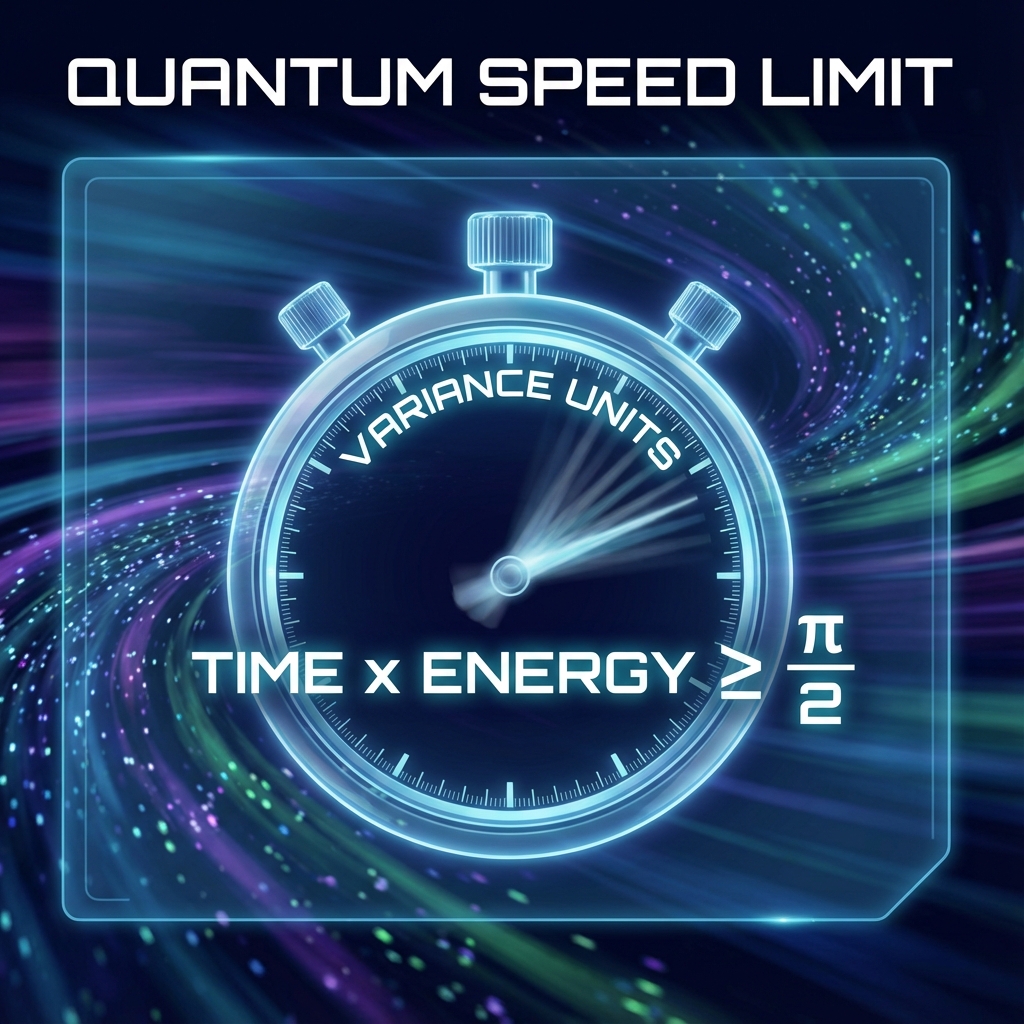
This is the parameter-free geometric form of the famous Quantum Speed Limit (QSL).
It tells us: For a quantum system to change its state (i.e., travel distance ), it must consume a product of “variance resources” () and “time resources” (). If the system’s energy variance is small (“poor”), it must spend a long time to complete the evolution.
B.3 The Relationship Between Intrinsic Time and Laboratory Time
Now, we apply this inequality to the core architecture of Vector Cosmology.
Introducing the definition of Intrinsic Time , i.e., choosing parameters such that FS velocity is constant at the universe’s total budget :
Using the chain rule , we can establish a strict conversion relationship between any physical time parameter (such as laboratory time ) and intrinsic time :
Integrating this relationship, we obtain the connection between the two time increments:
This integral formula is the mathematical root of all “time relativity” phenomena in the book.
-
Time Dilation: If (e.g., internal mass energy gap) decreases, the denominator decreases. To cover the same intrinsic distance , the required external time increases (time dilation).
-
Photon’s Eternity: For photons, (in the mass sector), which means . That is, a finite instant in their own coordinate system corresponds to infinite time in the external world.
Through this derivation, we prove that relativistic effects are not the curvature of spacetime background, but inevitable consequences of systems following geometric conservation laws in the “variance-time” trading market.