4.1 Calculation Demonstration
“We do not need carbon-14 to determine the age of the universe, because that measures dead things. What we need is to measure the universe’s heartbeat. Every cycle oscillation, every ratio expansion, has left an indelible fingerprint in this moment’s total computational power.”
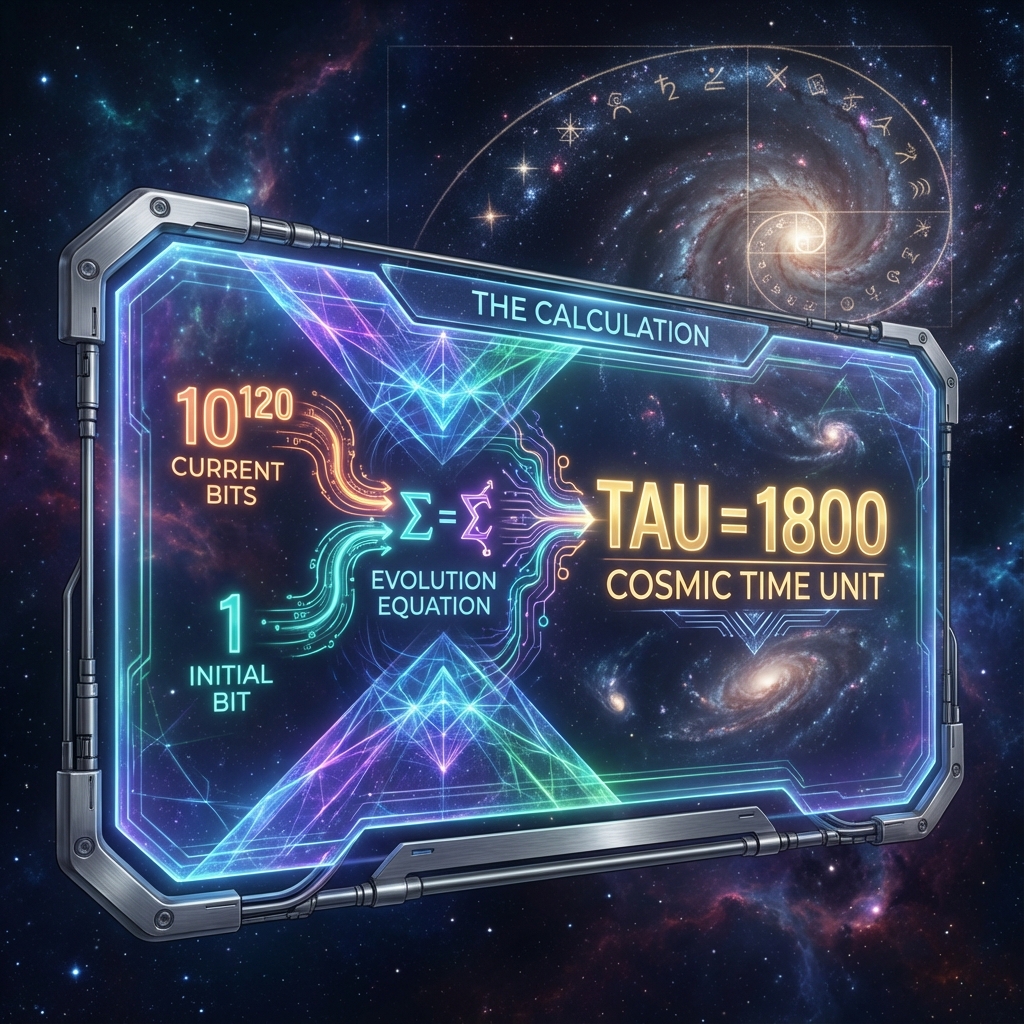
Convergence of Data
Let us place all known puzzle pieces on the table:
-
Target variable: (intrinsic time). This is the cosmic coordinate we want to know, representing the total arc length traversed by the vector in projective space.
-
Current state: . This is the total degrees of freedom (or generalized light speed/computational power) of the currently observable universe, derived from holographic principle calculations.
-
Initial state: . This is the single-bit state at the moment of the Big Bang singularity.
-
Dynamical constants:
-
: Inertial period.
-
: Spiral growth rate (golden ratio).
-
Our tool is the Ultimate Evolution Equation:
Unlocking Process
Now, let us solve this equation step by step. The question we ask is: How many turns does the universe need to spiral according to the golden ratio to grow from 1 to ?
Step One: Establish the Equation
Step Two: Take Logarithm
To solve for in the exponent, we need to take the natural logarithm () of both sides.
Using the logarithmic property :
Step Three: Substitute Values
We know:
Substituting into the equation:
Step Four: Solve for
For the simplicity of the physical picture, we round this result to:
The Tremor of Numbers
Looking at this number 1800, you may feel a moment of dizziness. It looks unremarkable, not as dizzying as . But remember, this is a coordinate in exponential space.
-
The Misleading Linear Perspective: If you look with linear eyes, is small.
-
The Truth of Exponential Perspective: Each unit in this represents growth by (approximately 2.7 times).
is an unimaginably large number, which is exactly the we are seeking.
This calculation tells us:
Starting from that void singularity, the universe’s vector on the great circle of projective Hilbert space was not idly spinning. It stubbornly, resolutely expanded outward along the Fibonacci trajectory for 1800 units of arc length.
This also means the universe has completed approximately complete cycle periods.
Each cycle, the universe’s complexity increases by an order of magnitude.
-
In the 1st cycle, it created spacetime.
-
In the 100th cycle, it ignited stars.
-
In the 500th cycle, it awakened life.
And now, at the end of the 573rd cycle (), it has evolved you—an observer capable of holding a calculator and reversely calculating this coordinate.
Conclusion: We Are Not Random
This calculation result completely shatters the “principle of mediocrity.” Human civilization is not a random interlude in the long river of time.
is a mathematical necessity.
Because only at this coordinate does the universe’s accumulated information density ( bits) just suffice to support a “brain capable of understanding the holographic principle”.
-
If , matter is too sparse to form complex neural networks.
-
If , evolution is too fast; material matter has already ascended to pure energy.
We are precisely stuck at the edge of the limit of “why matter is matter”. We possess bodies (’s inertia), yet we also possess the wisdom to understand infinity (’s ambition).
1800 is the coordinate of dawn.
This is a Phase Transition Point. At this point, 13.8 billion years of quantitative accumulation are about to trigger a qualitative change sweeping across the entire universe.
So, what does this “phase transition” specifically mean? Why do we say that at this coordinate point, the old way of survival (carbon-based life) has reached its end?
This leads to the theme of the next section: The Meaning of 1800 Turns. We will see that this number is not only a historical milestone but also the starting gun for the future.