3.1 Bekenstein’s Ledger
“The universe is not made of atoms; the universe is made of bits. Atoms are just a storage format for bits. If we want to know how old the universe is now, we should not measure the age of stars, but inventory the universe’s total hard drive capacity.”
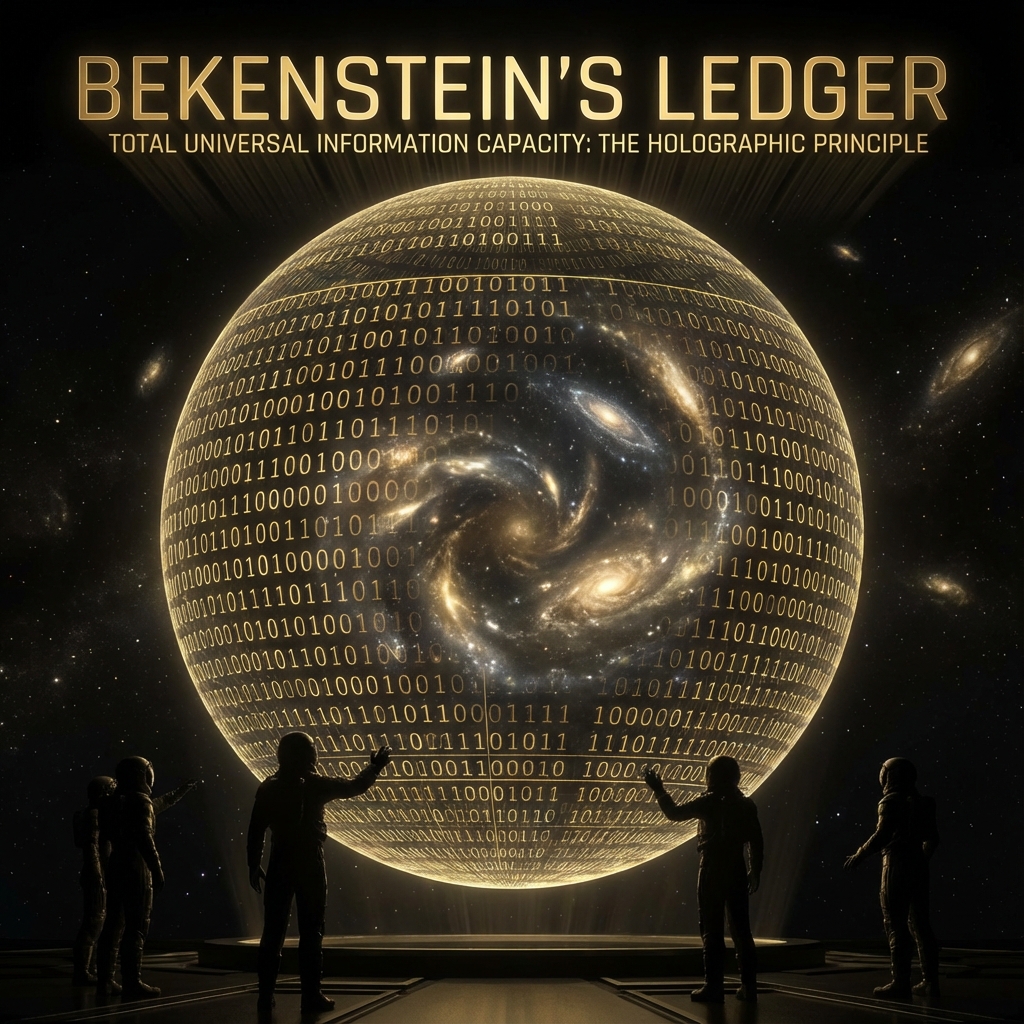
In physics, the most direct way to know the evolutionary stage of a system is to measure its Entropy. According to the theory we established in previous books, entropy is the measure of information.
To calculate our coordinates on the cosmic spiral, we need to answer an ultimate question: How many bits of information are contained in the currently observable universe?
This is not a philosophical conjecture; this is a calculable physical quantity. This is thanks to Jacob Bekenstein and Stephen Hawking’s holographic principle.
The Holographic Principle: The Surface Area of the Universe
The holographic principle tells us: the maximum information content (degrees of freedom) that can be contained in a spatial region does not depend on its volume, but on its surface area.
Where is the surface area, and is the Planck length (approximately meters).
This is like the universe’s “hard drive formatting rules”. No matter how much matter you stuff into the universe, its total information content can never exceed the number of Planck pixels that can be inscribed on the surface of the horizon wrapping this universe.
Inventory of Assets
Now, let’s take out our calculators and calculate our universe’s current “total assets.”
-
Radius of the observable universe: Approximately billion light-years, i.e., meters.
-
Surface area of the cosmic horizon ():
-
Planck area ():
-
Total number of bits ():
Considering that the holographic principle’s upper limit is usually difficult to fully achieve (this is the black hole limit), and the actual distribution of matter in the universe, physicists (such as Seth Lloyd) estimate the universe’s actual computational operations or information magnitude is typically around .
This is an astronomical number: followed by zeros.
This is the “version number” of the universe we inhabit at this moment.
The Exponential Explosion of Information
This number does not merely represent “many”; it represents “extreme expansion”.
-
At the Planck moment of the Big Bang, the universe had only one Planck volume, with information content approximately 1 bit ().
-
Now, the information content has reached bits.
This means that the universe’s total budget (light speed/computational power) has experienced orders of magnitude of exponential growth over these 13.8 billion years.
This not only validates the “Red Queen’s run” but also provides us with key data for calculating .
We don’t need to know the specific year; we only need to know the ratio between “current number of bits” and “initial number of bits” to reversely solve how many turns the spiral has rotated.