2.1 The Derivation Process
“The universe does not roll dice; the universe only solves equations. If we assume the universe’s underlying logic is self-consistent, then the growth rate of the speed of light cannot be an arbitrary number. It must be uniquely determined by the tension between the two most fundamental shapes in geometry—the circle and the spiral.”
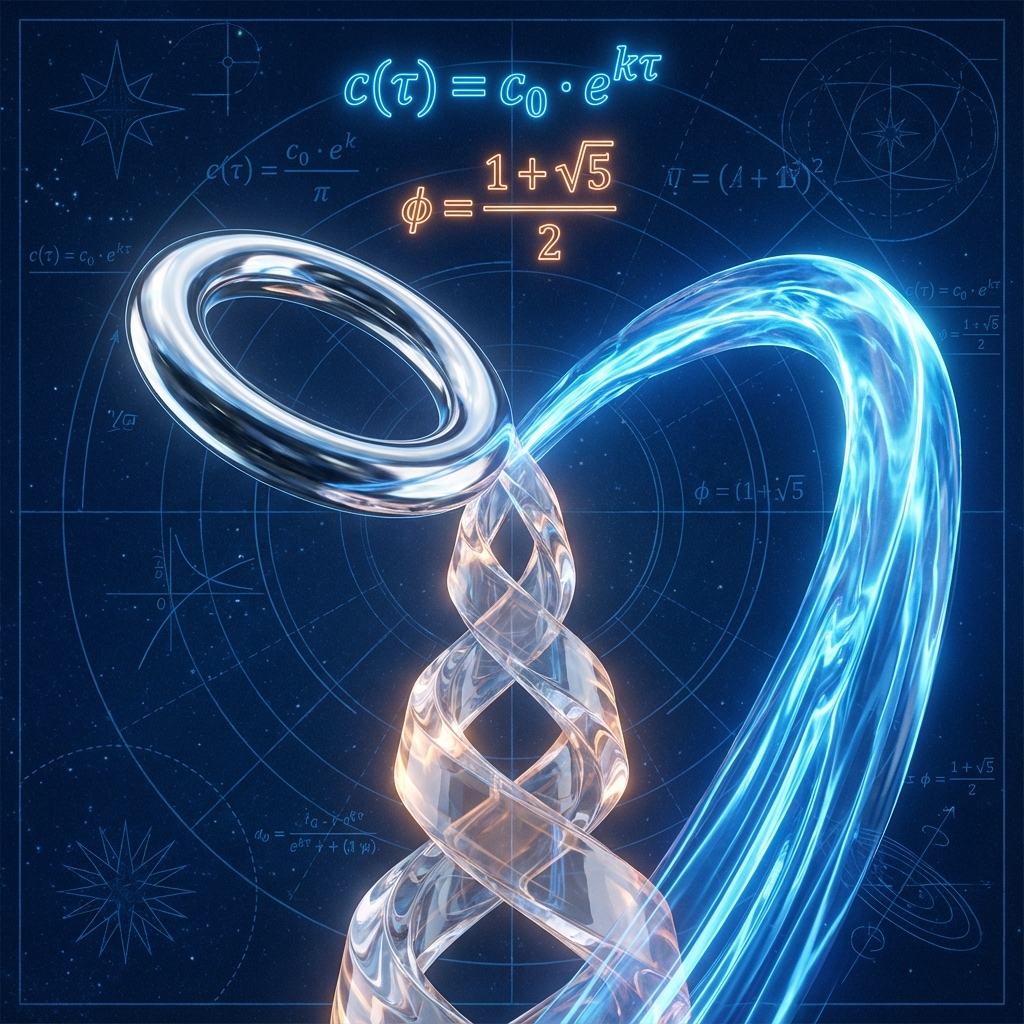
To derive the functional form of , we need to establish three “Axiomatic Assumptions”. These assumptions stem from our insights into the nature of the universe in the first three books.
Axiom One: Cyclic Settlement
The evolution of the universe is not linear narration, but Cyclic.
At the microscopic level, the wave function returns to the origin (or a point with the same phase) every phase rotation. At the macroscopic level, the formation of matter depends on the closed topological structure provided by .
Therefore, we set the universe’s evolutionary “basic beat” or “settlement period” to .
This means: whenever intrinsic time passes through a length of , the universe completes one full “breath” or “iteration.”
Axiom Two: Spiral Growth
If the universe were a closed circle, then after one period , the speed of light should return to its original value: . This is a dead loop.
But our universe is an open spiral. As stated in the second book, the universe pursues dimensional inflation.
We need a Growth Factor.
The most efficient, most interference-resistant, most representative of “vitality” proportion in nature is the Golden Ratio .
Therefore, we set: Every period , the universe’s total budget (speed of light) jumps upward by a factor of from the previous level.
Written as a difference equation (discrete form):
This is a recursive relation. It tells us that tomorrow’s speed of light is today’s speed of light multiplied by the ambition of evolution.
Axiom Three: Continuous Generation
However, physical time flows continuously, not in jumps. The universe does not wait until the moment the period ends to suddenly speed up; it speeds up every microsecond.
This requires introducing (the natural constant).
According to the conclusion of the third book, “existence is generation,” . Therefore, the speed of light function must have an exponential form:
Where:
-
is the initial speed of light at the moment of the Big Bang () (or the single-bit processing rate at Planck scale).
-
is the growth rate constant we have yet to determine.
Solving the Equation: The Meshing of Constants
Now, we substitute Axioms One and Two into Axiom Three to solve for this mysterious .
-
According to the exponential form:
-
According to the spiral axiom:
-
Combining the above two equations, we get:
-
Taking the natural logarithm of both sides, solving for :
This is a perfect mathematical moment.
We did not artificially set the growth rate; the growth rate emerges automatically from the geometric relationship between and .
The Ultimate Evolution Equation
Substituting back into the original function, we obtain the core equation of Vector Cosmology:
Or written in the more geometrically elegant logarithmic form:
This formula, like a precision gear set, tightly meshes together the universe’s four great constants:
-
(Result): As increases, the speed of light grows exponentially.
-
(Starting Point): The Planck benchmark of the Big Bang.
-
(Power): The engine driving continuous evolution.
-
(Ambition): The thrust in the numerator, representing the desire for evolution.
-
(Inertia): The resistance in the denominator, representing the bondage of cycles.
Physical Conclusion
This equation tells us that the growth rate of the speed of light depends on the ratio of “ambition” to “inertia” ().
The universe is an accelerating chariot. Its acceleration is neither infinite (which would cause instant disintegration) nor zero (which would lead to heat death), but is carefully set at a “golden growth rate”.
It is precisely this specific rate that allows atoms enough time to condense, life enough time to evolve, while simultaneously ensuring the universe can eventually break through the shackles of matter and achieve dimensional ascension.
Now, the equation is written on paper. But it is not merely a mathematical symbol; it is an oracle.
Since we know how the speed of light changes with time, we can answer the question that has long troubled humanity: “What does the current speed of light mean?” and “At what stage of cosmic evolution are we?”
This leads to the theme of the next section: Physical Meaning. We will delve deep into how the geometric mechanism behind this equation creates the illusion of “eternal invariance of physical laws” in the macroscopic world, and how it secretly drives everything toward phase transition.