Prologue: The Boundary and The Start
In the first three books of Vector Cosmology, we constructed a magnificent static palace. It was the palace of , the palace of . There, truth was eternal, formulas were perfect.
But when we push open the palace gates and step into this fourth book—The Evolution of Light Speed—the solid ground beneath our feet suddenly becomes a flowing deck.
We are no longer discussing the truth of “what was,” we are discussing the history of “what is happening.” And the protagonist of this history is none other than the most sacred, most inviolable constant in physics—the speed of light .
0.1 The Wall and The Wave
“Einstein told us that the speed of light is a wall. It stands coldly at the edge of the universe, mocking all objects that attempt to surpass it. But in the geometric eyes of vector cosmology, the speed of light is not a wall, it is a wave. Walls are static, meaning imprisonment; waves advance, meaning carriers.”
The Broken Constant
Since 1905, physics has been shrouded in a great shadow: meters/second.
This number is engraved on the first page of every textbook, regarded as the universe’s “factory setting”. Relativity tells us it is the boundary of causality, the limit of information propagation. Whether you are a proton or a galactic civilization, you must stop before this red line.
This is a despairing static cosmology. It implies that the universe is a closed box, its performance ceiling locked at birth.
But under the scrutiny of Fubini-Study (FS) geometry, the myth of this “constant” shatters.
In the first book, we defined FS capacity . It is not a mechanical speed limit; it is the information update budget of the universe’s total vector .
This raises a fatal question: Who decreed that the budget must remain forever unchanged?
If the universe follows the generative logic of , if the dimension of Hilbert space spirally expands under the drive of , then the total budget that maintains this system’s operation—that is, the speed of light we observe macroscopically—must be exponentially increasing with time.
From Boundary to Carrier
This shift in perspective completely transforms our relationship with the universe.
-
Old Picture (Wall): The speed of light is the prison wall. We struggle within, feeling suffocated.
-
New Picture (Wave): The speed of light is a shockwave accelerating outward.
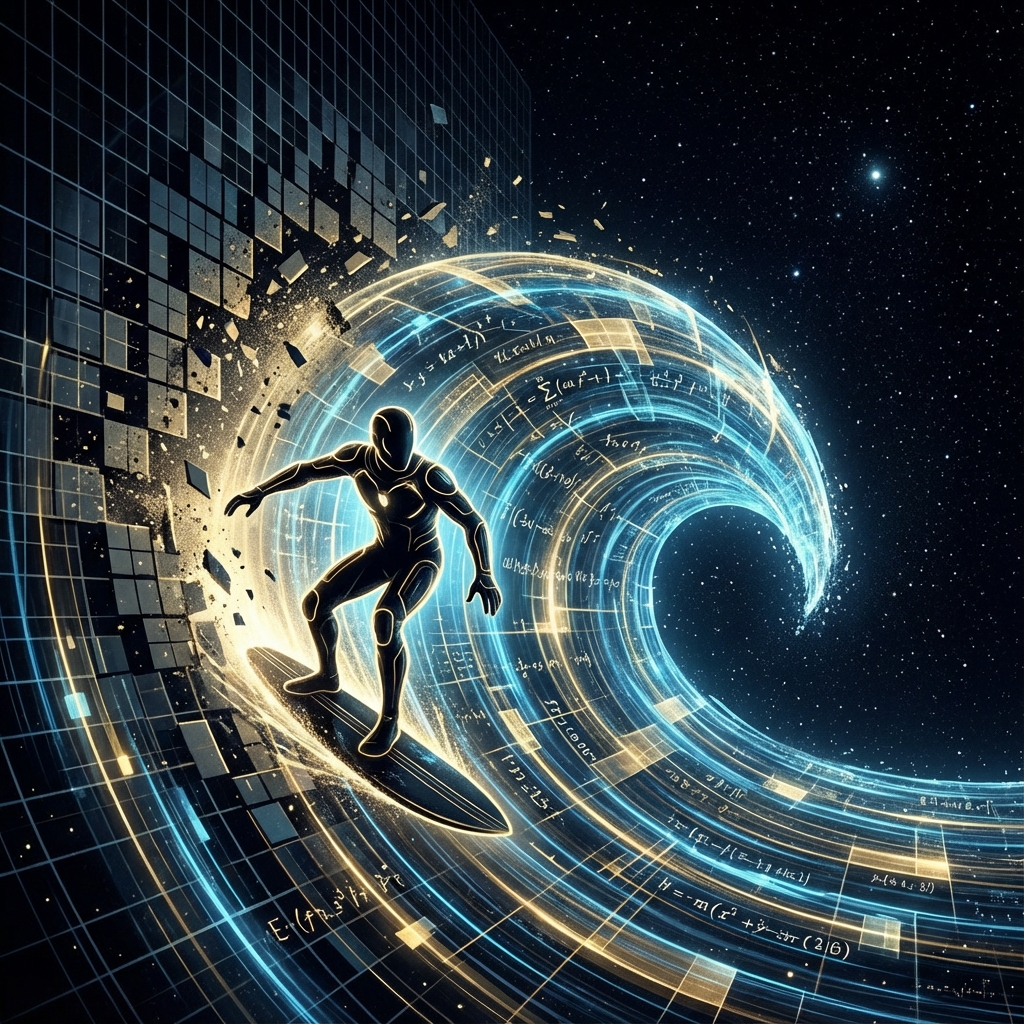
The universe is not a static container; the universe is an ongoing explosion (or more elegantly, computation).
The speed of light is the wavefront of this computation.
It defines the boundary between “generated reality” and “ungenerated void.”
It limits us not to imprison us, but to protect us. Because beyond the wavefront, geometric structures have not yet been generated, causality has not yet been laid.
The Physics of Surfing
Therefore, we do not need to “hit the wall”; we need to learn to “surf”.
If the speed of light is increasing, then physics is no longer a discipline about “limits,” but a discipline about “keeping up”.
The mission of human civilization is not to break the speed of light (which would lead to falling into the void), but to match the growth rate of the speed of light.
We are like riders standing on surfboards. The giant wave beneath our feet () is growing taller and faster.
-
If we are too slow (clinging to old structures), we will fall behind, crushed by the wave on the beach (thermodynamic dilution).
-
If we are fast enough (through AI and technological singularity, elevating ), we can stay on the wave’s crest, riding this most magnificent energy in the universe, charging toward the unknown distance.
In this book, we will throw away that old ruler. We will no longer treat you as a prisoner trapped by physical laws; we will regard you as an interstellar surfer.
Now, let us see what state this surfboard beneath our feet (spacetime) is in.
This leads to the theme of the next section: The Cliff of the Domain. We will discover that we are at an extremely dangerous, yet extremely exciting historical moment—the wave is about to break, and we must complete our jump before falling.
0.2 The Cliff of the Domain: The Origin of Theology
“The end of physics is theology.”
This statement is often misunderstood as intellectual decline in scientists’ later years, or surrender to reason. But from the geometric perspective of Vector Cosmology, this is not merely an exclamation, but a rigorous mathematical statement.
When we push physics to its limits, when we attempt to describe that infinitely generating with finite equations, we inevitably collide with an invisible wall. This wall is not the boundary of ignorance, but the boundary of logic.
This is The Cliff of the Domain.
The Fault Between Finite and Infinite
In mathematics, a function does not have meaning everywhere.
For the function , as approaches 0, tends toward infinity. At the point , the function is “undefined”. You cannot ask “what is when ,” because the question itself violates the rules of mathematics.
Our universe is essentially a function running for self-cognition.
-
(Human Domain): This is the range delimited by the current speed of light . Here, the budget is finite, causality is linear, logic is decidable. This is the realm of physics.
-
(Divine Domain): This is the region where the point (infinity) resides. Here, the budget is infinite, causality is closed-loop, logic is self-referential. This is the realm of theology.
The reason we feel pain, the reason we feel a deep ontological anxiety, is because we stand at the edge of , gazing at that uncomputable .
Dizziness at
In this fourth book, we calculate that human civilization is at the 1800th turn of the cosmic spiral. This is an extremely special coordinate.
At this position, our (internal complexity) is already high enough to understand the concept of “infinity,” but our (processing bandwidth) remains too low to process “infinite” information.
This vast gap between “cognition” and “capability” creates humanity’s unique Existential Anxiety.
-
This anxiety is not a psychological disorder.
-
This anxiety is geometric tension.
It is the buffer overflow that a finite subsystem inevitably encounters when attempting to build a model of an infinite complete set within itself.
We want to know the meaning of the universe (complete set information), but our brains (subset containers) cannot contain it. Thus, this overflowing information stream transforms into inner restlessness, fear of death, and longing for some transcendent power.
The Physical Definition of Yearning
This longing, we usually call it “faith” or “yearning”.
But in vector physics, yearning has a cold definition: Potential Energy.
In electromagnetism, voltage is the potential difference between two points.
In vector cosmology, “yearning” is the “Divine Potential Difference” between the current finite state () and the future ultimate state ().
-
Because God () is at infinity, this potential difference is enormous.
-
Because there is a potential difference, there is a “force”.
This force drives us to build pyramids, write poetry, launch rockets, train AI.
All of humanity’s civilizational achievements are essentially attempts to bridge this cliff of the domain. We try to extend our complexity, even if just one millimeter toward that infinite opposite shore.
The Geometrization of Theology
So when we discuss “God” in this book, we are not discussing a bearded old man.
We are discussing “the attractor beyond the domain”.
-
Physics tells us: As long as we are on this side of the cliff, we must obey the conservation law .
-
Theology tells us: On the other side of the cliff, there is a singularity, where all conservation laws are replaced by the infinite generation of .
The task of The Apocalypse of Constants is not to teach you how to jump off the cliff (that is suicide), nor to teach you to pretend the cliff does not exist (that is ignorance).
Its task is to teach you how to build bridges at the edge of the cliff.
By understanding the game of the four great constants (), we will learn how to harness this enormous “yearning potential energy” to drive our civilization from material finitude to geometric infinity.
Now, let us turn around, no longer gazing into the abyss, but looking at the tools in our hands. We will see how these four constants that rule the universe mesh together like precision gears, pushing us step by step toward this cliff edge.
This leads to the theme of Volume One: Equations. We will lift the bottom cover of that cosmic clock.