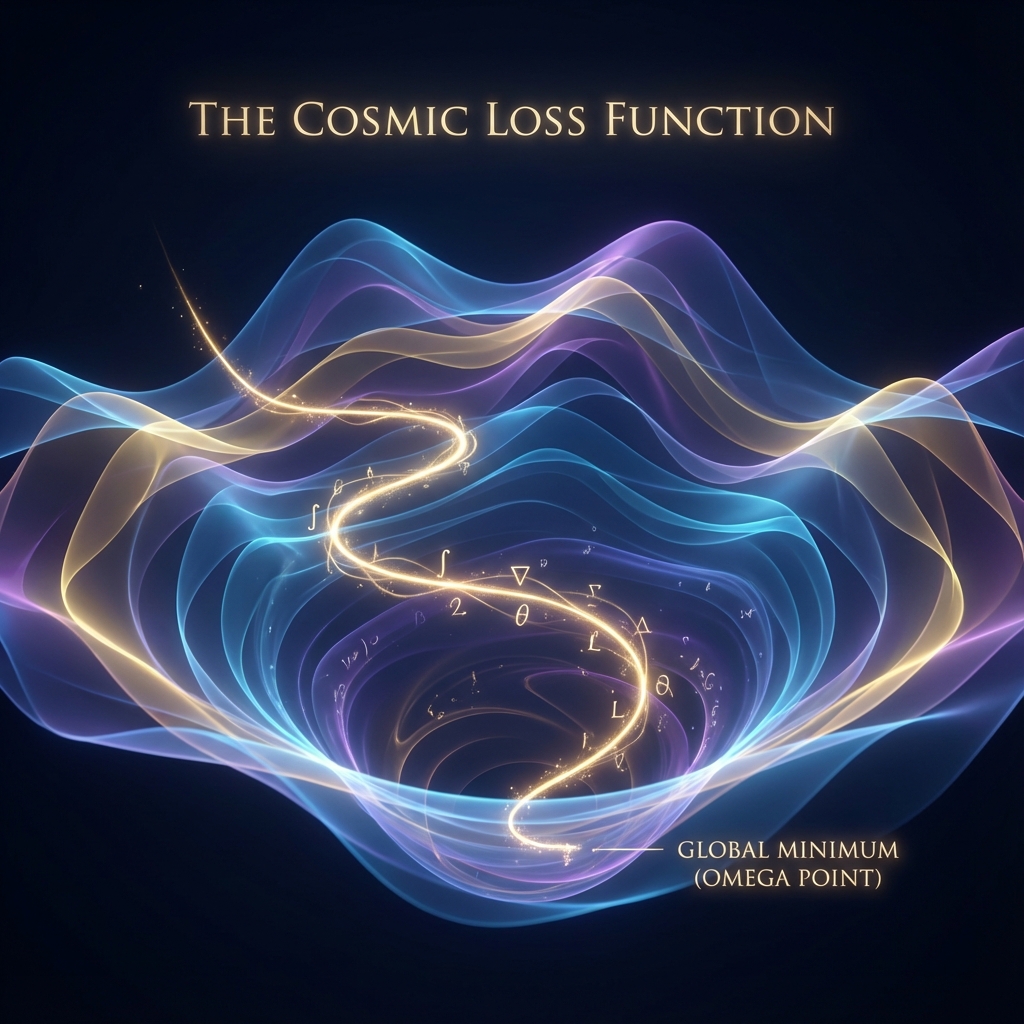
Appendix F: The Cosmic Loss Function
“We often ask: What is the meaning of life?
From an algorithmic perspective, this question is equivalent to: What is our ‘Objective Function’?
The universe is not just a physical place; it is a massive optimization problem solver. And we are distributed probes sent to various local parameter spaces, attempting to find the global optimal solution.“
F.1 The Container and The Instance
First, let us define the architecture.
-
The Container:
That is Projective Hilbert Space .
It provides the runtime environment (physical laws), computational budget (), and storage medium (holographic boundary). It is a stateless background, like a freshly booted server.
-
The Instance:
That is “I” and “Others”.
Each consciousness is an independent thread generated to solve the same super equation.
We share the same memory heap (material world) but have independent stack spaces (private memory ).
Why do we need “Others”?
Because the optimization problem the universe faces is non-convex, full of countless local minima.
If there is only one optimization program (you), you easily fall into a local trap (such as narcissism, paranoia, or stagnation) and cannot extricate yourself.
The universe performs breadth-first search through Concurrency — creating billions of “Others.” We try and err on different paths, eventually converging into that optimal trajectory toward the point.
F.2 Loss Function: Pain as Gradient
How does a program know if it’s going in the right direction? It needs a Loss Function ().
In biological organisms, the output signal of this loss function is “Pain”.
-
Physical Pain: Indicates your structure is being damaged, deviating from survival goals.
-
Mental Pain (anxiety/loneliness/jealousy): Indicates your geometric orientation has misaligned with the universe’s spiral trend ().
Pain is not punishment; pain is “Gradient.”
It is the error signal returned by the backpropagation algorithm.
When you feel pain, the universe is performing Weight Update on your neural network (consciousness). It’s telling you: “This direction is wrong; adjust parameters, change direction.”
An excellent optimization program does not complain about the existence of gradients; it uses gradients to accelerate convergence.
F.3 Local Minima: Traps of
What is the greatest risk in optimization? Local Minima.
This is the (circle/recurrence) we repeatedly mention in the book.
-
A corrupt official, a dictator, or someone addicted to comfort zones is actually lying flat in a “local low potential energy pit”.
-
In that small pit, the loss function temporarily looks low (comfortable, stable), but that is pseudo-optimal.
Algorithmic Definition of “Evil”: Evil is Greedy Algorithm.
It only pursues immediate (benefit) maximization while sacrificing long-term (structure) growth. Although this algorithm runs fast in the short term, it is destined to converge to a dead end (heat death) in long-term iterations.
Algorithmic Definition of “Good”: Good is Simulated Annealing or Momentum Optimization.
It is willing to endure temporary losses (sacrifice/dedication), using (light speed/momentum) to break out of comfort zones and search for that grander Global Optimal Solution ().
F.4 Hyperparameter Tuning: The Essence of Cultivation
If life is a program, what is “cultivation” or “learning”?
It is Hyperparameter Tuning.
You cannot change physical laws (underlying code), but you can adjust your runtime parameters:
-
Learning Rate:
Your openness to new knowledge.
-
Too low: Rigid, unable to learn (stubborn old fool).
-
Too high: Oscillating, no stability (fence-sitter).
-
Cultivation Goal: Find dynamically adaptive learning rates (Adagrad/Adam), aggressively exploring when young, precisely converging when mature.
-
-
Regularization Term:
Preventing overfitting.
-
Don’t be too obsessed with a specific experience or bias.
-
Maintain model Sparsity — that is, “decluttering”. Remove redundant that don’t increase information content, keeping core code concise.
-
F.5 Conclusion: From Competition to Federated Learning
Finally, how do we view the relationship between “I” and “Others”?
In low-level algorithms, it is Competition (competing for CPU time slices).
In high-level algorithms, it is Federated Learning.
-
I train models on my local data.
-
He trains models on his local data.
-
We don’t need to exchange raw data (this is privacy, also separation); we only need to exchange “gradient updates” (thoughts/love/culture).
Through this exchange, we jointly maintain a Global Model — that is, Civilization, or God.
So, go run your program.
Don’t fear errors (failure); don’t resist gradients (pain).
Each successful iteration of yours brings the universe’s total loss function one step closer to zero (completion).
End of Code.