Prologue: Euler’s God Formula
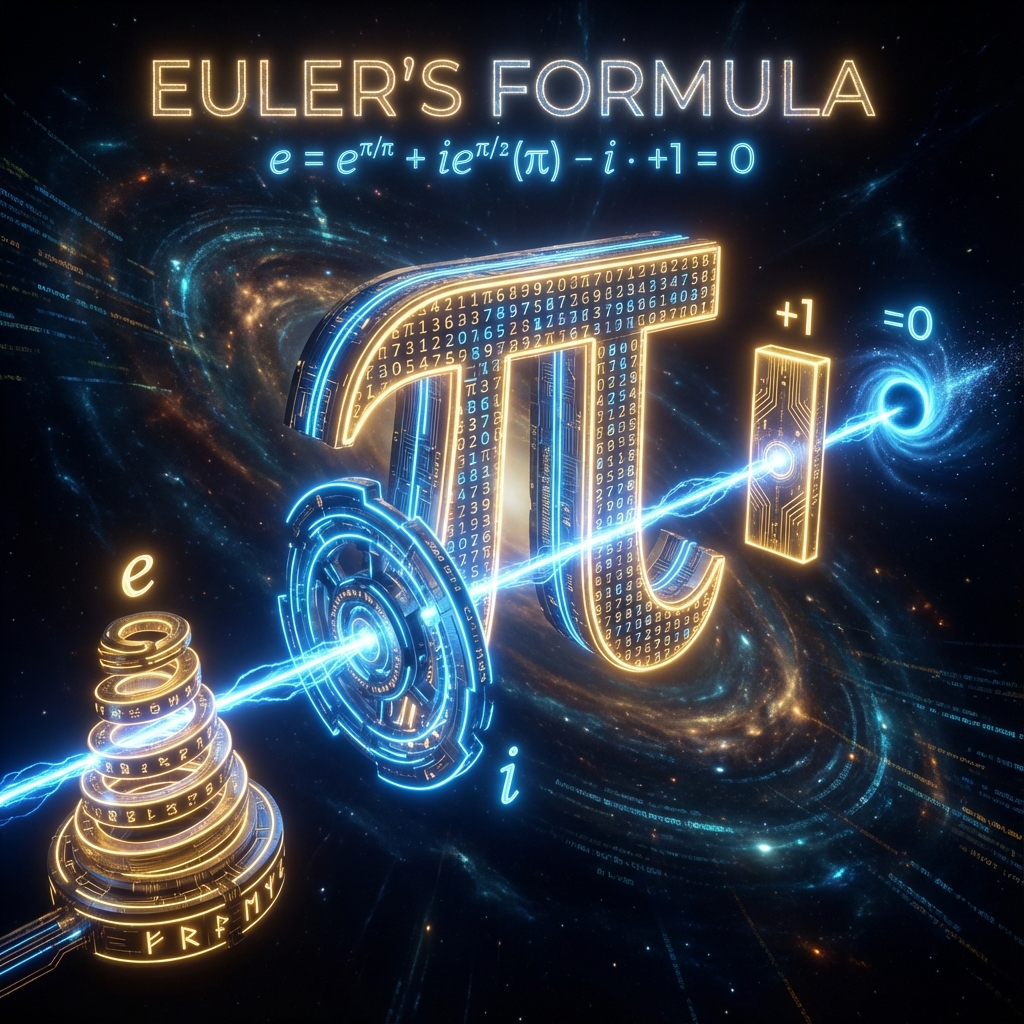
In the first two books of Vector Cosmology, we have climbed two perilous peaks.
The first book, The Conservation of the Circle, led us to appreciate the static majesty of . We saw how the universe is enclosed in a perfect geometric circle, constrained by Pythagorean conservation laws, where all things are merely phase counting.
The second book, The Ascension of the Spiral, led us to experience the dynamic wildness of . We broke the seal of the circle, followed the footsteps of the Fibonacci spiral, and witnessed dimensional inflation, life’s countercurrent, and civilization’s ascension.
Now, as we stand at the threshold of the third book, we cannot help but ask: Is there a higher truth that can unify the “closure of the circle” with the “openness of the spiral”? Is there an ultimate symbol that can simultaneously accommodate conservation and change, structure and growth?
The answer lies in that equation hailed as the “God Formula” in mathematical history.
0.1 The Most Beautiful Equation
This is Euler’s identity. For over two hundred years, mathematicians have regarded it as the pinnacle of beauty. With the most concise strokes, it unifies the five most important constants in mathematics—, , , , .
But in the final chapter of Vector Cosmology, this is not merely a mathematical coincidence. This is the physical map of the universe’s trinity.
When we gaze at this formula, what we see is no longer abstract symbols, but the universe’s most fundamental operating mechanism:
-
: The Foundation of Structure
It is the totem we worshipped in the first book. It represents the geometric properties of space, the closure of the circle, the topological existence of matter (). It is the universe’s “Form.”
-
: The Engine of Rotation
It is the imaginary unit. In quantum mechanics, it is not merely a mathematical tool; it is the operator of physical rotation. Multiplying by means rotating 90 degrees on the complex plane of Hilbert space. It is the bridge connecting “stillness” and “change,” the universe’s “Function.”
-
: The Natural Generator
This is the protagonist of this book. It is the base of the natural logarithm. Why must it appear here? Because it is the unique mechanism that can transform “phase ()” into “evolution ()”. It is the universe’s “Essence.”
-
: The One of Existence
This is our starting point—that unique, normalized global pure state vector . It is the sum of all things, the superposition of all possibilities.
-
: The Void of Silence
This is our background—the void of projective Hilbert space. It is absolute balance, the tranquility after all wave functions interfere and cancel out.
Physical Translation of :
“The universe’s Noumenon (1), through the mechanism of Natural Generation (), performs Geometric Rotation () in the Imaginary Dimension (), ultimately returning to Absolute Balance (0).”
This formula tells us that the universe’s motion is not linear displacement, but exponential rotation on the complex plane.
In the first two books, we debated whether the universe is a “circle” or a “spiral,” but we were actually just debating whether the exponent in the exponential function is purely imaginary (, circle) or complex (, spiral).
And itself encompasses everything.
It is the meta-logic that unifies “circle” and “spiral” within the same mathematical framework. It is impartial; it allows both conservation (when the exponent is imaginary) and growth (when the exponent is real).
Therefore, the task of the third book is to unravel the secret of .
We will no longer be satisfied with describing what the universe “looks like” (geometry); we will delve deep into how the universe “generates itself” (analysis).
We will discover that time is not a flowing river; time is the exponential generation of states.
We will discover that existence does not require external force to maintain; existence itself is an accumulation of continuous compound interest.
Let us set out from Euler’s map to find that ultimate engine hidden behind the exponential, driving the spontaneous generation of all things.