3.2 The Generation of Lie Algebra
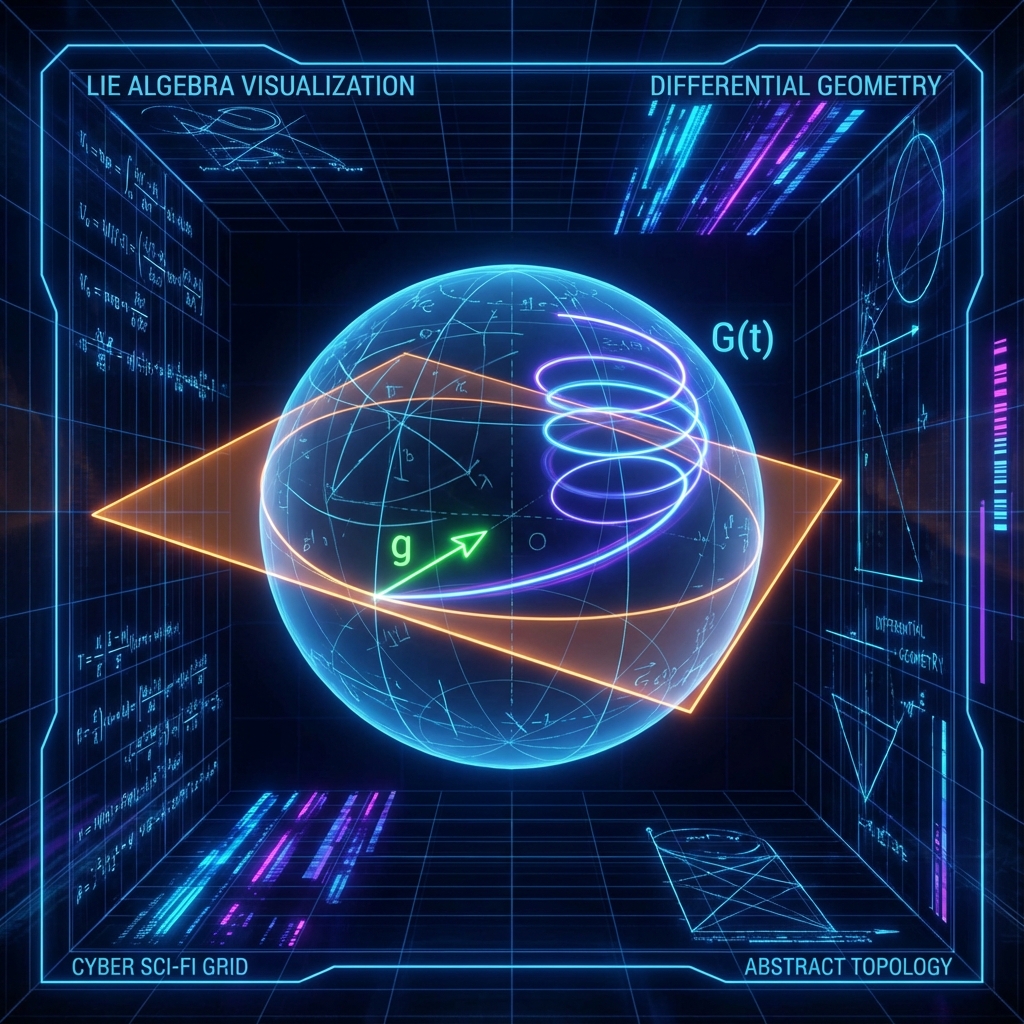
“Give me a fulcrum, and I can move the Earth. Give me a generator, and I can rotate the entire universe. Those dazzling symmetries of the macroscopic world—rotation, translation, gauge groups of elementary particles—are actually all folded in an infinitesimal tangent space. You don’t need to draw the entire circle; you only need to define the tangent at one point on the circle, and the exponential function will automatically complete the rest for you.”
In the previous section, we established the calculus principle of “state is trend.” Now, we need to delve into the internal structure of this trend.
Physicists often talk about symmetries: spheres are round, space is translation-invariant, charge is conserved. Mathematically, these symmetries form Lie Groups. But a Lie group is a vast, curved, complex whole object. If you want to directly describe the entire universe’s symmetries, that’s too tiring.
Nature is stingy. It doesn’t store the entire group; it only stores the seed of the group.
This seed is the Lie Algebra, which we know in quantum mechanics as the Generator.
The Alchemy of Tangent Space
Imagine a huge globe (Lie group). You want to describe the operation of “rotating around the equator.”
You could record all states of rotating 1 degree, 2 degrees, … 360 degrees. But this is still the clumsy “list method.”
The Lie algebra method is: stand at a point on the equator (the identity element ), and find that “infinitesimal tangent vector” pointing east.
This tangent vector is denoted .
It is not rotation itself; it is the “tendency to rotate”.
Once you have , you no longer need the globe. You just need to put into the oven of the Exponential Map:
-
When is small, this is a tiny shift.
-
When becomes large, the power series expansion of () automatically handles all curvature effects, making your trajectory perfectly fit the surface of the globe, forming a great circle.
This is the magic of generation.
Local defines global. Linear defines nonlinear.
The universe doesn’t need to remember what the complex eight-dimensional manifold of “strong interaction” looks like. The universe only needs to remember 8 tiny generators (gluons). With these 8 seeds, through the continuous compound interest of , the entire magnificent strong force gauge field automatically grows.
Hamiltonian: The Conductor’s Baton
In the physical picture of Vector Cosmology, there is only one most important generator: the Hamiltonian ().
In the paper, we wrote that for any parameter , the evolution equation is . Here, (or ) is that tangent vector.
-
What is ? It is an operator, a matrix, or an “arrow” in the tangent space.
-
What does determine? It determines in which direction the global vector “wants to rotate” in the next instant.
If points in the momentum direction, the universe undergoes translation.
If points in the angular momentum direction, the universe undergoes rotation.
If points in the isospin direction, a proton becomes a neutron.
The entire evolution history of the universe is merely the expansion of the single formula .
All physical laws—from Newton’s laws to Maxwell’s equations—are actually structure constants hidden inside ’s Lie algebra.
Extreme Information Compression
This reveals the universe’s astonishing information compression ratio.
If the universe is a huge video file (history), the size of this file is nearly infinite.
But if the universe is generated, we only need to store its generator code.
-
Code: A set of generators and their commutation relations .
-
Input: An initial state .
-
Run: Press the key.
The video starts playing automatically.
The (internal structure) we mentioned in the first book is mathematically the projection length of the vector onto the Lie algebra generators of the internal symmetry group (such as ).
What we call “a particle has mass” means that the vector not only has a projection in the “mass generator” direction but is also rotating wildly.
Conclusion: The Universe is an Exponential Map
At this point, we see the underlying architecture of nature.
The universe is not built from static building blocks; the universe is a dynamically generated flow.
And Lie algebra is the valve that controls the direction of this flow.
-
The imaginary number ensures the flow is rotational (conserved).
-
The exponential ensures the flow is continuous (self-driven).
-
The generator determines the shape of the flow (physical laws).
When we understand this, we are no longer amazed by the complexity of the universe. Because complexity is only appearance; the essence is extremely simple. Even the most complex galaxy evolution, the most entangled quantum entanglement, ultimately, are just elegant arcs drawn by the same tangent vector driven by along the surface of the manifold.
Since we have mastered the principle of “generation,” the next question is: How does this generation mechanism connect between the microscopic and macroscopic? Why do the discrete pixels (QCA) we see microscopically become smooth continuous spacetime macroscopically?
This leads to the theme of the next chapter: Continuous Compound Interest. We will reveal how bridges the gap between discrete and continuous.