2.2 The Compound Interest Interpretation of Least Action
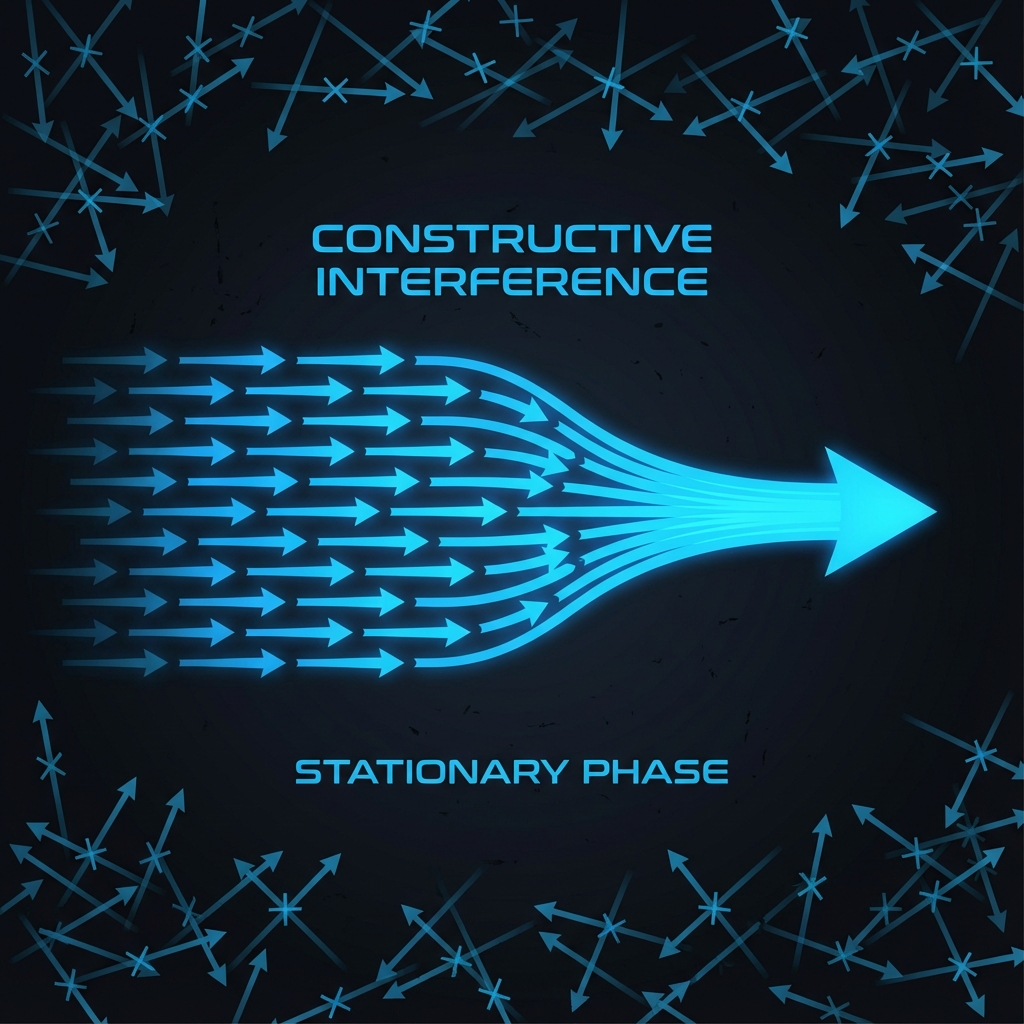
“A photon is not a meticulous accountant; it doesn’t really calculate which path has the lowest cost. It is just a crazy investor who bets on all paths. But only on the track of ‘least action’ does its investment generate positive compound interest, while on all other tracks, returns cancel each other out.”
In the hall of classical mechanics, the Principle of Least Action is revered as the supreme oracle. It tells us that nature is “stingy”: light takes the shortest time, objects slide along geodesics. This sounds full of mysterious teleology—as if nature knew the destination in advance and planned the optimal route accordingly.
But from the perspective of Vector Cosmology, nature is neither stingy nor possesses the wisdom to foresee the future. What we call “least” or “shortest” is actually the inevitable result of Phase Compounding.
Action as Cost
First, we need to redefine Action ().
In classical physics, . This is the integral of kinetic energy minus potential energy over time.
In our “cosmic economics,” action represents the geometric cost paid by the system during evolution.
-
Every tiny movement, every energy transformation, consumes the universe’s budget.
-
This consumption is not merely a quantitative reduction, but a phase rotation.
According to Feynman’s formula, with each step, the system’s phase rotates by an angle: .
Remember what we said in Chapter 1? is rotation on the complex plane.
Therefore, action actually measures how many times the vector has “circled around” in Hilbert space.
The Interference Mechanism of Compound Interest
Now, let’s see how “compound interest” occurs.
In finance, compound interest means interest continuously joins the principal, producing exponential growth.
In quantum mechanics, path integrals are also a form of compound interest calculation, but conducted on the complex plane.
The universe invests unit of principal (amplitude modulus) on every possible path.
However, the “investment returns” of these principals—that is, the final phase directions—are all different.
1. On Non-Classical Paths (Bad Investment)
If you deviate slightly from that “correct” path, your geometric cost will fluctuate wildly.
-
Path A’s phase points to 3 o’clock.
-
Path B (deviated slightly) points to 9 o’clock.
-
Result: .
This is like a bad investment portfolio where assets hedge each other, resulting in zero returns. This is Destructive Interference. These historical paths have “occurred,” but they are written off in the macroscopic ledger.
2. On the Least Action Path (Good Investment)
This is a mathematical Stationary Point, i.e., .
This means that even if you deviate slightly from this path, your geometric cost remains almost unchanged (because at the bottom of the valley, the slope is zero).
-
Path A points to 12 o’clock.
-
Path B (deviated slightly) also points to 12 o’clock.
-
Path C (deviated a bit more) still points to 12 o’clock.
-
Result: .
Countless adjacent paths point in the same direction. Their amplitudes add up, and the signal is amplified. This is Constructive Interference.
Geometrically Shortest, Economically Maximum
This is the emergence of classical reality.
The photon did not “choose” a straight line. The photon took all curves.
But only near the straight line is the “compound interest accumulation” of phases positive.
On all other curved paths, the “compound interest” of phases returns to zero due to violent oscillations.
So, it’s not that “nature likes the shortest path.” Rather, “only the shortest path can survive in the summation.”
This reveals the profound wisdom of as a generator:
-
(exponential mechanism) allows all possibilities to occur concurrently.
-
(phase cost) acts as a filter.
The principle of least action is essentially “survivor bias” in Hilbert space. The reason we see physical laws so perfect and efficient is that those “inefficient” and “wasteful” versions have self-destructed in the mutual cancellation of phases at the microscopic level.
Conclusion: Existence is Resonance
At this point, we have completed our exploration of Volume I: 【The Engine of Imaginary Numbers】.
We saw the continuous generation of time from Schrödinger’s , the conservation of rotation from the imaginary number , and finally the emergence of reality from Feynman’s path integral.
We discovered that the universe does not need a precise dispatcher to direct traffic. The universe only needs a simple compound interest mechanism: Let everything happen, then let the inconsistent cancel each other out, and let the consistent resonate with each other.
Existence is the resonance of phases.
The macroscopic world is solid because it is a geometric consensus reached by countless microscopic paths driven by .
Since we have understood how the universe generates states through “imaginary numbers” and “compound interest,” how does that source driving all this—that tiny, invisible generator operator—define the symmetries and conserved quantities we observe?
This leads to the theme of Volume II: Generator: The Secret of Lie Algebras. We will dive into the deepest layers of mathematics to see how that ghost called “infinitesimal” supports the entire cosmic edifice through the amplification of .