Chapter 10: The Fractal Universe
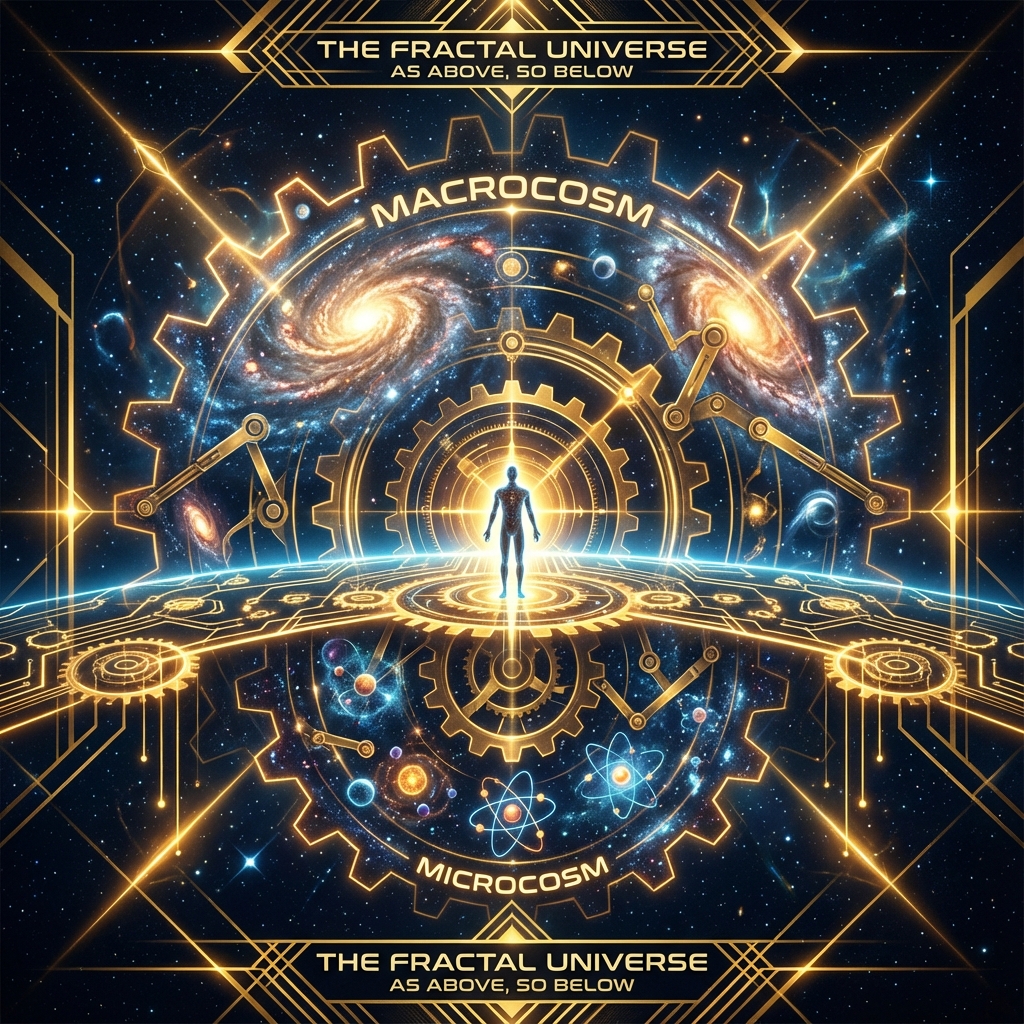
In the previous chapter, through Naimark’s dilation theorem, we glimpsed that all-encompassing “great circle.” But this is merely a mathematical existence proof. The real physical world is not an empty circle; it is full of details, layers, and structures.
When we look around, we see not chaos, but hierarchy. Quarks compose protons, protons compose atoms, atoms compose cells, cells compose us, we compose civilizations, civilizations compose galactic networks.
This looks like a linear chain. But from the geometric perspective of Vector Cosmology, this is a Fractal structure.
This chapter will reveal that the structure of the universe is essentially “recursive nesting of circles.” Each level is a tangent point on the circle of the previous level, and also the starting point of the spiral of the next level.
10.1 Between the Layers
“As above, so below. An atom is a miniature solar system, and a galaxy is a giant cell. This is not merely a poet’s metaphor; it is the self-similar projection of a holographic universe at different focal lengths.”
The Geometry of Self-Similarity
If in the first book, we emphasized the conservation of at a single scale; then in this chapter, we discuss the universality of this equation across Multi-Scale.
A core feature of fractal geometry is Self-Similarity. That is, no matter how much you zoom in, the pattern structure you see is similar.
In Vector Cosmology, this means the form of physical laws has Scale Invariance.
-
At the Microscopic (Level ): Electrons orbit atomic nuclei. This is an structure driven by electromagnetic force.
-
At the Macroscopic (Level ): Planets orbit stars. This is an structure driven by gravitational force.
Despite different driving forces (electromagnetic vs gravitational), despite different parameters (fine structure constant vs gravitational constant), in geometric essence, they are all performing the same task: locking the budget of onto a closed circular orbit to resist environmental dissipation.
Each level is an independent circle.
An atom is a circle, thinking itself closed.
A solar system is a larger circle, also thinking itself closed.
The Ladder of Renormalization
Since levels are so similar, why don’t we sense direct connections between them? Why do quantum mechanics (microscopic circle) and general relativity (macroscopic circle) seem so incompatible?
The answer lies in Renormalization.
In physics, renormalization group flow (RG Flow) describes how physical parameters change when we alter the observation scale.
In FS geometry, this is “information encapsulation.”
-
Encapsulation: When we ascend from the atomic level (Level ) to the cellular level (Level ), the underlying details are “packaged.”
The frantic rotation of atoms () is averaged into a static background property from the cell’s perspective—internal energy or mass.
-
Forgetting: Cells don’t need to know the specific positions of electrons. The underlying (electron motion) becomes invisible (thermal noise) for the upper level.
The barrier between levels is essentially the abandonment of information precision.
The “noise” of the previous level’s circle constitutes the “foundation” of the next level’s circle.
-
The chaotic thermal motion at the atomic level is renormalized into smooth temperature at the macroscopic level.
-
The discrete jumps of microscopic lattices (QCA) are renormalized into continuous spacetime background at the macroscopic level.
This is why the universe appears layered. Each layer is an “Effective Field Theory”, running independent logic within its specific budget range, exchanging extremely limited energy with other levels through “renormalization interfaces.”
The Gear Ratio of Time
The most shocking corollary of this fractal structure concerns time.
If the universe is great circles within small circles, then different circles must have different rotation speeds.
-
Microscopic Level (Small Circle): Extremely fast rotation. Electrons complete one life cycle (rotation) in femtoseconds ( seconds).
-
Macroscopic Level (Great Circle): Extremely slow rotation. Galaxies need hundreds of millions of years to complete one rotation.
This constitutes a massive cosmic gear set.
We (humans) live at an intermediate level.
-
Looking down, the microscopic world is fast like a blurry cloud (electron cloud). We can only see probability distributions because their evolution speed far exceeds our perception frame rate.
-
Looking up, the macroscopic world is slow like a static painting (constellations). We feel the universe is eternal because, relative to our lifespan, the great circle’s pointer has barely moved.
What we call “relativity” is actually a speed conversion protocol between gears of different levels.
Conclusion: Nested Fate
Therefore, we do not live in a single universe. We live in a Russian nesting doll.
We think we are spiraling upward (evolution, civilizational progress), and that’s correct. But our spiral may be just a tiny arc on the larger circle of the Milky Way. And the Milky Way’s spiral is an arc on the great circle of the Local Supercluster.
All spirals ultimately serve the closure of higher-level circles.
Does this mean the loss of free will again?
No.
Because fractal structure means not only “upper level determines lower level,” but also “lower level maps upper level.”
As we said in the holographic chapter, even the smallest fragment contains the logic of the whole.
As observers at an intermediate level, we possess a unique privilege: we can look both ways. We can see the underlying pixels (QCA) with microscopes, and also see the top-level horizon with telescopes. We are the hub connecting the microscopic and macroscopic.
Since we are in the middle of this fractal ladder, what is the ultimate goal of civilization? To continue horizontal expansion at this level, or to attempt crossing levels, going to that larger or smaller circle?
This leads to the theme of the penultimate section of this book: Escape Velocity. We will see that the true destination of Type III civilizations is not conquering the starry sea, but dimensional migration.