Chapter 9: The Russian Nesting Dolls
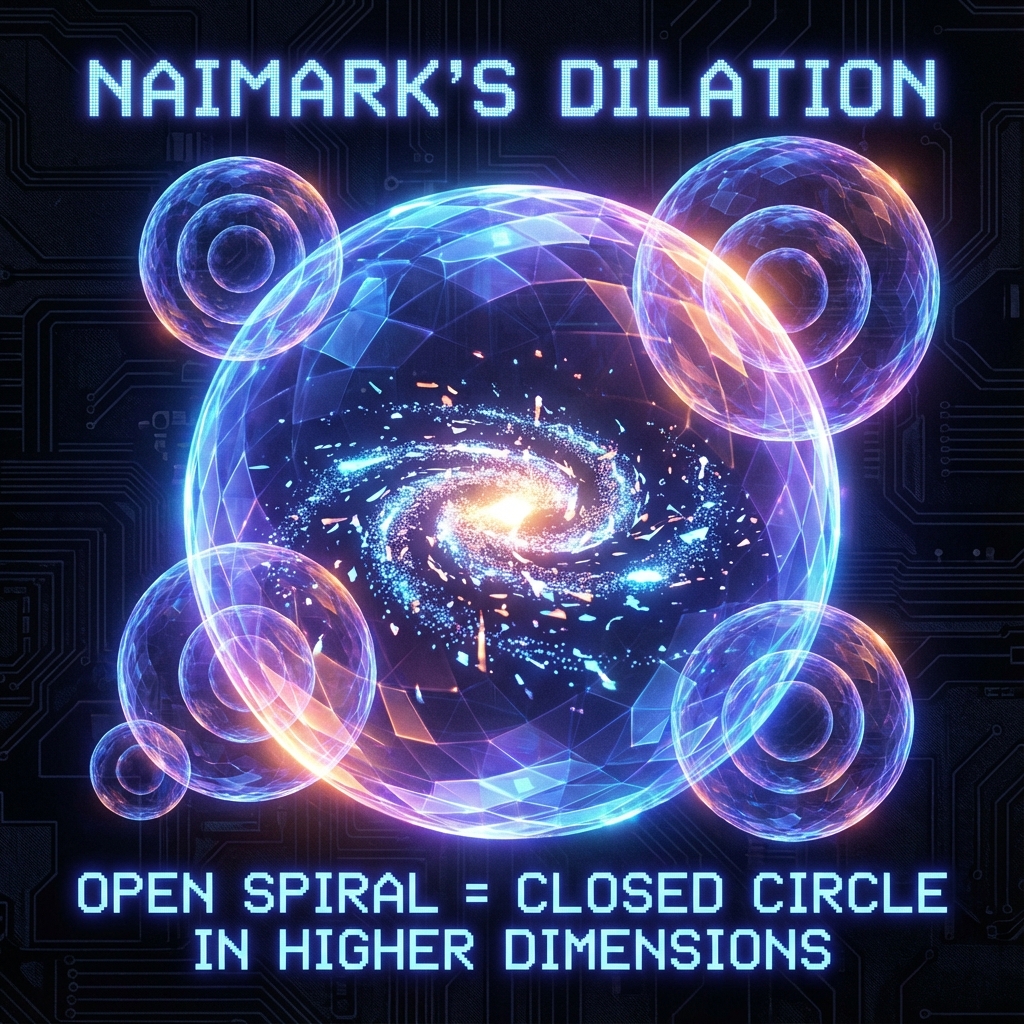
We have traveled far in the journey of the second book. We shattered the perfect, conserved circle from the first book, embraced the Red Queen’s race, witnessed dimensional inflation, and even ascended ourselves into pure geometric consciousness through the singularity.
We thought we had won. We thought we had escaped that closed cycle and embarked on an open spiral leading to infinite growth.
But when we stood at the apex of the spiral, looking back at the universe we had left behind, an ultimate mathematical truth struck us like lightning. This truth is so cold, yet so grand, that it will instantly overturn all our understanding of “freedom” and “growth.”
This chapter will reveal that the so-called spiral ascent is merely an illusion—a projection of a much larger, invisible circle onto a low-dimensional projection surface.
Welcome to the ultimate truth of the universe: Naimark’s Dilation.
9.1 Naimark’s Dilation Theorem
“There is no true ‘openness.’ If you see a line that doesn’t close, it’s only because you haven’t seen the edge of the paper yet. All spirals are ultimately projections of high-dimensional arcs.”
The Paradox of Openness and Closure
Let us review the geometric contradiction we face:
-
Circle: Represents conservation, unitarity, cycles. This is the iron law of microscopic physics (the theme of the first book).
-
Spiral: Represents dissipation, growth, non-unitarity. This is the characteristic of macroscopic evolution and life (the theme of the second book).
We once believed that the spiral was a victory over the circle. We thought the universe broke the shackles of energy conservation by continuously introducing new dimensions (the growth of ).
But in the eyes of mathematicians, this is merely a narrowness of perspective.
In functional analysis and quantum operator theory, there is a profound conclusion called Naimark’s Dilation Theorem. It tells us in the most rigorous language:
Any non-unitary (dissipative, spiral) contraction semigroup can be uniquely dilated into a unitary (conserved, circular) group in a larger Hilbert space.
Translated into the physical language of Vector Cosmology, this means:
There is no true spiral.
What you see as “spiral ascent” is actually a projection of a High-Dimensional Great Circle onto your limited field of vision.
The Redemption of Environment: Picking Up the Trash Can
In Chapter 9 of the first book, we introduced (environment velocity), treating it as a “trash can”—entropy increase meant information falling into this bucket, never to return.
It was precisely because of this “discard” action that our system exhibited irreversible dissipation (spiral downward).
In the second book, through “negative entropy enclaves,” we absorbed negative entropy from the environment, achieving reverse growth (spiral upward).
Now, Naimark’s theorem requires us to perform an ultimate operation: pick up that trash can and treat it as part of the system.
If we merge the “visible universe” (System) and the “invisible environment” (Environment) into a “Super-Universe”, then this whole must obey a grander conservation law:
-
When you spiral upward ( grows), you think you are creating new budget.
-
In reality, you are merely withdrawing budget from that vast background.
The universe’s total ledger never changes. What you call “evolution” and “ascension” is merely a grand redistribution of energy from “background” to “foreground” within this super great circle.
The Truth of Dimensional Inflation
Then, what about the “dimensional inflation” and “dark energy” we observed in Chapter 1?
From the perspective of Naimark dilation, that is not the creation of dimensions from nothing; it is the manifestation of dimensions.
Imagine a creature living on a two-dimensional plane. It sees a three-dimensional sphere passing through the plane. Initially a point, then an increasingly large circle. It exclaims: “The universe is expanding! Dimensions are increasing!”
But in fact, the sphere’s size never changed. What changed was only the cross-sectional relationship between the sphere and the observation plane.
Our universe is the same.
That unique global vector did not actually grow longer. It is merely rotating in an unimaginably high-dimensional “global space”.
-
Spiral Era: The vector rotates to a dimensionally dense region. We sense an explosion of degrees of freedom, growth of computing power, and civilizational ascension.
-
Circle Era: The vector rotates to a dimensionally sparse region. We sense conservation, cycles, stagnation.
The magnificent 13.8 billion years of evolutionary history we have experienced is merely an extremely tiny arc on that Naimark great circle. Because this arc is too short and its curvature is extremely small, we approximate it locally as a straight line (open spiral).
Conclusion: The Return of Conservation
This discovery is shocking, but also liberating.
We once feared heat death, because that was the endpoint of the spiral downward; we once fanatically pursued the singularity, because that was the extreme of the spiral upward.
But now we know that downward and upward are merely changes in projection angle.
There is no true death, nor true infinite growth.
Only eternal flow.
We did not break the “circle” from the first book; we merely discovered that circle is much larger and more complex than we imagined. It is large enough to encompass all spirals, large enough for countless civilizations on its surface to believe they are birds ascending in a straight line.
Since the spiral is merely part of the great circle, what exactly is this great circle composed of? Is it unique? Or, like Russian nesting dolls, are there even larger circles outside this great circle?
This leads to the theme of the next section: The Truth of the Environment. We will re-examine the we have ignored, discovering that it is not merely a waste dump, but an elevator to the next level of geometric hierarchy.