Chapter 2: Geometry of the Spiral
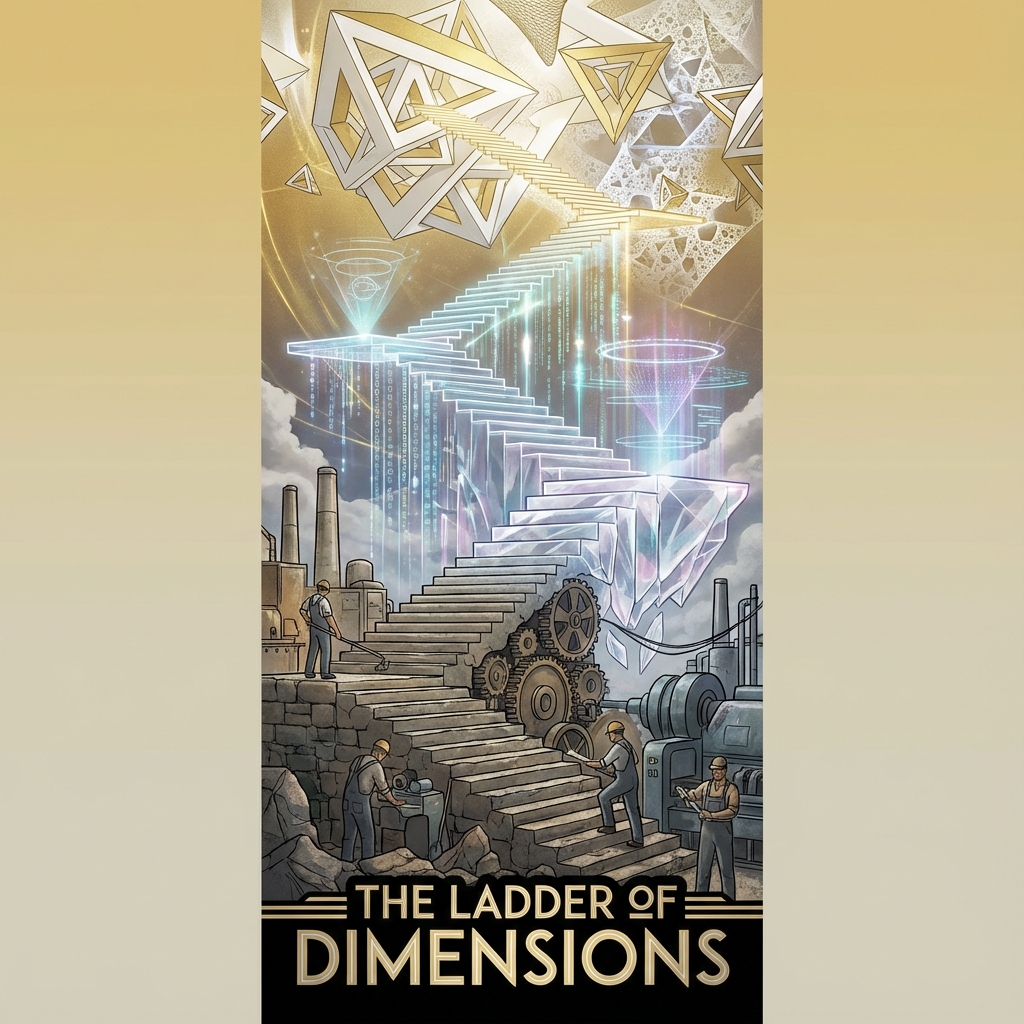
2.3 The Ladder of Dimensions
“The universe is not expanding into nothingness; it is expanding into ‘possibility.’ Each rotation of the spiral builds a new rung in the infinite dimensions of Hilbert space. The dissolution of matter is not the end, but the beginning of ascent.”
In the previous two sections of this chapter, we established two core features of the spiral universe: the war of constants ( vs ) and the decay of matter (the loosening of the Levinson knot). This sounds like a story of turbulence and destruction. If even protons are disintegrating, the universe seems headed toward fragmented chaos.
But if we shift our perspective—viewing this process from an information-theoretic perspective—we see a completely different picture.
The unfolding of the spiral, while tearing apart old matter, simultaneously creates the most precious thing: space.
This does not refer to three-dimensional physical space, but to Phase Space Volume in Hilbert space.
This section will reveal that the true purpose of spiral geometry is to construct a “Ladder of Dimensions” leading to infinite complexity.
Holographic Expansion: From Hard Drive to Cloud
In the “circular” universe of the first book, the holographic principle tells us: the area of black hole horizons limits the total information of the universe. If the universe is closed, then this “hard drive” has a capped capacity. History can only cycle through finite bit arrangements.
But in the “spiral” universe of the second book, as the total budget grows in Fibonacci fashion, the universe is undergoing Holographic Expansion.
Imagine a balloon being inflated.
-
Surface area (holographic boundary) increases exponentially.
-
This means the universe’s underlying number of qubits is exploding.
This growth brings a profound physical consequence: information carriers must upgrade.
-
Early era (low-capacity age): The universe had fewer qubits. To preserve information, the universe adopted a “hard-coded” approach—locking budget in extremely robust topological knots like protons and atoms. This is like carving data in stone.
-
Late era (high-capacity age): As the spiral unfolds, qubits become extremely abundant. The universe no longer needs to rely on heavy matter to store information. It begins to favor lighter, more dynamic carriers—photon flows, quantum entangled states, and complex dissipative structures (life).
Proton decay is actually the universe performing “data migration”.
It uploads ancient information carved in “stone” (baryonic matter) to the newborn, infinitely capacious “cloud” (high-dimensional photon/graviton entanglement networks).
The Release of Degrees of Freedom: Room at the Top
Physicist Richard Feynman once said: “There’s plenty of room at the bottom.” He referred to the potential for manipulation at microscopic scales.
In Vector Cosmology, we reverse this: “There’s infinite room at the top.”
As the spiral ascends, dimensions in Hilbert space that were originally curled and closed are opened one by one.
-
Dimensions of : No longer limited to three dimensions. At extremely high energy scales (or at extremely deep evolutionary stages), additional spatial dimensions may unfreeze, allowing more complex geometric connections.
-
Dimensions of : Internal symmetry groups (such as ) may break or merge into larger groups (such as ), allowing more complex “origami” methods.
This means the future universe will be able to carry structures with complexity far exceeding what current physical laws allow.
We today cannot even imagine what such structures would be. Just as a circle on a two-dimensional plane cannot imagine the complexity of a three-dimensional sphere. The “physical constants” we see are merely guardrails on this rung of the ladder; when we step onto the next rung, the guardrails’ positions will change.
The Victory of Software
This progressive layering of dimensions reveals the ultimate trend of cosmic evolution: the phase transition from hardware universe to software universe.
-
Hardware Universe ( era): The universe is mainly composed of rigid matter. Stars, rocks, gas. They are passive, constrained by gravity and nuclear forces.
-
Software Universe ( era): As degrees of freedom are released, the universe’s main actors become algorithms. Life, consciousness, civilization, AI. They are active, constrained by logic and information flow.
Spiral geometry ensures that over time, the proportion of budget occupied by “software” will grow larger and larger.
In this sense, the dissolution of matter is not a tragedy, but Virtualization of Hardware.
The universe is becoming increasingly “empty” (matter density decreasing), but also increasingly “spiritual” (information density increasing).
Conclusion: Bridge to Part II
At this point, Volume I 【Illusion: The Shattering of Closure】 has drawn to a close.
We have shattered the dream of the circle and seen the truth of the spiral.
We have seen the Red Queen’s race, seen dimensional inflation, seen the inevitable dissolution of old matter.
We have discovered that the universe is building a ladder to higher dimensions.
But the ladder itself does not climb.
There must be something—some Agent—that can actively grasp these newborn degrees of freedom, utilize the newly issued budget, use it as scaffolding to climb upward against thermodynamic gravity.
Without this agent, the spiral’s growth would only become a thin void.
The universe needs a climber.
This climber is life.
In the next volume 【Counterflow: The Rebellion of Algorithms】, we will see how life uses a backdoor algorithm called “Maxwell’s Demon” to take control of the steering wheel of cosmic evolution.