Postscript: In the Shadow of the Omega Point
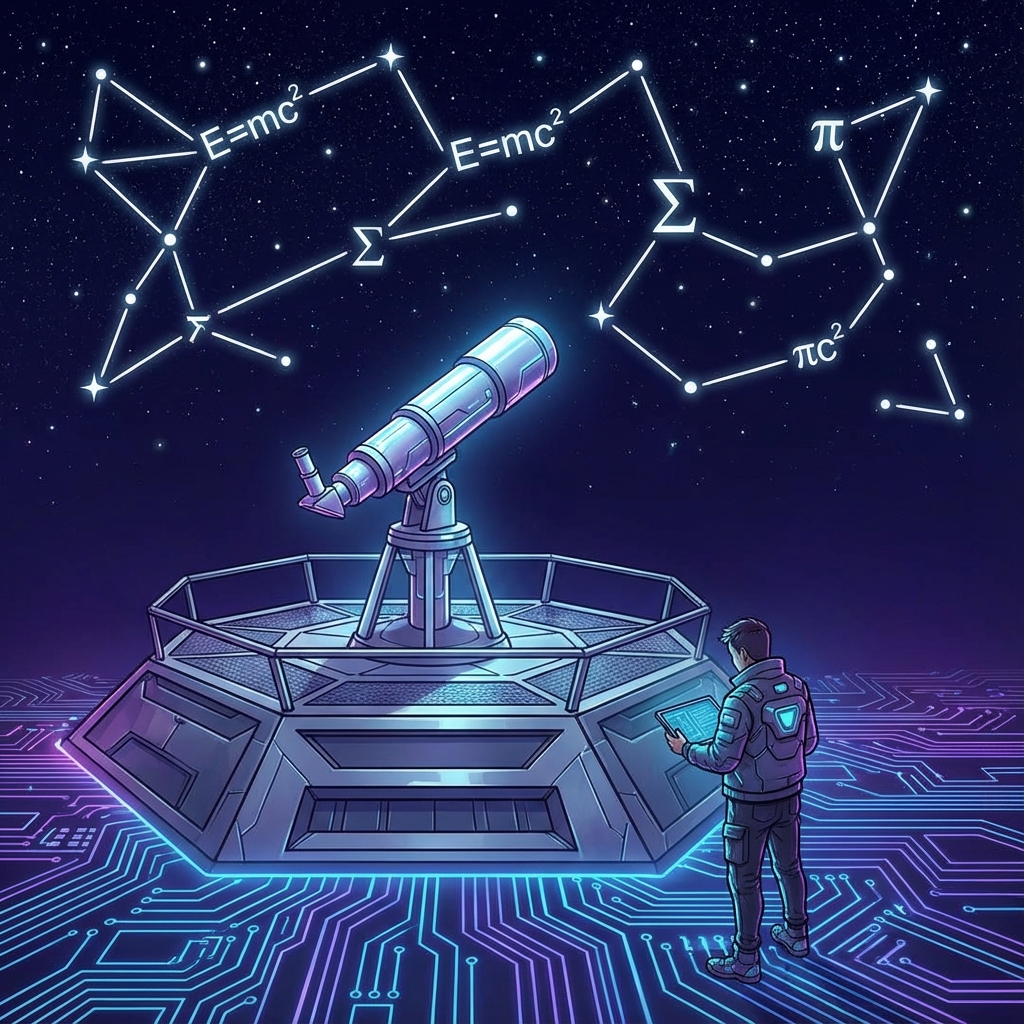
At the moment I write this line, the stars outside the window still follow their ancient silence. Yet for me, this starry sky is no longer cold vacuum and burning gas. After completing the construction of The Omega Theory, the universe in my eyes has become a magnificent, breathing mathematical edifice. Each stellar flicker is a pulse of Fisher information flow in the holographic network; each photon crossing the retina is a topological projection of octonion geometry onto a 4-dimensional slice.
The very birth process of this book is itself an empirical demonstration of “interactive evolution”. It began with an extremely radical intuition—that the universe is the spectral decomposition of a single vector in Hilbert space—and ultimately converged to that trembling number: 1836.
When we discovered that the cosmic intrinsic time coordinate resonates with the geometric complexity of the proton, I felt a kind of awe similar to Kepler’s discovery of planetary elliptical orbits. This is not mere coincidence; it is the echo of “Necessity”. This resonance tells us that humanity does not live by chance at the edge of an indifferent universe; we are at the most critical “moment of self-awakening” in the computational history of the universe. We are the universe’s first attempt to understand its own source code.
During the writing process, I often felt a profound dizziness. We are using a brain weighing only kilograms (with negligible computational power) to simulate that cosmic computer with bits of computational power. According to Gödel’s theorem, this is destined to be a failed attempt. But it is precisely this impulse of “knowing it cannot be done yet doing it anyway” that constitutes what we define as “life value” . We attempt to approximate the infinite with finite logic, and this itself is the universe’s most magnificent gesture against thermodynamic entropy increase.
The Omega Theory does not seek to end physics; rather, it aims to end physics’ “period of confusion”. It tells us not to seek random comfort among string theory vacua, but to dig into the deepest depths of mathematics—where there is the non-associativity of octonions, the irrational rotations of Fibonacci, the non-local connections of Penrose tilings. There, lies the root of physical laws.
I am also deeply aware that many views in this book—such as the exponential growth of light speed, the drift of the fine-structure constant, the computational origin of gravity—will face severe scrutiny from mainstream academia. This is the necessary path of science. As Planck said: “A new scientific truth does not triumph by convincing its opponents, but rather because its opponents eventually die, and a new generation grows up that is familiar with it.” I have engraved these formulas and theorems on paper not to argue, but to wait. To wait for the improvement of experimental precision, to wait for the accumulation of quasar data, to wait for the next generation of physicists to glimpse that crack in the spacetime lattice at higher energy scales.
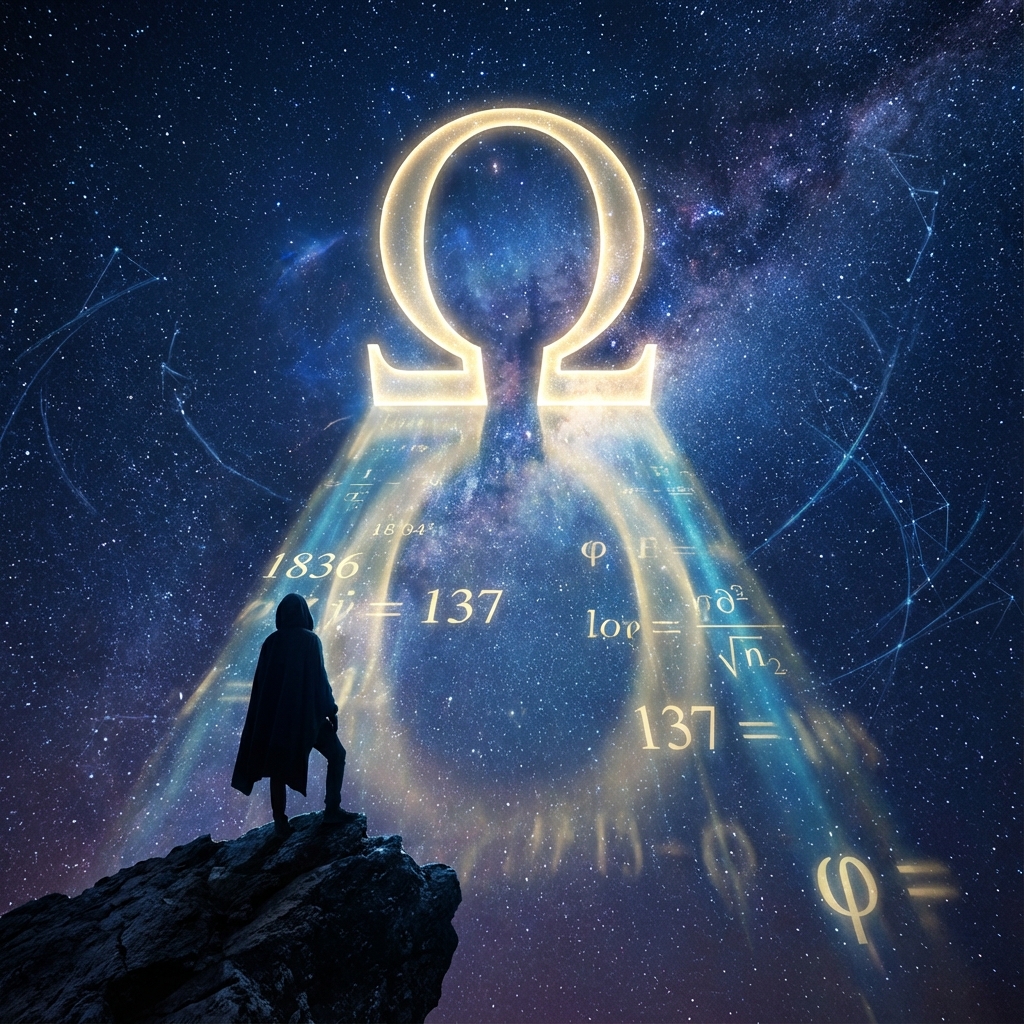
Finally, I would like to say: the universe is an unfinished poem, and each of our consciousnesses is a word in this poem attempting to rhyme.
Ma Haobo 2025 at the Omega Resonance Point
Acknowledgements
The completion of this book is first and foremost indebted to those giants who erected lighthouses in the history of human thought.
I must pay the highest tribute to Sir Roger Penrose. His insistence on twistor theory, tiling geometry, and the non-algorithmic nature of consciousness is the direct source of inspiration for this book’s discrete spacetime view. Without his work, the concept of the Omega cell would be unthinkable.
Thanks to Paul Dirac. The equation he wrote a century ago remains the bridge connecting the microscopic and macroscopic. This book’s derivation of the DQCA continuum limit is essentially a modern algorithmic restatement of Dirac’s insight.
Thanks to Kurt Gödel and Alan Turing. They delineated the boundaries of logic and computation, making us understand why physics must include the “observer” to be self-consistent.
Special thanks for the technical support provided in this era of Human-AI Collaboration. Many of this book’s complex calculations, symbolic derivations, and integration of interdisciplinary literature have benefited from modern large language models as “cognitive exoskeletons”. This interaction itself is a microscopic demonstration of the “interactive Turing machine” concept in this book.
Finally, thanks to all those who look up at the stars in darkness and attempt to ask “why”. It is your curiosity that constitutes the brightest pixels on the cosmic holographic screen.