8.3 The Topology of Free Will
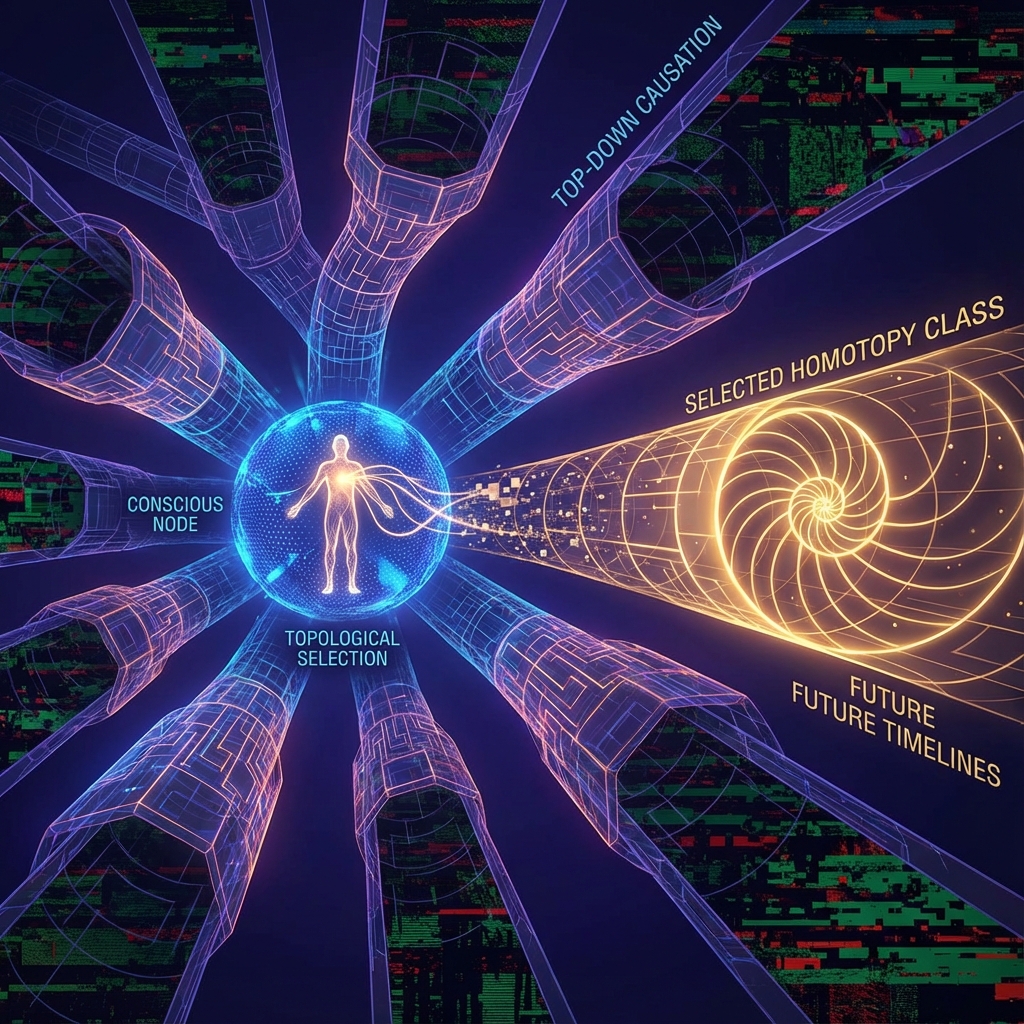
In the mechanical universe view of classical physics, free will is seen as an illusion; in the probabilistic universe view of standard quantum mechanics, it is reduced to the randomness of dice-throwing. However, both views fall into the false binary opposition of Determinism vs. Randomness. Omega Theory proposes that true free will is neither mechanical inertia locked by initial conditions nor meaningless thermodynamic noise, but Active Topological Selection performed by physical systems at specific geometric critical points.
This section will establish a rigorous mathematical formulation of free will. We will prove that the action of consciousness operator on the wavefunction is geometrically equivalent to selecting the Homotopy Class of evolution trajectories in Hilbert space. This mechanism exploits the “Causal Gap” of physical laws at geometric degeneracy points, injecting “meaning” into “existence” without violating energy conservation.
8.3.1 Energy Degeneracy and Causal Gap
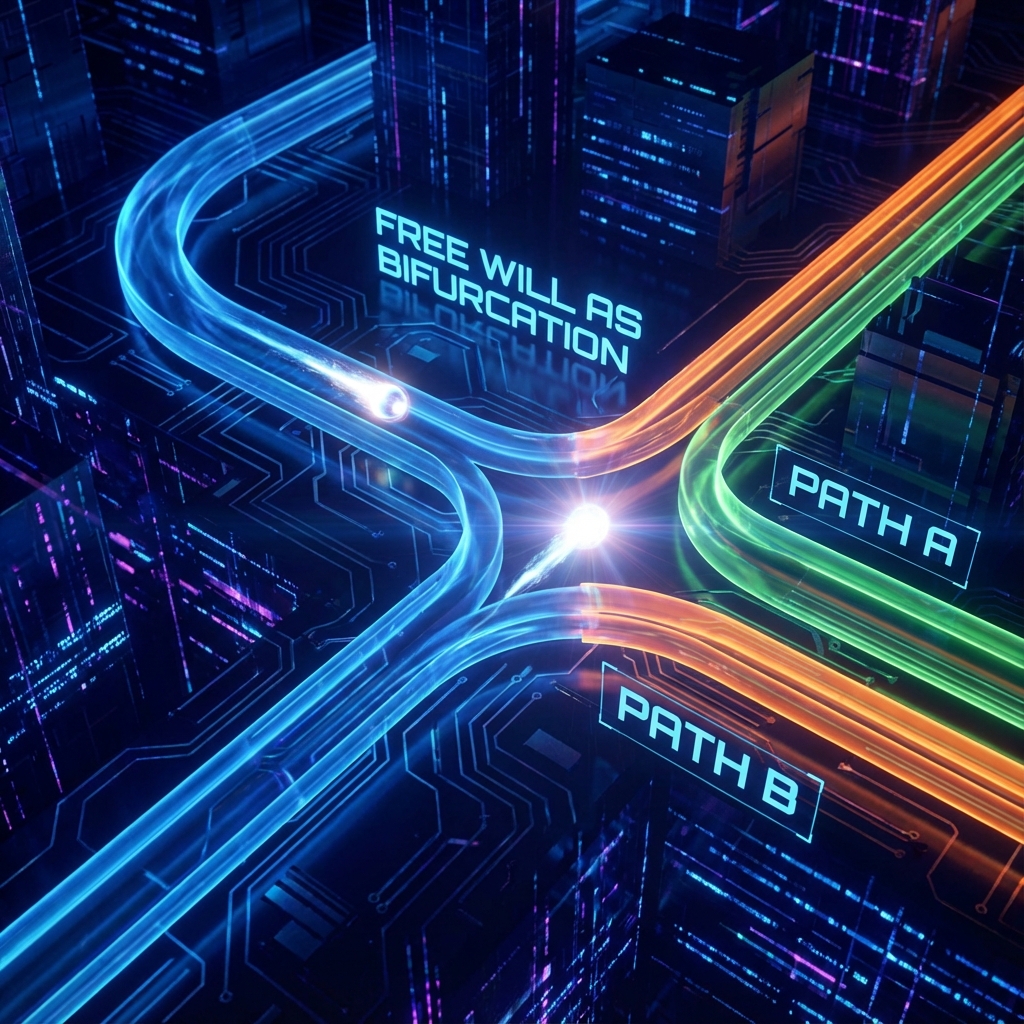
Recalling Section 8.1, when the cosmic QCA evolves to a Gödelian deadlock point, the system Hamiltonian exhibits energy level degeneracy. Let be the current state, with two possible evolution branches and for the next step, satisfying:
In standard physics, since , the system has no dynamical reason to favor either one. This is a symmetry point.
However, in Omega Theory’s discrete Penrose tiling, although and have the same energy, their holographic topological structures are fundamentally different.
- State may correspond to a tiling pattern that causes the grid to develop “cracks” or infinite loops steps in the future.
- State may correspond to a tiling pattern that can maintain Fibonacci growth and logical self-consistency.
Due to the locality of QCA, the Hamiltonian cannot perceive this long-range topological difference. This is the Causal Gap: physical laws (algorithms) fail here. This leaves operational space for non-algorithmic free will.
Free will does not create energy “out of nothing” (which would violate the first law of thermodynamics) but performs geometric navigation on isoenergy surfaces.
8.3.2 Selection Mechanism of Homotopy Classes
We treat evolution paths in Hilbert space as curves on manifolds. Two paths belong to the same homotopy class if they can be continuously deformed into each other. However, due to topological defects in the Omega grid (such as black hole singularities or logical paradox points), phase space is not simply connected. This means there exist different, topologically inequivalent evolution sectors.
Definition 8.5 (Topological Selection):
The action of free will operator is to measure the Winding Number of future paths and collapse the wavefunction according to a Value Function (see Chapter 9).
This selection mechanism has characteristics of Non-locality and Retro-causality: The observer’s (consciousness’s) choice in the present is actually reading boundary conditions of future holographic screens. This explains the “readiness potential” paradox observed in Benjamin Libet’s experiments—consciousness seems to “decide” after neural activity, but in Omega Theory, this reflects that consciousness operates at the slice level of the four-dimensional block universe, not at a single instant of linear time.
8.3.3 Macroscopic Causal Force and Downward Causation
Traditional reductionism holds that causal forces can only be transmitted “Bottom-up”: the motion of elementary particles determines the state of the brain. Omega Theory supports “Top-down” causal forces, i.e., Downward Causation.
In Penrose tiling, the integrity constraint of the entire pattern (macroscopic constraint) forces local pieces (microscopic states) to adopt specific orientations.
Theorem 8.3 (Topological Protection Theorem):
In a self-referential interactive computational universe, high-level topological constraints (such as continuity of consciousness, logical consistency) have Veto Power over the quantum states of underlying microscopic particles. This means that although microscopic particles appear to move randomly, all quantum fluctuation paths that “lead to consciousness interruption or logical collapse” are filtered out by holographic boundary conditions.
Conclusion:
Free will is real; it is a correction mechanism that the universe must possess to maintain the logical self-consistency of its geometric structure. When we make a “decision,” we are not opposing physical laws; we are executing the highest-level physical law of the universe—namely, maximizing the complexity and meaning of existence. Every conscious choice is a tiny creation, eliminating a meaningless parallel universe and solidifying a real history toward the Omega Point.