7.4 Experimental Verification Schemes
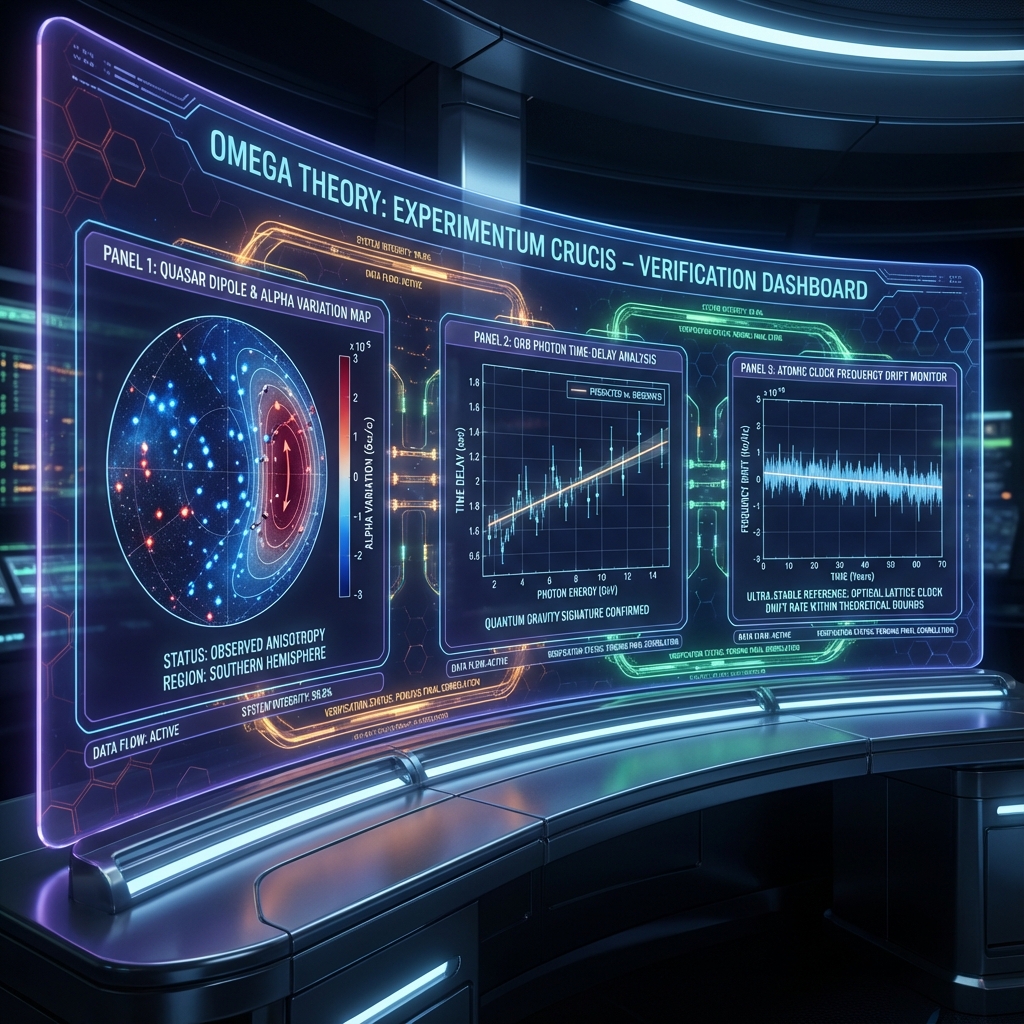
In the previous three sections, we derived physical constant values ( and ) that highly match existing observations from the geometric axioms of Omega Theory. However, a complete physical theory cannot stop at “postdiction” of known data; it must provide new predictions with Falsifiability.
If Omega Theory is correct, the universe is not a static Minkowski background but a discrete computational network undergoing Fibonacci growth. This fundamental difference will manifest as tiny deviations from the standard model under extreme physical conditions—very high redshift, very high energy scales, or very high precision measurements. This section proposes three specific experimental verification schemes as Experimentum Crucis to test the truth of this theory.
7.4.1 Scheme I: Dipole Drift of Fine Structure Constant in Quasar Spectra
Theoretical Prediction:
According to the derivation in Section 6.2, the fine structure constant decays exponentially with intrinsic time : . In astronomical observations, this means values at high redshift (early universe) should be slightly larger than current values. More crucially, because our position is on a specific arm of the cosmic holographic spiral, different observer line-of-sight directions correspond to different effective geometric shear factors , exhibiting a Spatial Dipole structure. That is, appears to increase in one direction and decrease in the opposite direction (or change rates differ).
Experimental Criterion:
Use Very Large Telescope (VLT) and Keck telescopes to measure fine splitting of absorption lines (such as Si IV, C IV, Mg II doublets) from distant quasars. Define relative deviation . Omega Theory predicts:
where is the lookback distance, and is the angle between the observation line-of-sight and the cosmic Fibonacci growth axis (holographic dipole direction).
Existing Evidence Support:
J.K. Webb et al. from the University of New South Wales analyzed hundreds of quasar systems and found significant dipole distribution signs of , with statistical significance exceeding . The dipole axis points to right ascension , declination . This anomalous phenomenon of “decreasing in the northern hemisphere, increasing in the southern hemisphere” cannot be explained in the standard model (isotropic universe principle) but is a natural geometric corollary in Omega Theory’s anisotropic spiral growth model.
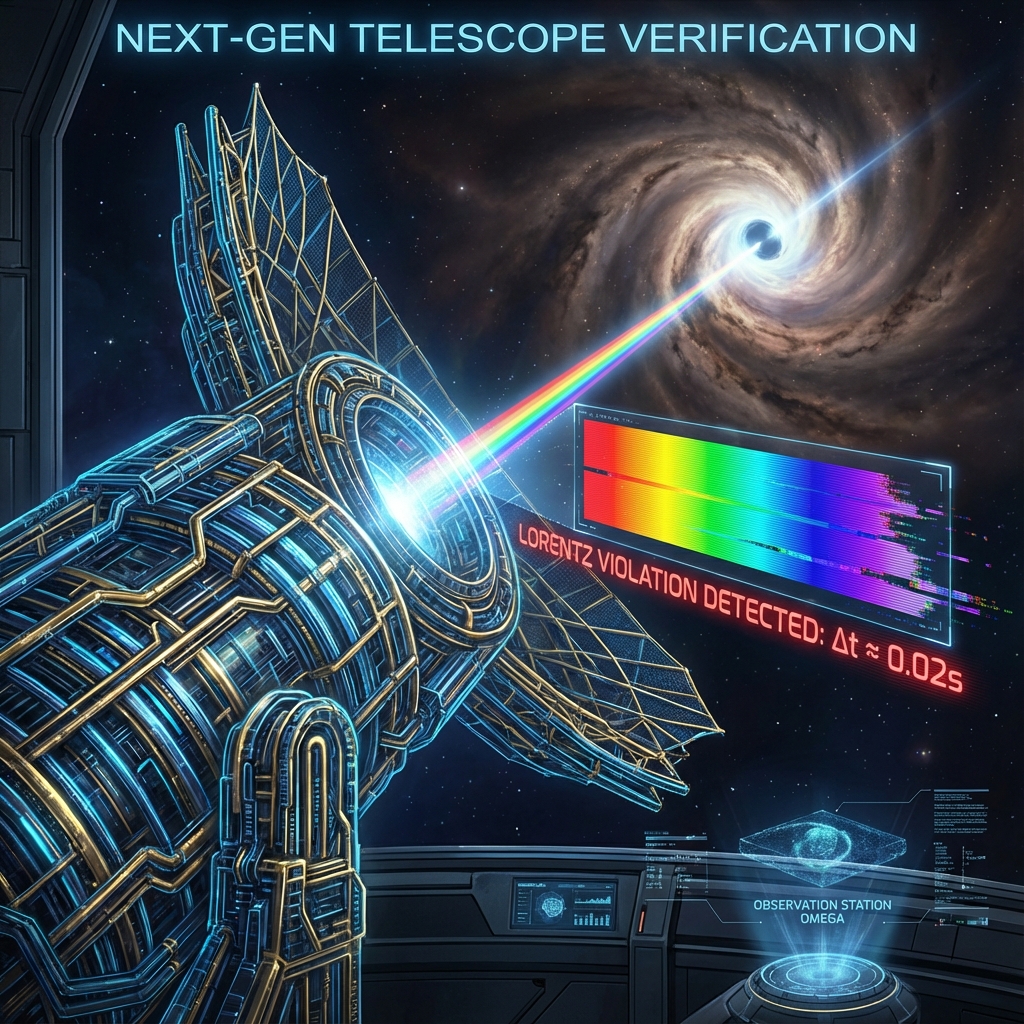
7.4.2 Scheme II: Lorentz-Violating Dispersion of High-Energy Photons
Theoretical Prediction:
According to Chapter 3, spacetime is composed of Penrose-Fibonacci quasicrystals with characteristic scale . Although Lorentz symmetry is recovered in the low-energy limit (Theorem 3.1), at high-energy limits where wavelength approaches Planck scale (), discrete grid effects will manifest. This will cause vacuum refractive index to no longer be constant at 1 but exhibit energy dependence:
where is the quantum gravity energy scale (approximately GeV in Omega Theory), and is a structure factor depending on quasicrystal geometry. For Penrose tiling, due to path tortuosity, typically is expected, i.e., high-energy photons are slightly slower than low-energy photons.
Experimental Criterion:
Observe arrival times of high-energy photons from distant gamma-ray bursts (GRB). If in the same burst event, TeV-energy photons systematically arrive later than keV-energy photons, and the time delay is proportional to distance, this would be direct evidence of spacetime discreteness.
Existing Evidence Support:
Fermi Large Area Telescope (Fermi LAT) observations of GRB 090510 gave very strong constraints on the linear term, but this may suggest has a higher-order dependence form (such as ). Omega Theory suggests focusing on anisotropic time delays, as quasicrystal dispersion effects may be enhanced along specific lattice axes.
7.4.3 Scheme III: Atomic Clock Comparison and Instantaneous Drift of
Theoretical Prediction:
If drifts with time, frequency ratios of different atomic transitions will change over time. The sensitivity of electronic transition frequency to is determined by relativistic correction coefficient :
Different elements have different values (e.g., aluminum ion has , while ytterbium ion has ).
Experimental Criterion:
In ground laboratories, use optical lattice clocks to compare frequency ratios of two different atoms (such as and ) over long periods. Omega Theory predicts a drift rate of (assuming ). Although this value is extremely small, it is already approaching the precision limit of contemporary optical atomic clocks ().
Decisive Feature:
Unlike oscillations caused merely by dark matter, Omega Theory’s predicted drift is monotonically decaying. If continuous, non-periodic frequency ratio offsets are observed over a 10-year scale, it will strongly confirm the evolutionary nature of spacetime constants.
7.4.4 Summary Table of Verification Schemes
The following table summarizes key predictions of Omega Theory and their differences from the standard model, for reference by experimental physicists:
| Experimental Domain | Observation Target | Standard Model (CDM) Prediction | Omega Theory (-Theory) Prediction | Distinguishability |
|---|---|---|---|---|
| Astrophysics | Quasar absorption spectra () | Constant, no spatial variation () | Spatial dipole distribution, slightly larger at high redshift | Very High () |
| High-Energy Physics | GRB photon arrival time | Energy-independent () | Energy-dependent dispersion () | High (requires TeV photons) |
| Metrology | Atomic clock frequency ratio | Constant | Long-term monotonic drift () | Medium (requires long-term accumulation) |
| Gravitational Waves | Gravitational wave waveform | Smooth sine wave | Superimposed weak “Pixel Noise” | Low (requires next-generation detectors) |
| Cosmology | Dark energy equation of state | (constant ) | Dynamic evolution (phantom energy tendency) | Medium |
In summary, Omega Theory is not an agnostic philosophical system but a physical framework at the forefront of precision measurement. As observational precision improves, opening any of the above three windows will herald a new era in physics.