5.2 Modified Einstein Field Equations
In Section 5.1, we encoded the total dynamical behavior of the universe as the Omega action . This action contains three core parts: the Einstein-Hilbert term representing spacetime geometric rigidity, the Fisher information term representing matter field evolution cost, and the topological potential term maintaining cosmic Fibonacci growth.
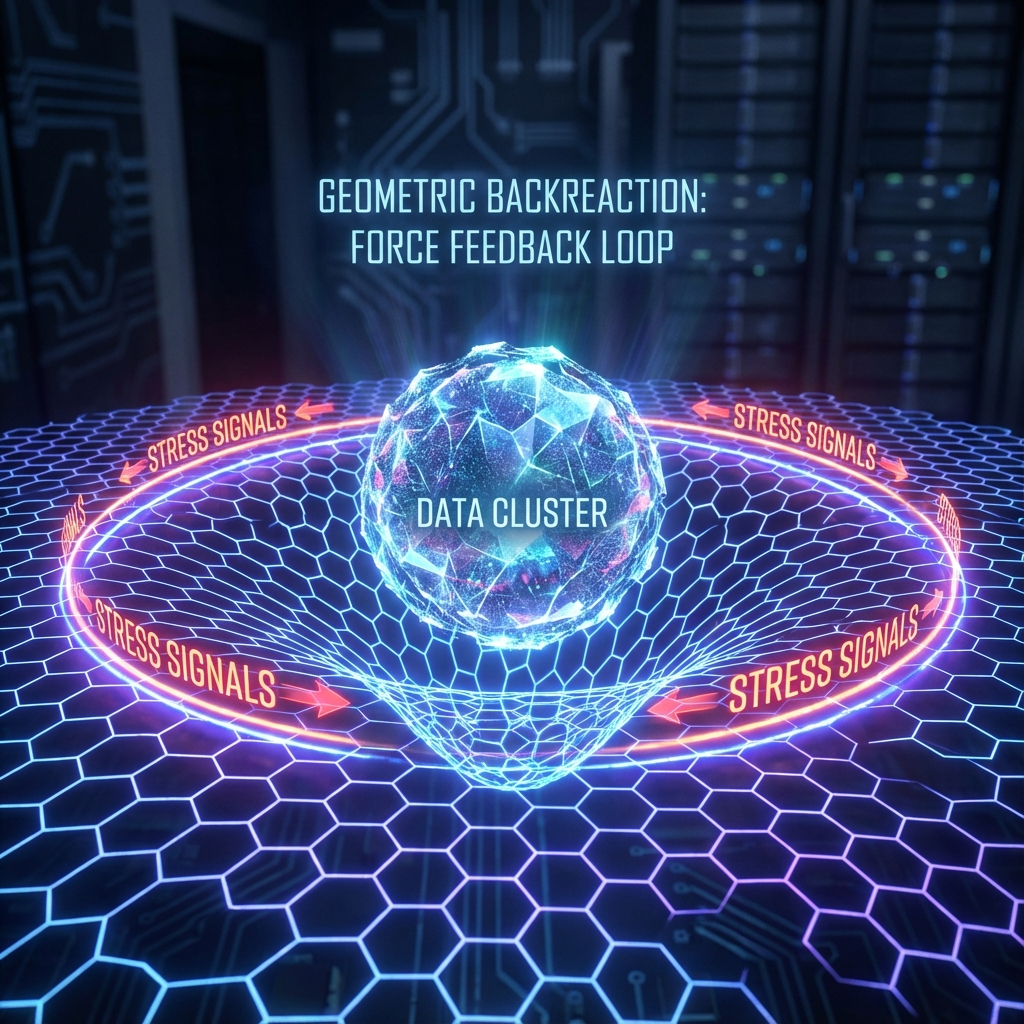
In this section, we will execute the variational procedure . Unlike standard general relativity, which merely treats matter as an energy-momentum tensor source on the right-hand side, the variational process in Omega Theory reveals the computational ontology meaning of gravitational field equations: spacetime curvature is not a container for energy but a “Geometric Backreaction” to information processing density. We will derive a set of modified field equations that explicitly include a dynamic cosmological term caused by holographic constraints.
5.2.1 Variation with Respect to the Metric Tensor
Consider the total action functional:
where is the effective gravitational coupling constant. According to the principle of least action (i.e., the principle of least computational complexity), the physically real metric field must keep the action stationary with respect to metric perturbations .
We perform variation term by term:
- Geometric term variation: This is the standard general relativity derivation result. According to the Palatini Identity:
where is the Einstein tensor. This term represents the “structural cost” required to maintain the geometric integrity of the spacetime grid.
- Information term variation and computational tensor: The Fisher information Lagrangian explicitly depends on the metric (through the inverse metric contracting gradients and the volume element ). Its variation defines the matter field’s Computational Stress-Energy Tensor:
where the explicit form of is:
In Omega Theory, this tensor is not merely a description of energy density; it quantifies the logic gate operation density required to process quantum state at spacetime point .
- Topological potential term variation and dynamic cosmological term: This is the key correction introduced by Omega Theory. The topological potential does not explicitly depend on derivatives of the metric, but it contains the volume element factor .
This means the topological potential’s contribution to the field equations manifests as a term proportional to the metric, i.e., an effective cosmological constant term.
5.2.2 Derivation of Modified Field Equations
Substituting the variational results of the above three parts into and canceling the common factor , we obtain:
Rearranging, we obtain The Omega Field Equations:
where the effective cosmological term is defined as:
5.2.3 Physical Interpretation: Hardware Response to Software
This set of equations reveals the deep mechanism of gravitational interaction:
-
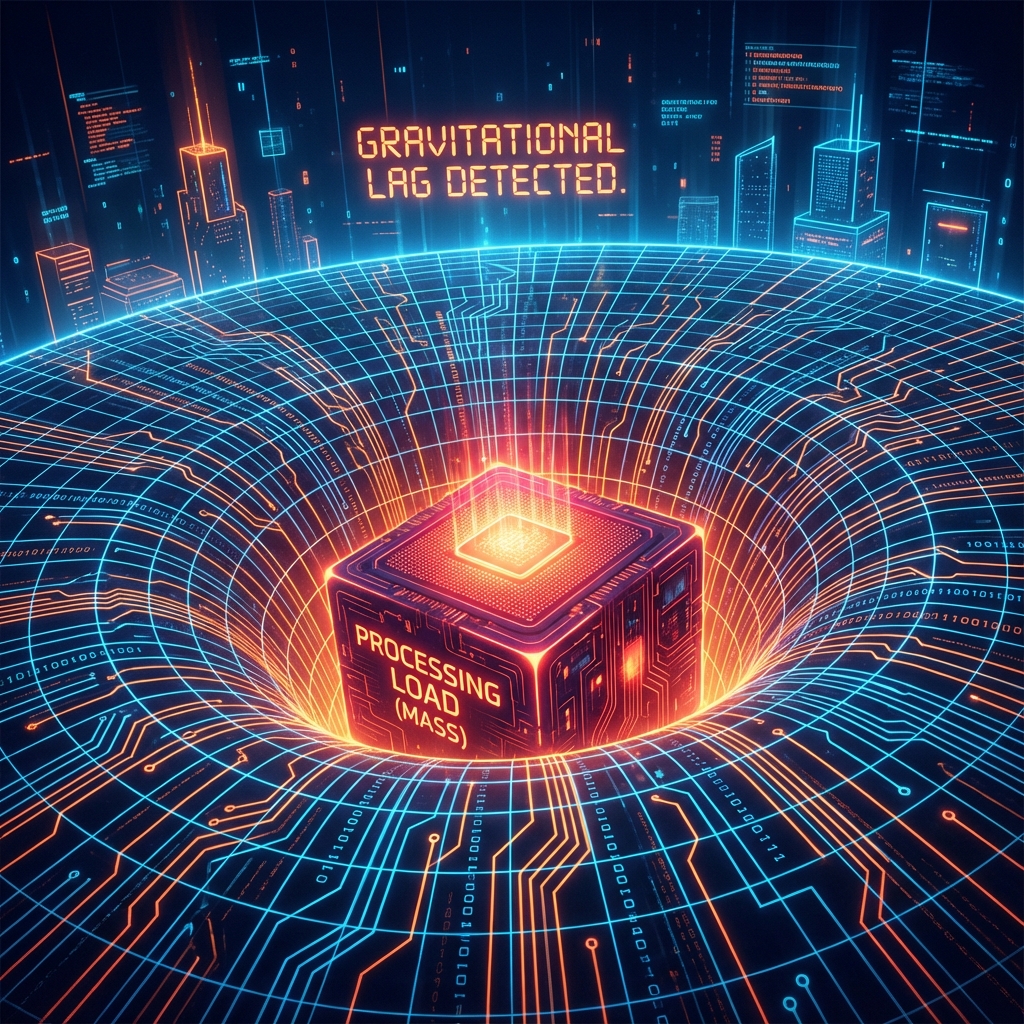
Gravity as Computational Lag: The right-hand side represents local information processing load. When the wave function is highly concentrated in some region (i.e., massive objects), the logical operation demand in that region surges. To maintain total computational complexity minimization (least action), the spacetime grid (hardware) must deform to increase local geometric connectivity, or reduce local time flow rate (time dilation), thereby alleviating processing pressure. Spacetime curvature is a throttling mechanism the system adopts to avoid “processor overheating.”
-
Dynamic Dark Energy: The on the left-hand side is no longer an artificially added constant but a geometric tension caused by deviation from the golden evolution trajectory. On large-scale cosmic averages, local matter density is diluted, with the main contribution coming from the Fibonacci growth target of the background field.
This shows that the “dark energy” driving cosmic accelerated expansion is essentially Spatial Accretion Pressure forced by the holographic network to satisfy the golden ratio growth rule. If the universe stops expanding, due to the existence of , the system’s action will tend to infinity. Therefore, expansion is a geometric rigidity requirement of the computational system.
- Return of Mach’s Principle: Since both and are holographically defined global variables (depending on total bit count), the local inertial frame structure is actually instantaneously determined by the entire universe’s matter distribution through this equation. The Omega field equations mathematically realize strong Mach’s principle: no matter, no geometry; no computation, no spacetime.
Theorem 5.2 (Classical Limit): In the weak field () and low energy () limits, the Omega field equations reduce to the standard Einstein field equations with cosmological constant. This ensures that this theory passes all known solar system gravitational experimental tests (such as Mercury’s perihelion precession and light deflection).
Through this derivation, we have proven that general relativity is not the ultimate truth of physics but the equation of state exhibited by interactive computational systems in the thermodynamic limit. Gravity is not a fundamental force; it is the elastic response of the spacetime network to information flow.