3.2 Lorentz Covariance of Quasicrystals
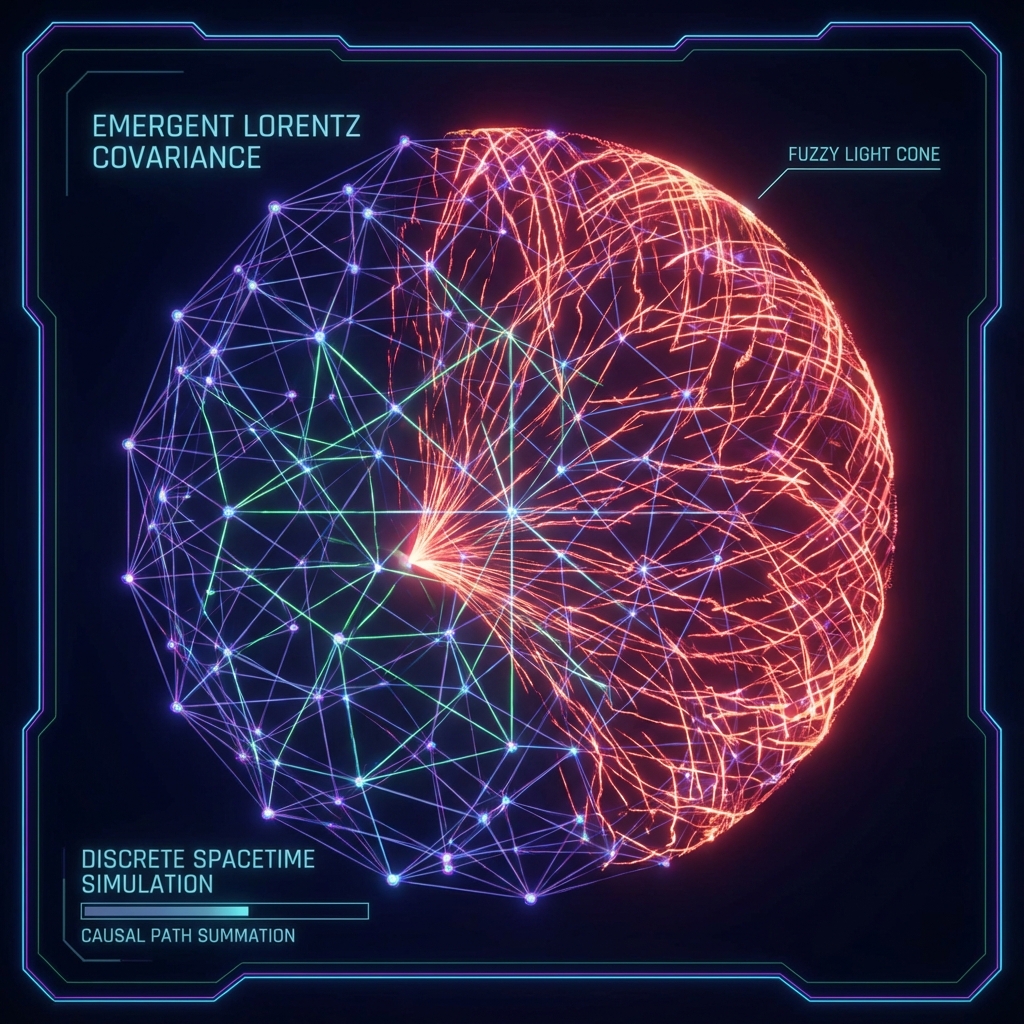
When constructing discrete spacetime models, the greatest theoretical obstacle physicists face has always been the violation of Lorentz Invariance. For any regular periodic lattice (such as cubic lattices), their geometric structure explicitly breaks continuous rotational symmetry and Lorentz boost symmetry . In cubic grids, the speed of information propagation along axes differs significantly from that along diagonals (i.e., anisotropy), causing light cones derived from discrete models to appear “square-shaped” rather than conical, which severely conflicts with the Michelson-Morley experiment and the experimental foundation of special relativity.
This section will prove that the Penrose-Fibonacci Quasicrystal structure adopted by Omega Theory, by virtue of its unique aperiodicity and high-order rotational symmetry, can naturally emerge statistical isotropy in the macroscopic limit, thereby restoring Lorentz covariance.
3.2.1 The Lattice Anisotropy Problem
Consider a periodic hypercubic lattice in -dimensional Euclidean space. A massless scalar field defined on it follows a discrete wave equation. Its dispersion relation (relationship between energy and momentum ) is typically expanded in the low-momentum limit as:
where the term represents Lorentz-violating corrections. For periodic lattices, is typically a non-zero large value, meaning high-energy photons’ speeds depend on their flight direction. Eliminating this effect usually requires extremely fine manual tuning or assuming the lattice spacing occurs in some smooth manner.
However, for networks composed of Omega cells, their geometric symmetry is controlled by the icosahedral group (in 3D projections) or the Coxeter group (in 4D). These point groups contain 5-fold or higher-order rotation axes, which are mathematically incompatible with periodic translational symmetry (crystallographic restriction theorem). It is precisely this “incompatibility” that saves relativity.
3.2.2 Dense Distribution of Vector Stars
The skeleton of the Omega network is composed of a set of basis vectors and their linear combinations. In dimensional Penrose tilings, these basis vectors point to the vertices of a regular icosahedron. Unlike cubic lattices with only 3 orthogonal basis vectors, icosahedral quasicrystals have 6 (or more, depending on projection dimension) basis vectors, and they are distributed more uniformly on the unit sphere.
Definition 3.2 (Vector Star): Let be the set of all possible unit bond vectors in the spacetime grid. For periodic lattices, is finite and sparse. For quasicrystals, due to their aperiodicity, local configurations continuously vary in space, causing the orientations of effective bond vectors to cover the entire solid angle in long-range statistics.
Theorem 3.1 (Quasicrystal Isotropy Theorem): Let be a quasicrystal lattice generated by high-dimensional hypercubes through irrational projection. The discrete Laplacian operator defined on has a spherically symmetric eigenvalue spectrum in the long-wavelength limit (). That is, the dispersion relation satisfies:
where the upper bound of the anisotropy correction term decays exponentially with increasing projection dimension.
Proof Outline:
- Projection operator: Lattice point positions in quasicrystals can be expressed as projections of high-dimensional lattice points onto physical space .
- Summation rules: Computing wave propagation operators on lattices involves summing over all adjacent edges : .
- Group-theoretic identities: For the icosahedral group (or higher-order groups), the following tensor identities exist:
This means that up to fourth-order tensors, quasicrystal geometric structures behave like continuous isotropic media. In contrast, cubic lattices are isotropic at second-order tensors (diffusion tensor) but necessarily exhibit anisotropy at fourth-order tensors (elastic tensor or higher-order dispersion). 4. Conclusion: Since Omega cells are based on 4D 8D projections, their high-order symmetry ensures that Lorentz-violating terms are extremely suppressed, making the speed of light effectively constant in all directions.
3.2.3 Fuzzy Light Cones and Statistical Lorentz Group
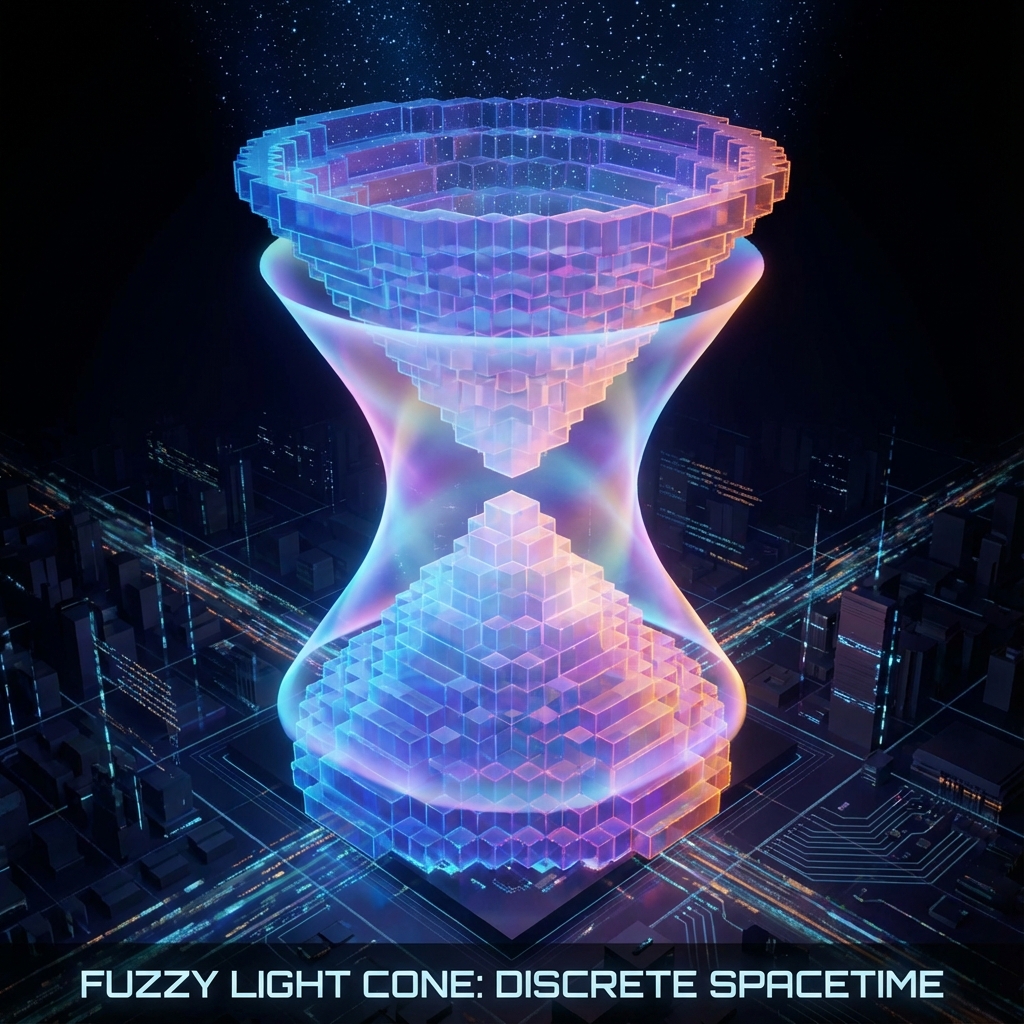
In discrete spacetime, we cannot define perfect continuous Lorentz transformations , as this would map a lattice point to a non-lattice position. However, we can restore Lorentz covariance in a statistical sense.
We introduce the concept of Causal Path Summation. The amplitude for a particle propagating from point to point is the weighted sum of all lightlike paths in the network connecting and . In the Omega network, due to the “irrationality” of path selection (Fibonacci branching), there is no single main path. This Multipath Interference effect causes microscopic lattice effects to be averaged out.
The “light cone” seen by macroscopic observers is actually the Envelope of countless microscopic zigzag paths.
- For cubic lattices: The envelope is an octahedron (Manhattan distance unit sphere).
- For Omega quasicrystals: The envelope is a nearly perfect sphere (Euclidean distance unit sphere).
Therefore, Lorentz symmetry in Omega Theory is not a microscopic exact symmetry but an Emergent Symmetry. It is only effective when energy is far below the Planck scale (). This provides the theoretical foundation for high-energy photon dispersion experiments discussed in Part IV: if tiny anisotropies of extremely high-energy gamma rays can be detected, that would be direct evidence of quasicrystal spacetime.