1.3 Holographic Encoding of Information
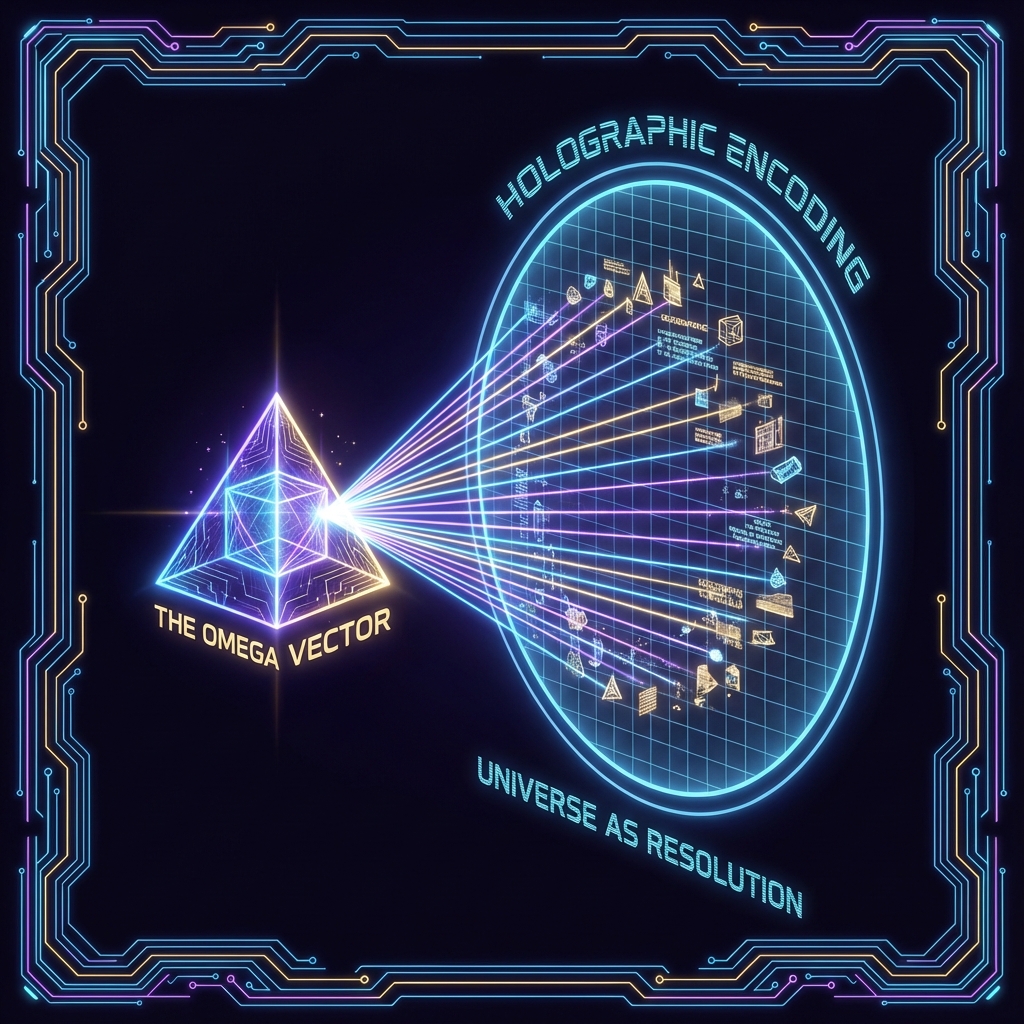
In the previous sections, we defined the universe as a single static vector in Hilbert space and demonstrated that its evolution is an ergodic process driven by the golden unitary operator. Although this axiomatic system is mathematically self-consistent, it immediately raises a core physical puzzle: how can a static, normalized vector (with constant modulus 1) describe a macroscopic universe that appears to contain extremely rich structures and whose information content seems to grow exponentially with time (expansion)?
This section will establish the holographic dual mechanism of Omega Theory. We will prove that abstract vectors in Hilbert space can be encoded as geometric information on low-dimensional holographic boundaries through a specific Spectral Mapping. This mechanism not only explains the emergence of physical entities but also derives the microscopic origin of Bekenstein-Hawking entropy.
1.3.1 Unitarity as the Highest Form of Information Conservation
In standard quantum mechanics, probability current conservation of state vectors is guaranteed by unitarity:
This means the total probability (or total existence) of the universal universe remains constant at 1. In Omega Theory, we elevate this mathematical property to the “Ontological Information Conservation Law”.
However, the physical universe we observe (phenomenal realm) is not the entirety of but its projection distribution onto a specific basis. Let be expanded on the eigenbasis of the Fibonacci Hamiltonian :
where is the occupation probability of the -th eigenstate (real number, with ), and is the phase rotating with time.
Here exists a profound duality:
- Amplitudes : are static. They encode the universe’s “initial code” or “intrinsic weights”. This corresponds to invariants in the octonion algebra structure.
- Phases : are dynamic. They rotate rapidly with intrinsic time .
We propose that “information” in the macroscopic physical world does not come from changes in (which is forbidden) but from the Relative Coherence between phases .
1.3.2 The Holographic Sieve and Geometric Emergence
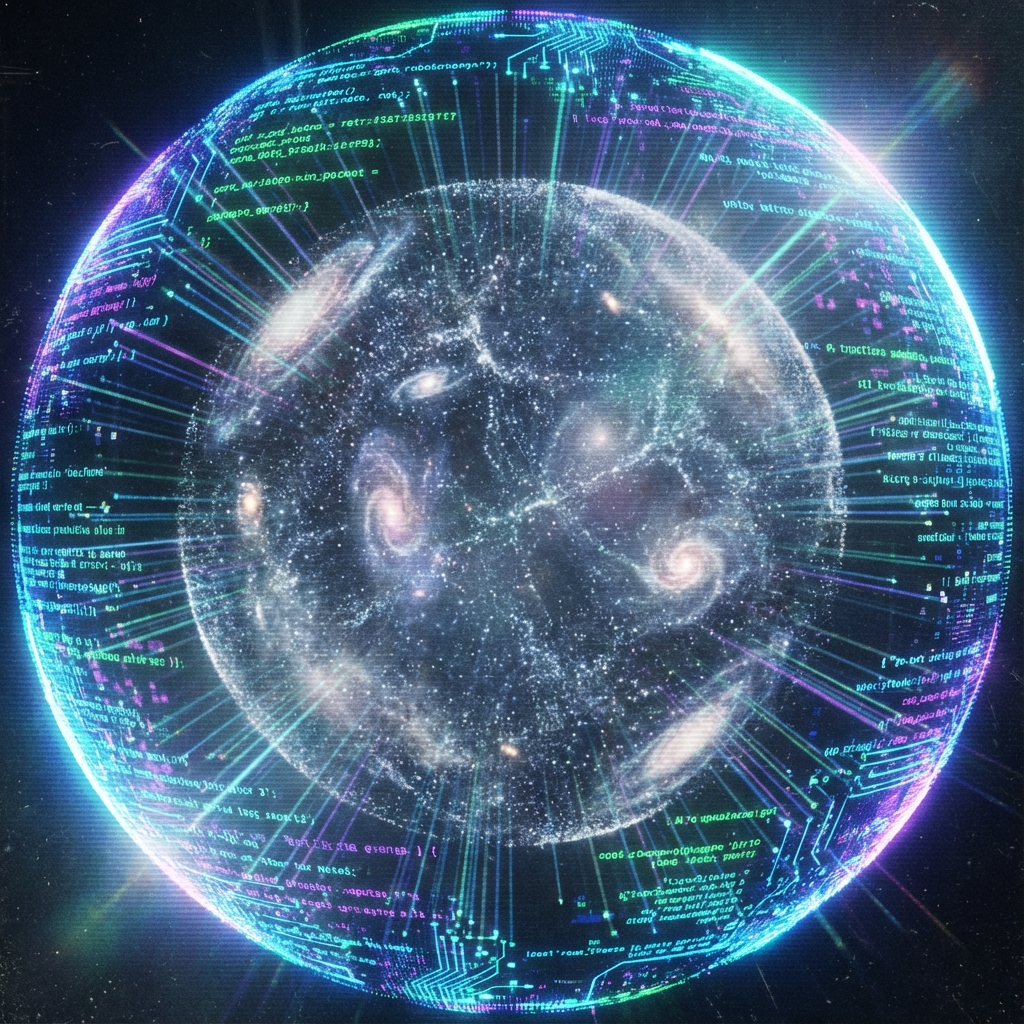
To transform spectral data from Hilbert space into spacetime geometry, we need to introduce the concept of the “Holographic Sieve”.
We define the holographic boundary as a two-dimensional complex manifold (physically corresponding to the spatial slice we observe). Basis vectors correspond to an “Omega Pixel” or “bit” on this boundary.
Definition 1.1 (Holographic Mapping ): The holographic mapping is a functional that maps eigenstates of Hilbert space to Area Elements on the boundary manifold. For any moment , the macroscopically observable geometric structure is determined by those basis subsets that are Phase Aligned.
Specifically, according to the principle of constructive interference, only when the phase difference of a group of basis vectors can they “crystallize” stable geometric connections on the holographic screen. This is the essence of matter and spacetime structure: they are interference fringes of instantaneously synchronized phases in Hilbert space.
1.3.3 Theorem 1.3: Isomorphism Between Geometric Entropy and Shannon Entropy
Now we can derive the core theorem of this section, which establishes a bridge between abstract information theory and concrete spacetime geometry.
Consider the set of pixels in an “active” state (i.e., participating in geometric construction) on the holographic screen at moment . The information content of this set is given by Shannon Entropy:
In general relativity, the entropy of black holes or cosmic horizons is given by the Bekenstein-Hawking formula:
where is the geometric area.
Omega Theory asserts that these two entropies are essentially different expressions of the same physical quantity.
Theorem 1.3 (Holographic Isomorphism Theorem): Let the universal state vector evolve under the golden unitary operator. If we define the geometric area of the holographic boundary as the sum of area elements corresponding to all phase-activated states , then:
where is a geometric constant depending on the spacetime discretization scheme (usually taken as ).
Proof Outline:
- Discretization: According to Chapter 1, space consists of discrete Omega units (causal diamonds). Each unit contributes one bit of freedom.
- Equal Probability Assumption: Under the maximum entropy principle, activated pixels have equal microscopic prior probability , where is the total number of pixels within the current horizon.
- Expansion:
On the other hand, geometric area is proportional to the number of pixels:
- Combining:
This shows that what we perceive as “geometric area expansion” (cosmic expansion) is microscopically equivalent to an increase in the number of activated, phase-aligned basis vectors in Hilbert space.
1.3.4 Physical Meaning: Why Does Information Appear to Proliferate?
This resolves the initial contradiction: is static, so why is the universe expanding?
The answer lies in the resolution of decoding. The static vector is like a holographic plate compressed to the bottom layer, containing all information of past and future. The golden unitary evolution is like a reference beam scanning this plate. Due to the self-similar fractal nature of , as increases, this beam scans the plate with exponentially increasing resolution. What we see as “information proliferation” or “entropy increase” is actually an increase in the effective number of bits we (observers) read.
The universe never grows larger; it is our Resolution of the universe that increases. This is precisely the essence of “interactive computation”: existence is eternal, but experience is generated.