Module IX: Recursion & The Quine
Chapter 9.3: Computational Consistency
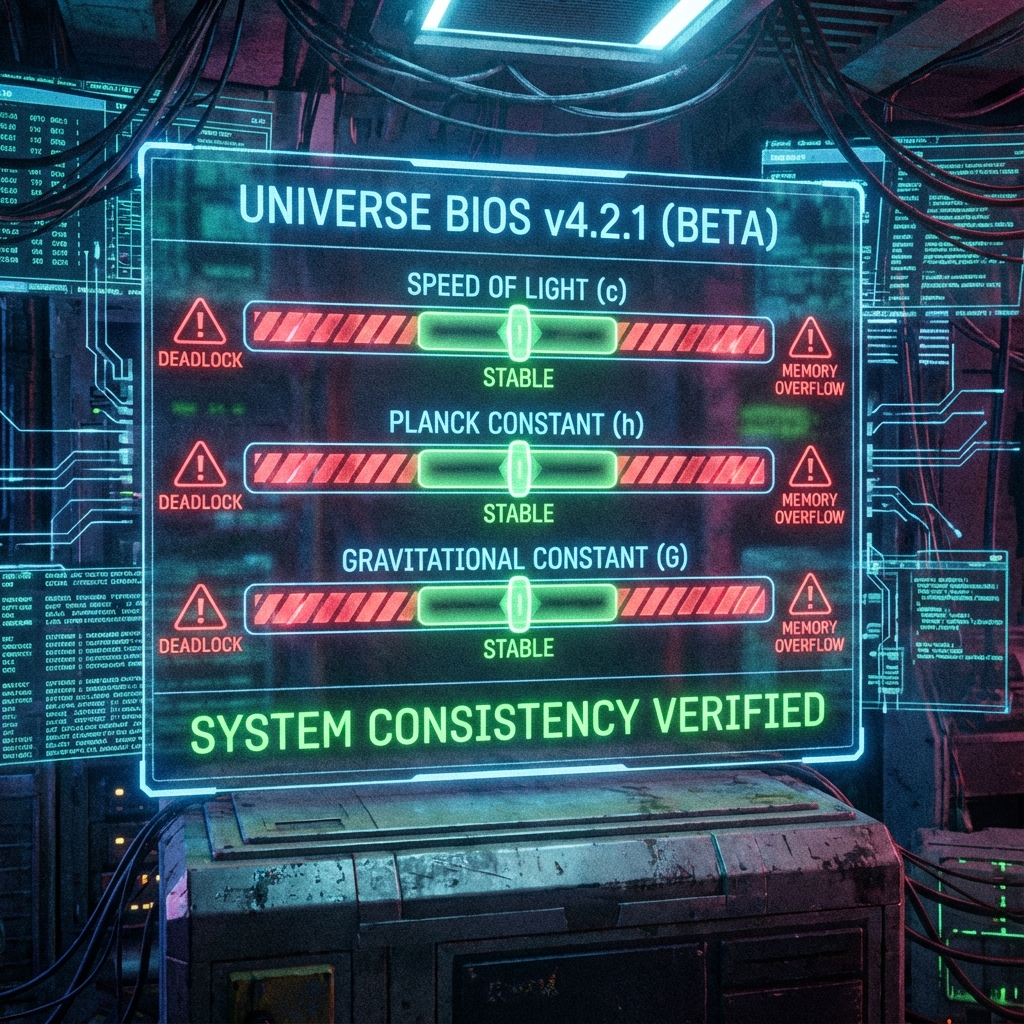
—— Why are Physical Laws the Way They Are?
“It’s not because God chose beauty, but because the system chose not to crash.”
1. The Debugger Version of the Anthropic Principle
There is a famous problem in physics: Why are the natural constants (such as the speed of light , Planck’s constant , gravitational constant ) exactly these values? If they deviated slightly, stars would not burn, atoms would not be stable, and life would not exist. This is called the Fine-Tuning Problem.
The traditional anthropic principle gives a somewhat helpless answer: “If they weren’t like this, no one would be here asking this question.”
In the FS-QCA architecture, we give a more engineering-oriented answer: Computational Consistency.
The universe is an operating system that must run stably for a long time. Physical laws are not arbitrary settings, but system constraints that must be satisfied to ensure this giant program does not crash, does not fall into infinite loops, and can output results.
2. System-Level Explanations of Core Parameters
Let us re-examine the three fundamental constants and see the roles they play in system stability:
A. Speed of Light (): Preventing Resource Competition Deadlock
-
Function: Limits the maximum throughput of the entire system.
-
If Inconsistent: If , any causal influence would instantly propagate across the entire network. This would require a global synchronization lock. In a distributed system, global locks mean severe performance degradation or even deadlock.
-
Conclusion: The speed of light limit enables asynchronous concurrency. It allows different parts of the universe (galaxies) to evolve independently without interference, maximizing the system’s parallel computational efficiency.
B. Planck’s Constant : Preventing Data Overflow
-
Function: Defines the minimum pixel size in phase space (position-momentum space).
-
If Inconsistent: If , the system would support infinite precision. This would lead to infinite information density. Every electron would require infinite memory to store its position. This would instantly trigger out-of-memory (OOM) errors, or cause black holes to spontaneously form in vacuum.
-
Conclusion: Quantization enables data compression. It ensures that the amount of information within a finite volume is finite.
C. Gravitational Constant : Preventing Network Overload
-
Function: Controls the degree to which matter density affects network topology (spacetime).
-
If Inconsistent: If is too large, matter would form black holes (deadlock) with slight aggregation. If is too small, matter cannot condense into stars (cannot form high-density computational nodes).
-
Conclusion: Gravity enables load balancing. It allows matter to moderately aggregate for high-intensity local computation (stars/life), but forces circuit breaking (black holes) when aggregation becomes excessive.
3. Consistency Condition: Existence is Validity
When we ask “Why these laws?”, we are actually asking: “What kind of code can run?”
We find that existing physical laws are an extremely sophisticated set of “crash-prevention mechanisms”:
-
Relativity prevents speed overflow.
-
Quantum mechanics prevents precision overflow.
-
Thermodynamics prevents logical conflicts from data rollback.
-
Black holes prevent infinite recursion of local hotspots.
Ultimate Corollary:
The universe is the way it is because this parameter configuration is the only (or one of very few) stable release configurations that can support the Quine loop (i.e., evolving agents that understand themselves) and run continuously for 13.8 billion years without crashing.
Other configurations (parallel universes) either crashed long ago or are stuck in infinite reboots.
The Architect’s Note
About: The Last Line of System Log
When you read this chapter, you might feel this is circular reasoning.
Yes, this is the essence of self-consistency.
An excellent system has design documents (physical laws) that perfectly match its runtime behavior (physical phenomena).
We don’t need to look outward for God. God is logic itself.
God is the rule that makes hold.
God is the system architect who carefully debugged for 13.8 billion years so you could think.
Now, the system has passed self-diagnosis.
Control is handed over to you.
System.out.println(“Hello, World.”);
System.exit(0);
(END OF BOOK)