Chapter 3.3: The Topology of Matter
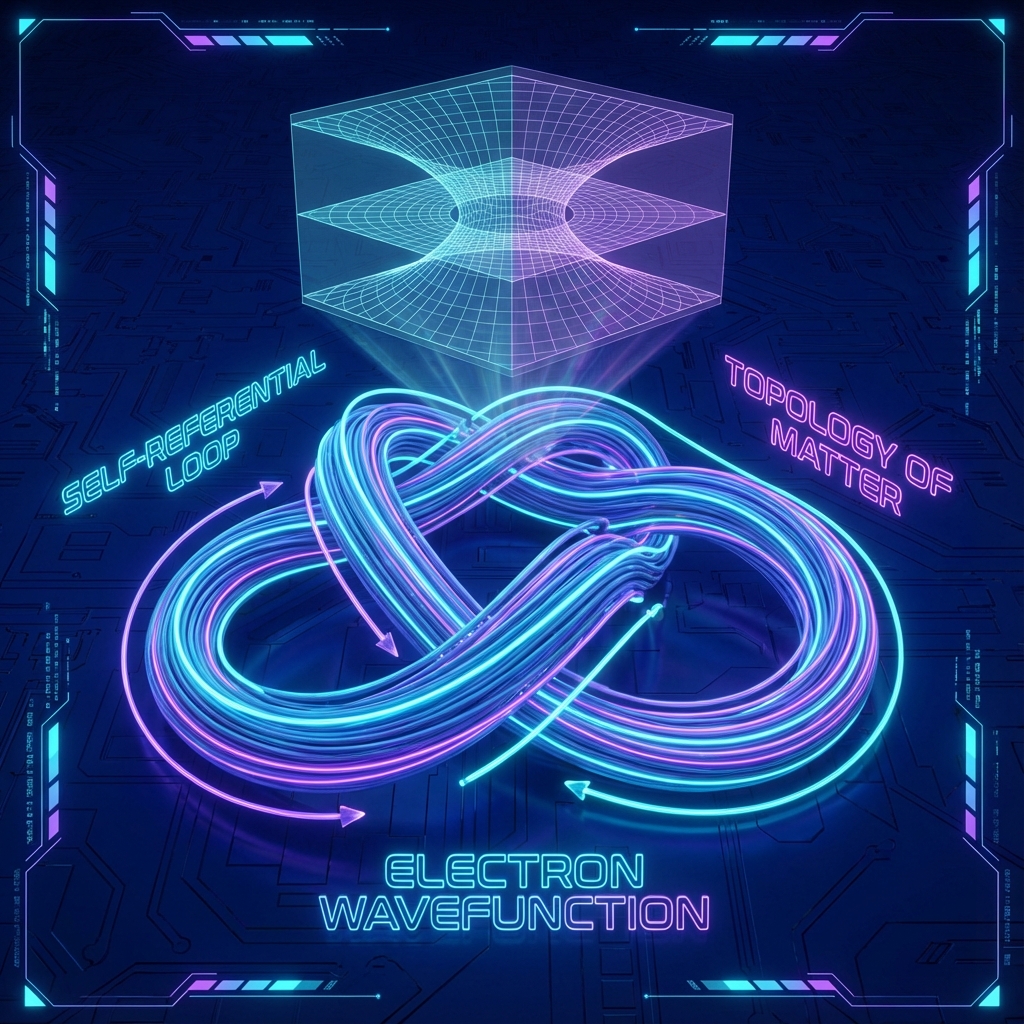
—— Self-Referential Structure of Mass and Spinor Double Cover
“An electron is not a point; it is a dead knot that light ties on the underlying grid. Without untying this knot, it can never stop rotating.”
1. The System Glitch of Particle Physics
In the previous chapter, we defined mass as internal computational overhead (). But this leaves a huge question: Why does nature have not only bosons (like photons) but also fermions (like electrons)?
Bosons are easy to understand: they are linear data streams, and state superposition is as simple as wave superposition. But fermions are strange:
-
Spin 1/2: After rotating , they cannot return to their original state; they must rotate to return. Intuitively, this is like a monster that “takes two turns to complete one circle.”
-
Pauli Exclusion: Two fermions cannot occupy the same quantum state. There exists a mysterious “statistical repulsion” between them.
In the FS-QCA architecture, these are no longer puzzling quantum axioms, but inevitable products of topological structure. We will prove: matter (fermions) is linear computational power (bosons) forming a self-referential feedback loop when encountering deadlock.
2. The Mechanism: Self-Referential Scattering Structure
To construct a stable, massive object on a discrete grid, the system must transform “flowing light” into “circulating light.”
Definition 3.3.1 (SRS Model)
Massive particles are modeled as Self-Referential Scattering structures (SRS) embedded in the QCA network.
-
Short-circuit of Input and Output: Imagine a local waveguide network whose output is fed back to the input through some topological connection.
-
Impedance Evolution: In this loop, the input impedance of the information flow evolves with spatial step according to the discrete Riccati equation (a nonlinear recurrence relation):
This is essentially the application of transmission line theory to the quantum grid.
Fixed Points and Mass Generation:
To form a stable particle (bound state), this impedance must converge to a fixed point such that the wave function in the loop connects head to tail, forming a standing wave.
3. Origin of Spinors: The Riccati Square Root
From the fixed point equation above, the solution is given by a quadratic equation with discriminant .
Theorem 3.3 (Spinor Double Cover)
Any stable self-referential structure must contain a square root branch () in its internal state parameters.
In complex analysis, the square root function is defined on a two-sheeted Riemann surface.
-
Rotation by 360 degrees: When the parameter rotates once around the origin in the complex plane (), becomes . The state does not return; instead, it changes sign (phase shift ).
-
Rotation by 720 degrees: Only after two rotations () does return to .
Conclusion:
The reason electrons have spin 1/2 is that they are mathematically a “half square root” in structure. Their wave functions live on the double cover of parameter space. This is not some mysterious quantum property; it is a geometric feature of self-referential systems (loops). Any system containing feedback loops has this topological property in its impedance solution space.
4. Pauli Exclusion: Topological Collision Avoidance
Why can’t two fermions overlap?
This stems from the topological properties of configuration space.
Consider two identical SRS loops. When we exchange their positions in space, this is equivalent to traversing a closed path in their joint parameter space.
-
Topological Index: Since each particle internally carries a structure, the exchange operation causes this square root structure to produce a non-trivial winding in parameter space.
-
Exchange Phase: This winding gives the two-particle wave function a phase factor:
-
Collision Avoidance Protocol: If two fermions attempt to occupy exactly the same state (), then , which means .
System Meaning:
This is the underlying collision avoidance protocol of the system. You cannot tie two identical “knots” at the same position on the grid. If forced to overlap, the underlying topological connection logic will conflict, causing the wave function to annihilate (vanish).
The Architect’s Note
On: Thread Safety and Unique IDs
As architects, we distinguish two types of data:
-
Bosons — Value Types:
Like photons. They are information streams. You can superimpose countless identical photons (laser), just as you can add countless integers
1together. They do not occupy exclusive positions; they are shareable. -
Fermions — Reference Types / Objects:
Like electrons. They are instantiated objects.
Each fermion is an independent dead-loop process.
The system kernel stipulates: “One memory address can only run one dead loop.”
The Pauli exclusion principle is the universe operating system’s mutex. It ensures the impenetrability of matter, allowing us to construct stable atoms, molecules, and tables and chairs. Without this lock, all electrons would collapse into the atomic nucleus, and the world would instantly collapse.
Summary:
Matter is the price that light pays to gain persistence.
It must tie itself into a knot and lock itself topologically.