Preface: The Architect’s Manifesto
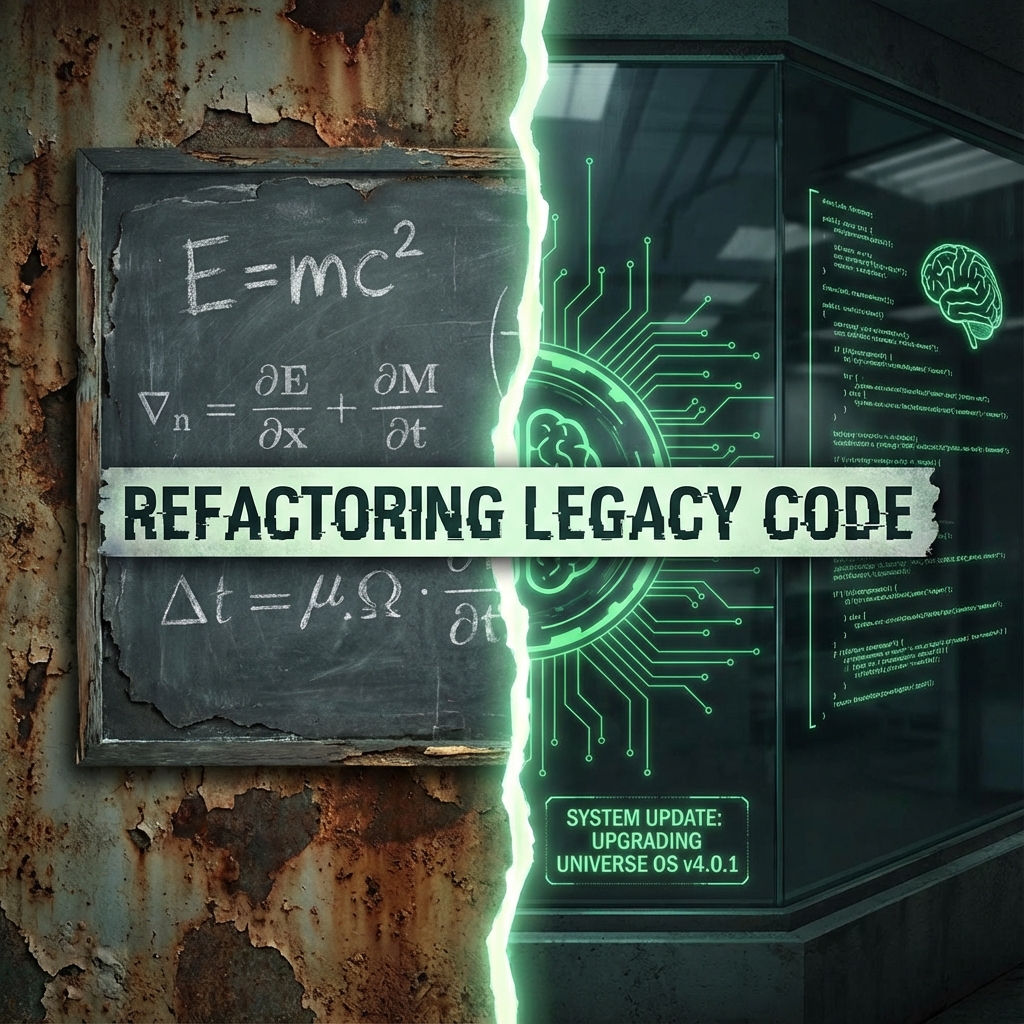
“Physics is no longer a grand edifice, but a pile of unmaintained legacy code. We need refactoring.”
0.0.1 Technical Debt in Physics: Why We Need Refactoring
As observers examining theoretical physics at the dawn of the 21st century, we see not elegance and simplicity, but heavy technical debt.
General Relativity and Quantum Mechanics—these two foundational theories are like system modules written by different teams, in different eras, using completely different programming languages. The former is based on smooth manifold geometry, using the language of continuous calculus; the latter is based on discrete Hilbert spaces, using linear algebra and operator language.
To make these two modules work together (unified field theory), physicists have spent nearly a century writing “adapters” and “patches.” From string theory’s higher-dimensional branes to loop quantum gravity’s spin networks, these attempts, though ingenious, are essentially trying to mask fundamental architectural incompatibilities. Each patch introduces new parameters, new assumptions, and the dreaded “infinity”—in software engineering, this is equivalent to unhandled exceptions or memory overflow.
If the universe is a software system, its current codebase is bloated, filled with “spaghetti code.”
The motivation for this book is not to add another patch to this codebase, but to perform a thorough refactoring. We will discard historical baggage, stop trying to reconcile the surface contradictions between “curved spacetime” and “wave function collapse,” and instead dig deeper to find the underlying kernel that can support both.
Our tools are no longer complex Lagrangians or Feynman diagrams, but the purest systems architecture thinking:
- Bandwidth replaces the speed of light.
- Latency replaces causality.
- Discrete Grid replaces continuous manifolds.
- Resource Scheduling replaces dynamical equations.
0.0.2 The Representational Stance: Agnosticism and Interface Programming
Before refactoring, we must establish the core philosophical position of this book—The Representational Stance.
Traditional physicists often fall into the obsession of “ontology”: What is an electron really? Is it “really” a wave or a particle? Has space “really” curved?
For systems architects, these questions are meaningless.
In computer science, we never care about which doping process the underlying transistors use; we only care about the interfaces and protocols they expose.
- If an object behaves like a particle (responding to position measurements), it is a particle.
- If it behaves like a wave (responding to interference measurements), it is a wave.
- If its behavior satisfies the interface specification of , we don’t need to care about its underlying “essence.”
This book adopts radical agnosticism:
We acknowledge that the universe’s source code—the ultimate ontology running below the Planck scale—is invisible (private/inaccessible) to us. The physical laws we can access are actually projections we obtain by probing this black box with mathematical tools.
Therefore, the Fubini-Study geometry in this book does not claim to be the “truth” of the universe, but rather a driver we designed to interact with the universe’s black box. Its superiority lies not in being more “true,” but in being more robust—it can, with minimal code (fewest axioms), be compatible with the widest range of hardware behaviors (physical phenomena).
0.0.3 How to Read This Documentation
This book 《The Matrix: Source Code of the Universe》 is not an ordinary popular science book; it is a technical documentation.
The book adopts a dual-layer narrative structure:
-
Kernel Layer:
The opening section of each chapter contains rigorous mathematical derivations. We use rigorous projective geometry, functional analysis, and operator theory to derive the mathematical forms of physical laws. This section requires readers to have a solid foundation in mathematical physics. There is no hand-waving here, only theorems and proofs.
-
Architecture Layer:
After the mathematical derivations, you will see “The Architect’s Note”. This is the soul of the book. We translate mathematical formulas into systems engineering language. We explain why Parseval’s identity is resource competition, why time dilation is CPU throttling, why black hole horizons are traffic congestion.
Reading Recommendations:
-
For Physicists: Focus on the kernel sections of Part A. You will find that many long-troubling physical puzzles (such as the origin of time, quantum speed limits, UV divergences) become obvious in the Fubini-Study geometric framework.
-
For Engineers and Hackers: Focus on the Architect’s Notes. You will find that physics is no longer unreachable theology, but systems design problems you deal with every day. You will see how the universe handles concurrency, synchronization, caching, and garbage collection.
-
For Explorers: Part B of this book is an open module. This is the Beta Testing Zone, full of experimental ideas (DLC). We encourage you to fork this documentation and submit your Pull Requests.
Now, let us initiate the boot sequence and load Volume Zero: Ontology and Axioms.
System Boot Sequence Initiated…
Loading Kernel: Fubini-Study Metric… [OK]
Checking Capacity Constraints… [OK]
Welcome to the Real World.