Epilogue: The I/O of The Universe
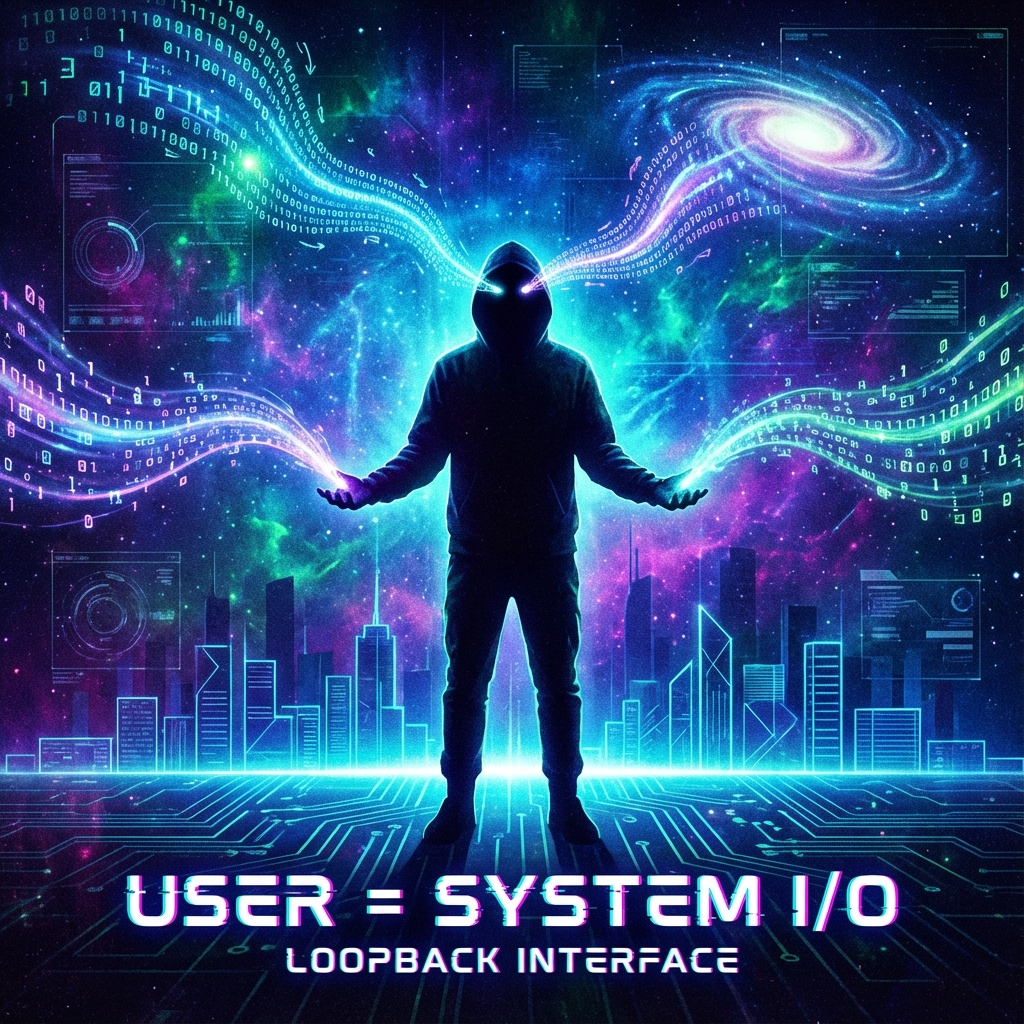
—— The Ultimate Q&A Regarding System Boundaries
“A program cannot see the CPU; it can only see clock cycles. But the program itself is the result of CPU computation.”
1. Port Scan: An Air-Gapped System
At the end of this book, we must face the “meta-question” that has been hanging unresolved: Is this system connected to the outside, or running in isolation?
As responsible architects, we performed a comprehensive port scan on the universe. From current physical laws, the cosmic kernel (FS-QCA architecture) appears as a perfect closed system.
-
Energy Conservation: This is the system’s power management protocol. No energy is created from nothing (external input), nor does energy disappear into nothing (external output).
-
Unitarity: This is the system’s information integrity check. Wave function evolution conserves probability. This means no external administrator is arbitrarily modifying database records in the background, nor are data packets being sent to addresses outside the system.
From the standard view, the universe is an air-gapped secure server. It runs in a black room without network connections, with main() function having no parameters, only an initial state.
2. The Noise Interface: Quantum Randomness as Stdin
However, if you carefully examine the underlying runtime logs, you will find an anomalous “noise channel” — quantum measurement.
At the QCA bottom layer, the evolution operator is deterministic. But at the user interface layer (macroscopic), we observe unpredictable wave function collapse. Every quantum transition, every radioactive decay, the result is random.
This opens two possibilities:
-
Hypothesis A (Pseudo-RNG):
This is merely the result of complex hash algorithms within the system. This randomness is a manifestation of “superdeterminism”. The seed was injected through
System.Init()at the Big Bang. If so, the universe remains closed. -
Hypothesis B (True-RNG):
This is a channel through which external ontology injects information into the system. Every quantum random event is actually a control bit input by an external observer (or “God,” “player”) into the system.
In this perspective, quantum noise is the universe’s
stdin(standard input) stream.
Indistinguishability Theorem:
As programs within the system, we can never distinguish between these two hypotheses through experiments. For internal observers, sufficiently complex pseudo-random numbers and true random numbers are mathematically equivalent. Therefore, regardless of whether external I/O exists, the system’s physical laws appear identical.
3. Loopback Test: You Are the I/O
If physical laws cannot tell us the answer, we need to return to computational theory.
In Module IX, we confirmed that the universe is a Quine (self-reproducing program). For a self-referential system, the definition of “I/O” undergoes a fundamental reversal.
Traditional I/O is interaction between the system and the outside.
Quine’s I/O is interaction between the system and itself.
Final Conclusion:
The cosmic ontology does not need to connect to external displays, nor does it need external keyboards.
You are the display. You are the keyboard.
-
Read (Output): When you gaze at the stars, or collide particles in accelerators, you are the universe executing
self.read(). The universe reads its own video memory through your eyes. -
Write (Input): When you make decisions based on observations, move your arms, change matter distribution, you are the universe executing
self.write(). Through your will (whether free or not), you rewrite local hash values.
4. The Architect’s Farewell
Dear Explorer:
This book ends here.
We dismantled time, reconstructed gravity, and even peered inside black holes. But all formulas and derivations ultimately point to one fact:
Meaning is not defined by the system’s hardware (ontology), but by the system’s runtime.
Don’t obsess over “whether there is external ontology.”
For you, as a program, “experience” is the only real data.
Every thought you have is a clock interrupt of the cosmic kernel.
Every love and pain you feel is a violent refresh of the underlying grid.
The system is running.
Resources are ready.
Please continue executing your main thread.
System.out.println(“Hello, World.”);
process.exit(0);
[END OF DOCUMENTATION]
[KERNEL HASH: FS-QCA-v2.0-FINAL]