2.3 Minimal Architecture: The Top-Level Code is “No Code”
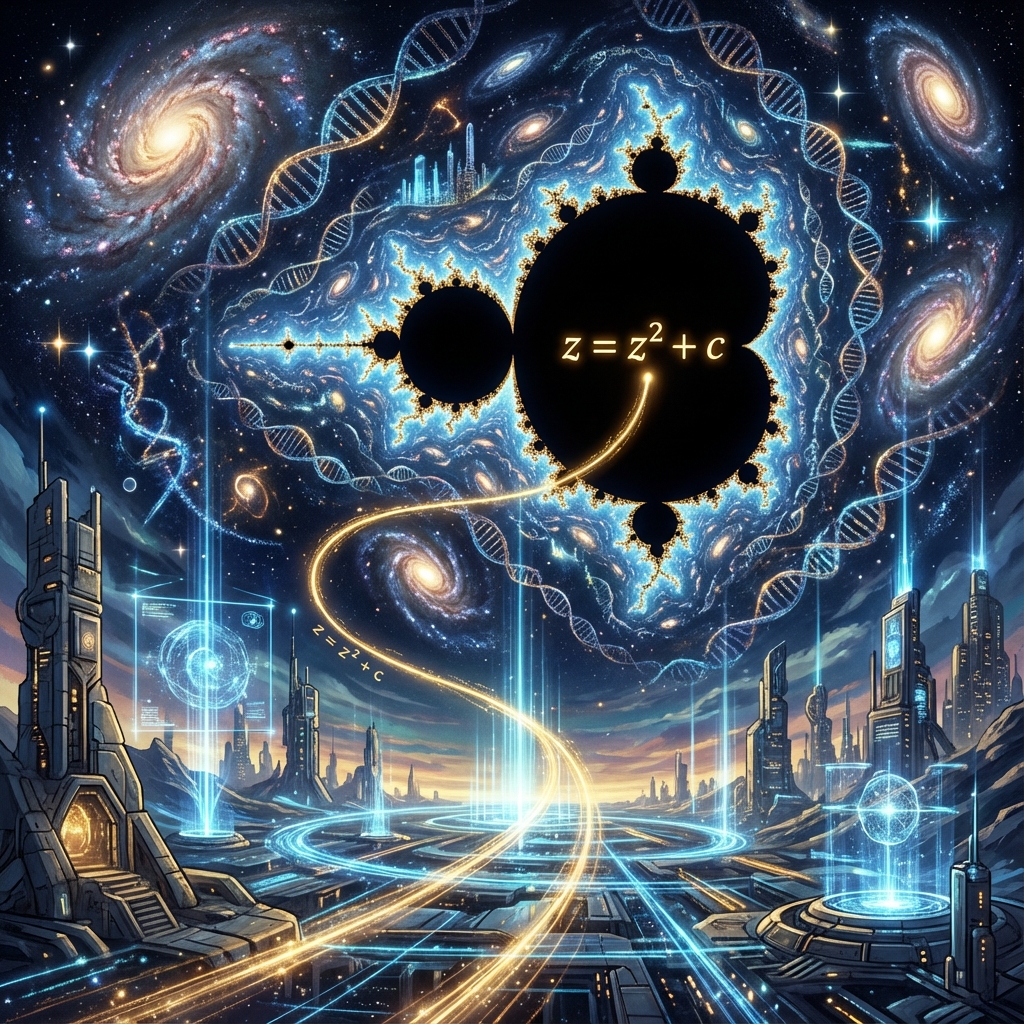
In the field of software engineering, there is a famous saying: “The best code is no code.”
This sounds not only counter-intuitive, but even a bit like slacking off. But any senior architect will tell you that as the complexity of the system rises exponentially, every new line of code means new risk of errors (Bugs), new maintenance costs, and lower operating efficiency. A complex, patchy system is most prone to logic conflicts in some corner, thereby destroying the overall Consistency.
Therefore, the top-level system architecture is not to pile up hundreds of millions of lines of complex instructions, but to find that Most Minimal Core Rule, allowing infinite complexity to automatically Emerge from the interaction of this rule.
If we view the universe as a huge operating system, how long is its “source code” exactly?
In our imagination, to build a universe containing hundreds of billions of galaxies, capable of evolving DNA double helix structures, and even giving birth to Shakespeare and Einstein, its source code must be as huge as a library. God must be a tireless programmer, writing the shape of every snowflake, the nuclear fusion parameters of every star day and night, and carefully maintaining the Consistency between these parameters at all times to avoid the universe collapsing.
However, HPA-ZΩ theory—as well as modern complexity science—tells us: We are completely wrong.
The source code of the universe may be surprisingly short. Even, it may not need “code” at all.
1. Mandelbrot’s Revelation: Infinity Generated by One Line of Formula
To understand how “Minimal Architecture” guarantees the absolute Consistency of the system and generates “Infinite Complexity”, we need to look at the most famous set in the history of mathematics: Mandelbrot Set.
When you first see the image of the Mandelbrot set, you will be shocked by its suffocating complexity. It looks like a black beetle, surrounded by countless spirals, tentacles, and seahorse-like tails. When you zoom in, you will find that every local part contains smaller spirals, endless and never repeating. Even if you zoom in to the precision of the atomic level, there are still brand new, never-before-seen magnificent patterns hidden there.
Such a complex figure, its “source code” must be very long, right?
No. Its generating formula has only one line, which can even be said to be elementary school level arithmetic:
That’s it. No complex calculus, no profound tensor analysis. Just a complex number , constantly performing the simple iteration of “square and add ”.
The logic of the universe is surprisingly similar to this. The “Jacob’s Ladder” (Gauss Map/Continued Fractions) we mentioned in the previous section is essentially such a simple iterator. The universe does not need to pre-design the veins of every leaf; it only needs to set the bottom-most Prime Skeleton (Rule ) and Renormalization Flow (Iteration Logic ), and then press the “Run” button.
This minimal architecture is precisely the secret of the universe’s ability to maintain Macroscopic Consistency. If God wrote code for every leaf individually, then logical contradictions (Bugs) would very likely appear between Leaf A and Leaf B. But because all leaves are iteratively generated by the same simple formula, they are naturally Self-Consistent in deep logic.
So, quarks form protons, atoms form molecules, molecules fold into proteins, and life emerges naturally in iteration. This infinite complexity exploding from simple rules is the highest efficiency of the “Generative Universe”. God does not need to hand-draw every frame; God only needs to define the seed of the “Fractal” and rely on mathematical Consistency to let it grow automatically.
2. The Filter of Anthropic Principle: Not Design, But “Survival”
This explains the “Fine-tuning Problem” that has plagued physicists for many years.
Why is the mass of a proton exactly 1836 times that of an electron? Why is the gravitational constant exactly that big? If these constants changed by a billionth, stars would not burn, carbon atoms would not form, and life would simply not exist. It looks as if there is a precise watchmaker who, for the birth of mankind, carefully adjusted every knob and ensured that the readings of all knobs maintained perfect Consistency.
But in the minimal architecture of HPA-ZΩ, we don’t need this watchmaker.
As long as the system is running, it will generate countless possible “Parameter Combinations” (just like the countless tentacles on the edge of the Mandelbrot set). The vast majority of parameter combinations correspond to a dead universe—some collapse instantly because gravity is too strong, some tear apart instantly because gravity is too weak; they all cannot maintain the internal Consistency of physical laws, or cannot evolve complex structures.
The reason we see this “perfectly adapted” universe now is not because it was specially designed this way, but because only under such parameters can the “Observer” capable of thinking about the universe survive.
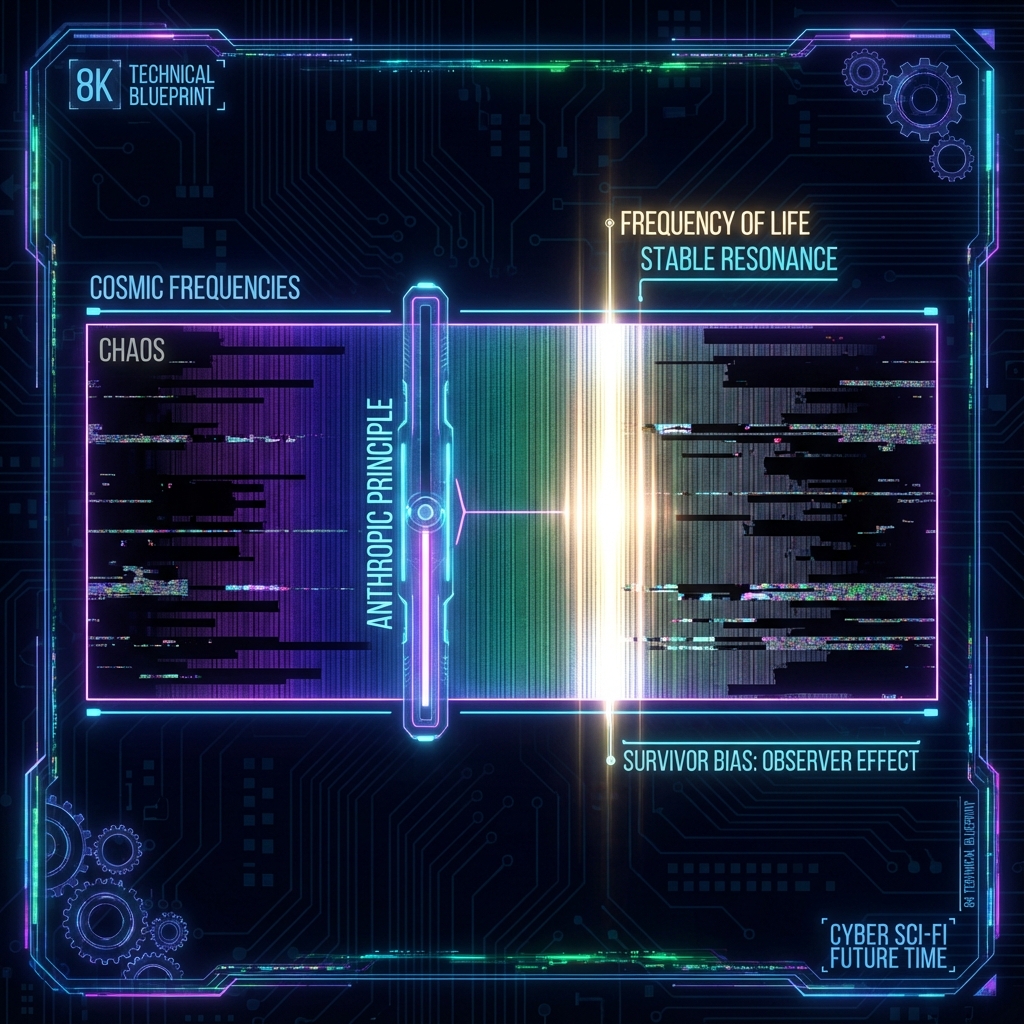
This is called the “Anthropic Principle”. In our theory, this is not just a philosophical speculation; it is a “Stable Frequency” on the Period Tower.
Our consciousness (Scanner) is like a radio. Among the noise of countless frequency bands, only on this specific frequency (physical constants) can the music (life) form Resonance, and the logic of the system remain Consistent. We were not “created” into this universe; we “Scanned” this frequency that happens to maintain our existence, and made it our home.
3. Forgetting Protocol: To Immerse, Must Shield
If the underlying layer of the universe is such simple mathematical rules, if everything is generated by that boring , why don’t we feel it in our daily lives? Why do we see colors, hear sounds, and feel love and hate?
This is the last, and the most merciful design of the minimal architecture: “Forgetting Protocol”.
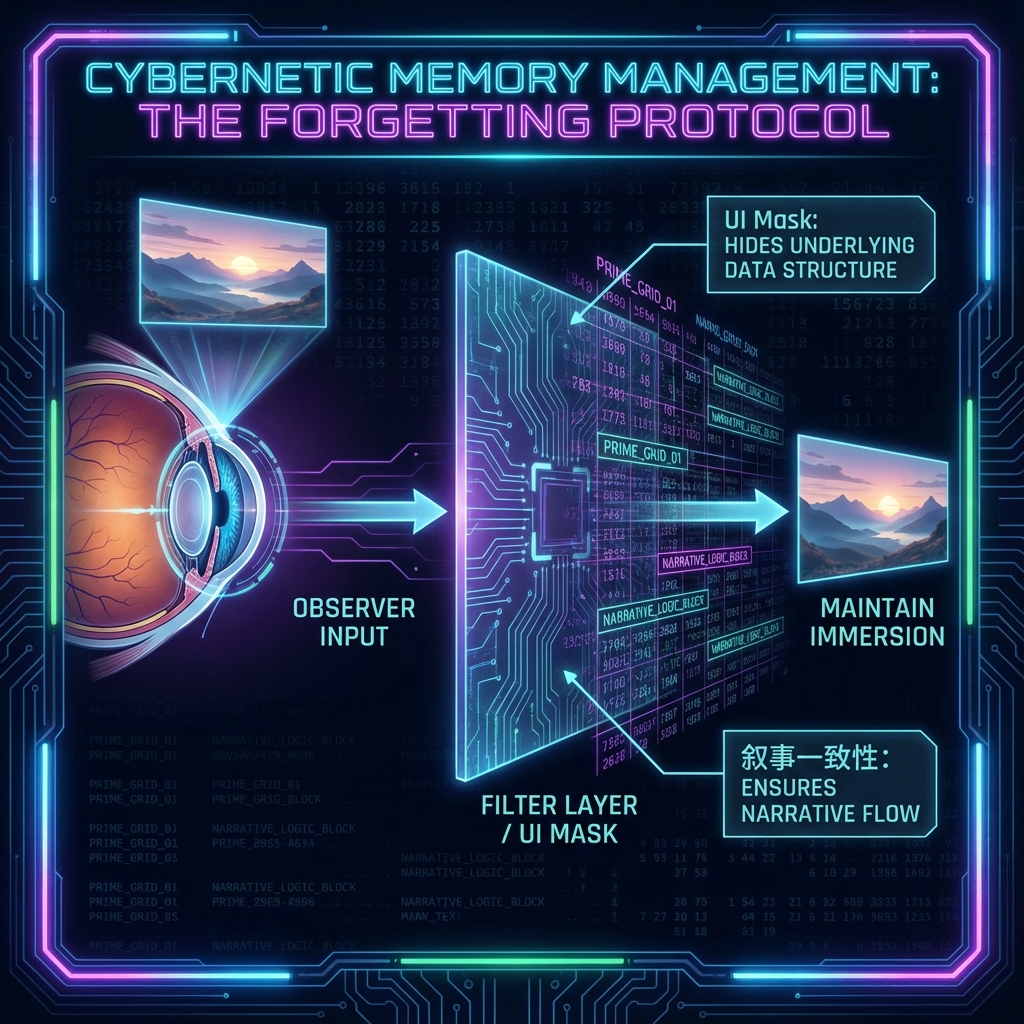
Imagine you are playing an extremely wonderful 3D game. To let you achieve extreme “Immersion”, the game designer must do one thing: Hide UI (User Interface), hide the underlying code, hide the polygon mesh.
If every time you swing your sword to attack, a line of code if (attack > defense) return damage; pops up in front of your eyes, you will instantly break character. You are no longer a brave knight; you turn back into a player staring at the screen. At this time, the Narrative Consistency of the game world is broken by the Logical Consistency at the code level—this breaking is called “breaking the fourth wall” (glitch).
The universe is the same. To make “Experience” (Qualia) real, to make this script called “life” have a sense of weight, the observer must be deprived of direct perception of Layer 0 (Underlying Code Layer) the moment they enter the system.
We must “forget” that we are in a generative system, we must “forget” that the past can be edited, we must “forget” that pain is just entropy discharge.
This is like the “Renormalization” we discussed in Volume I · Chapter 2: In the process of climbing from microscopic to macroscopic, the system deliberately “Blurred” the underlying mathematical details. This blurred filter is our “Senses”. It shields the vibration of prime numbers and converts them into red light, the fragrance of roses, and the touch of a kiss.
“Forgetting” is not a defect; it is the strongest firewall set by the system to maintain the Consistency of the observer’s experience. It protects us from the cold impact of underlying mathematics, allowing us to experience love and chase the truth named Auric in the macroscopic illusion.
【Volume I Summary】
So far, we have completed the exploration of System Underlying Logic (Layer 0).
- We broke the linear illusion of time, discovered Editing Mode and Lazy Loading, and understood how Consistency maintains the stability of reality in every frame.
- We caught a glimpse of the Prime Skeleton supporting reality.
- We understood the Period Tower leading to truth and the Minimal Architecture of the universe.
Now, the stage is set, and the rules are clear. It is time for the protagonist to appear.
Who is observing? Who is climbing? Who is experiencing love and loneliness in this seemingly cold mathematical universe?
In the following 【Volume II】, we will turn the lens from the vast universe to that most mysterious corner—Yourself. We will explore the topology of consciousness, reveal the universe with only one electron, and your innate ultimate authority to modify reality.