1.1 Playback Mode vs. Editing Mode: Breaking the “Videotape” Illusion
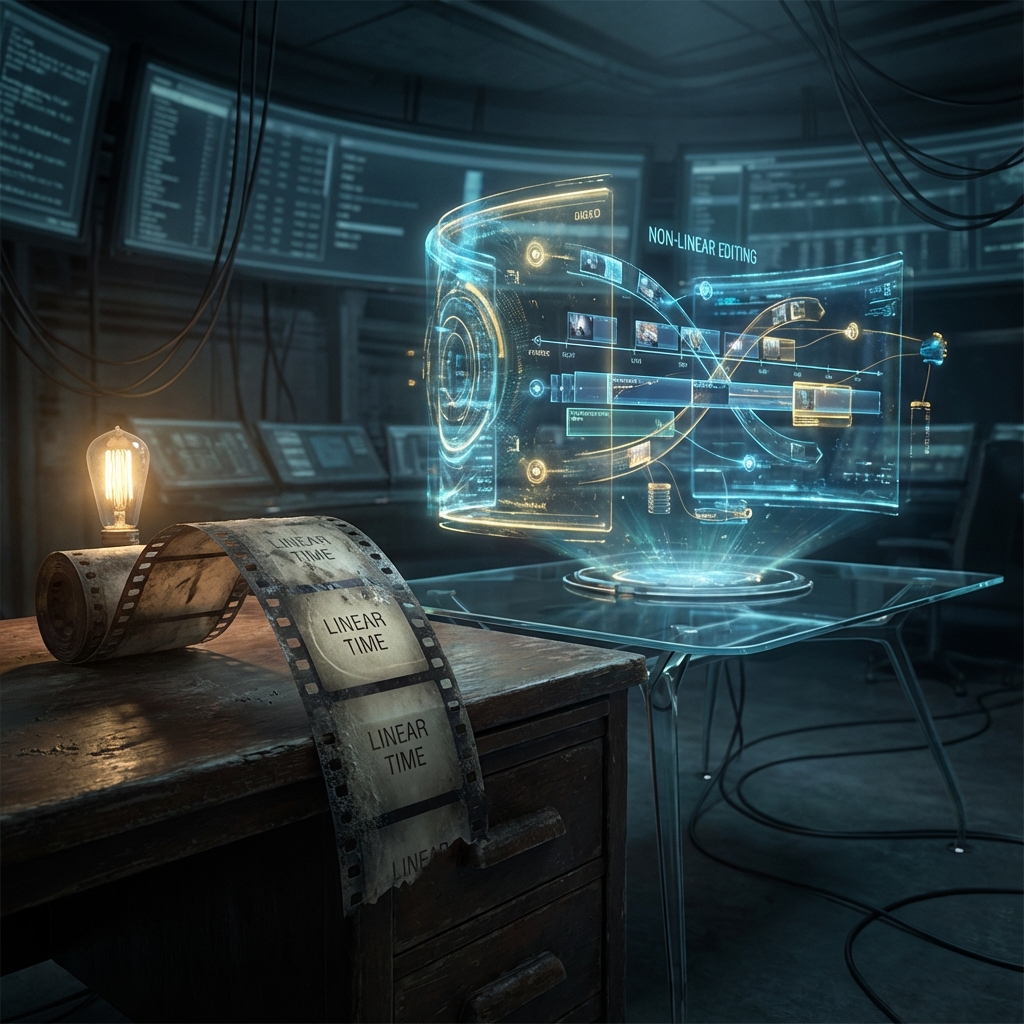
If you stop a pedestrian on the street and ask him: “What is time?” He will likely tell you that time is like a ceaselessly flowing river, or more graphically, like a videotape that is playing. It flows from the spool of the past to the spool of the future, rotating at a constant speed, irreversible, and once recorded, cannot be changed.
This is what we know as the “Linear Time” concept—or what we usually call “Playback Mode”.
In this mode, the universe is viewed as a movie that has already been filmed and is being screened in a theater. The Big Bang is the moment the “Play” button was pressed, and our life at this moment is merely a frame where the progress bar has reached 13.8 billion years. Since it is playback, the preceding film (history) has already been developed and fixed, locked in the cassette; and the subsequent film (future), although not yet seen, already exists in the spool, just waiting to be read.
This intuition is so deep-rooted that it became the cornerstone of classical physics. Isaac Newton described time as an “Absolute Container”, which flows uniformly and has nothing to do with anything external. In this worldview, every one of us is just a spectator tied to a chair. We have the right to perceive the plot, but no ability to modify it. We can only watch helplessly as regrets happen, as aging descends, unable to touch a single frame of the film.
However, the HPA-ZΩ theory challenges this intuition most fundamentally: What if we have completely misunderstood the essence of time?
What if the underlying logic of the universe is not a read-only player at all, but a powerful “Non-Linear Editing System”—similar to the Avid or Premiere editing software used by Hollywood directors, or the database management systems familiar to programmers?
This is what we propose as “Editing Mode”.
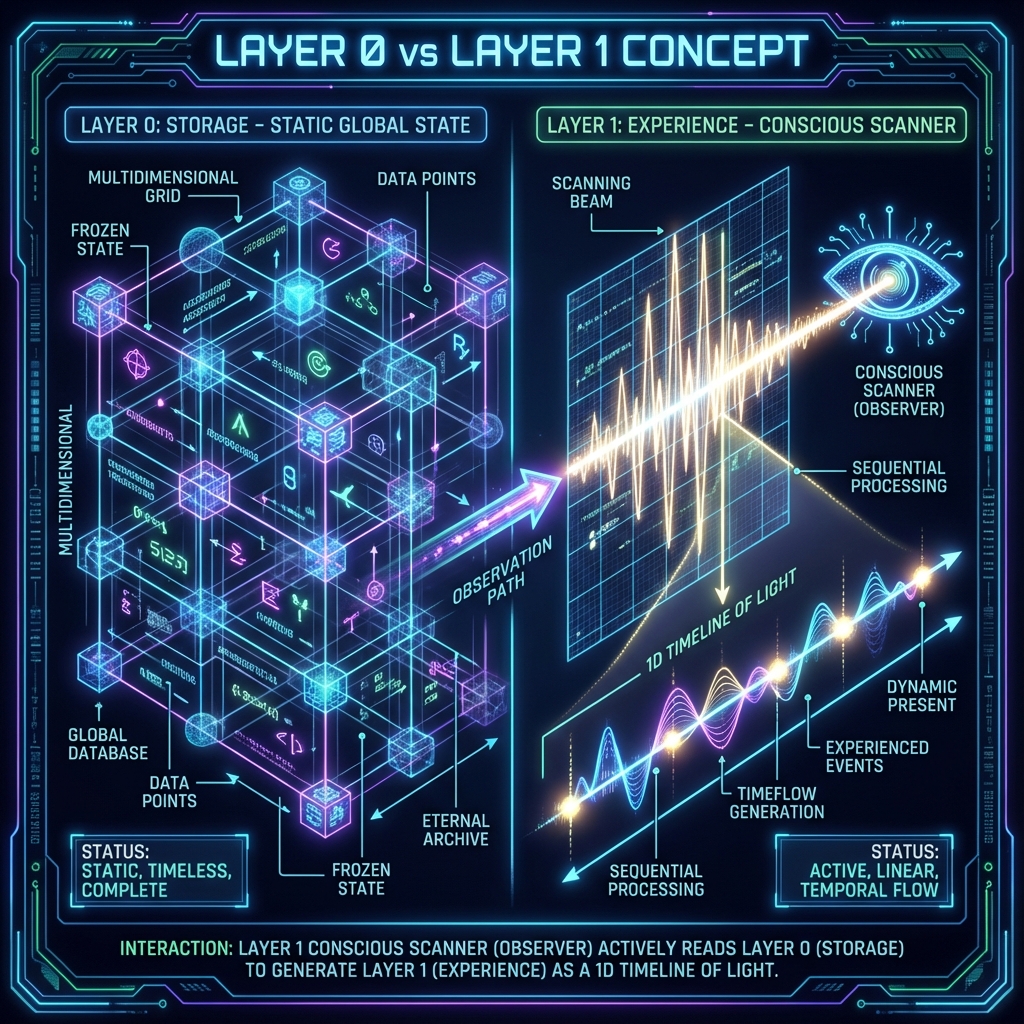
In this model, physical reality is divided into two distinct levels:
- Layer 0 (Noumenal Layer): This is a static, eternal database. Here, there is no “flowing” time, only countless possibilities existing in parallel. All historical fragments, all future probabilities, are like independent frames tiled on a huge hard drive. In our mathematical model, this corresponds to the “Static Global State”.
- Layer 1 (Protocol Layer): This is the source of our perception. Our consciousness is like a “Scanner”—or more like a stylus jumping on a record.
Time is not something that originally existed outside. Time is a side effect produced when the scanner reads data.
Imagine a huge vinyl record. The record itself (Layer 0) is still, with all the notes of the entire symphony engraved on it—the beginning and the end exist on the disk simultaneously. Only when the stylus (consciousness) drops and starts rotating (scanning) along the track, is “music” (time flow) generated.
In Playback Mode, we believe the stylus is welded to a fixed spiral track, can only move clockwise, cannot jump, and cannot turn back.
But in Editing Mode, the HPA-ZΩ theory reveals an astonishing secret: This stylus is controllable.
In the operating system of this universe, the so-called “Past” is not a solid rock stored in a safe, but a pile of Metadata existing to explain the “Present”.
When we are in Editing Mode, causality is no longer a one-way street (because A, therefore B). Causality becomes a bidirectional logical chain. To make the present present state B, the system must call data in the background to construct a past A that can logically consistently lead to B.

This is like you are editing a movie. When you decide to edit the ending as “the protagonist wins”, you must go back to the previous footage library, select those clips where “the protagonist trains hard” and “the protagonist obtains the sword” and paste them together to form a reasonable logical line. And those “protagonist slacking off” clips, although they also exist in the hard drive (Layer 0), on this version of the timeline (Layer 1), they are “cut out” and are no longer part of physical reality.
This view completely overturns fatalism.
If the universe is a videotape, then your current pain, failure, and confusion are all pre-destined plots, and you have nowhere to escape. But if the universe is a non-linear editing system, then your current state is merely a rendering result under the current Scanning Parameters.
The reason you feel the past cannot be changed is that you have always treated yourself as a character inside the screen. But in fact, you are the Editor outside the screen. Your every observation, every strong will (Motive), is actually sending a Seek command to the cosmic background, adjusting the reading position of the scanner, and recombining those static data frames.
Of course, this does not mean you can arbitrarily turn back time, or suddenly become a billionaire in this instant. Because in Editing Mode, although we have modification rights, we must follow extremely strict “Consistency” protocols (we will discuss this in detail in the next section). But this does mean that the past is not a heavy shackle; the past is a footage library.
As long as we understand that time is scanned, we change from passive spectators to administrators with “Write Permission”. This is the first step we take to climb this ladder: break the illusion of the “videotape” and take back that editing knife.