Volume I: Axiomatic Framework
(第一卷:公理化体系)
Chapter 2: The Holographic Equivalence Principle
(第二章:全息等价原理)
“From the ultimate perspective of physics, ‘possibility’ is a pseudo-concept. For the entire universe, all possible histories already exist eternally as superpositions in Hilbert space. The true puzzle is not how the universe chose a path, but why local observers can only see one.”
This chapter will expound the core theorem of Interactive Computational Cosmology (ICC)—the Holographic Equivalence Principle. To prove this principle, we first need to strictly define the two endpoints of the dual relationship. This section will first construct the physical model from God’s perspective, namely the Global Unitary Model (QTM).
2.1 The Global Unitary Model
(全局幺正演化模型)
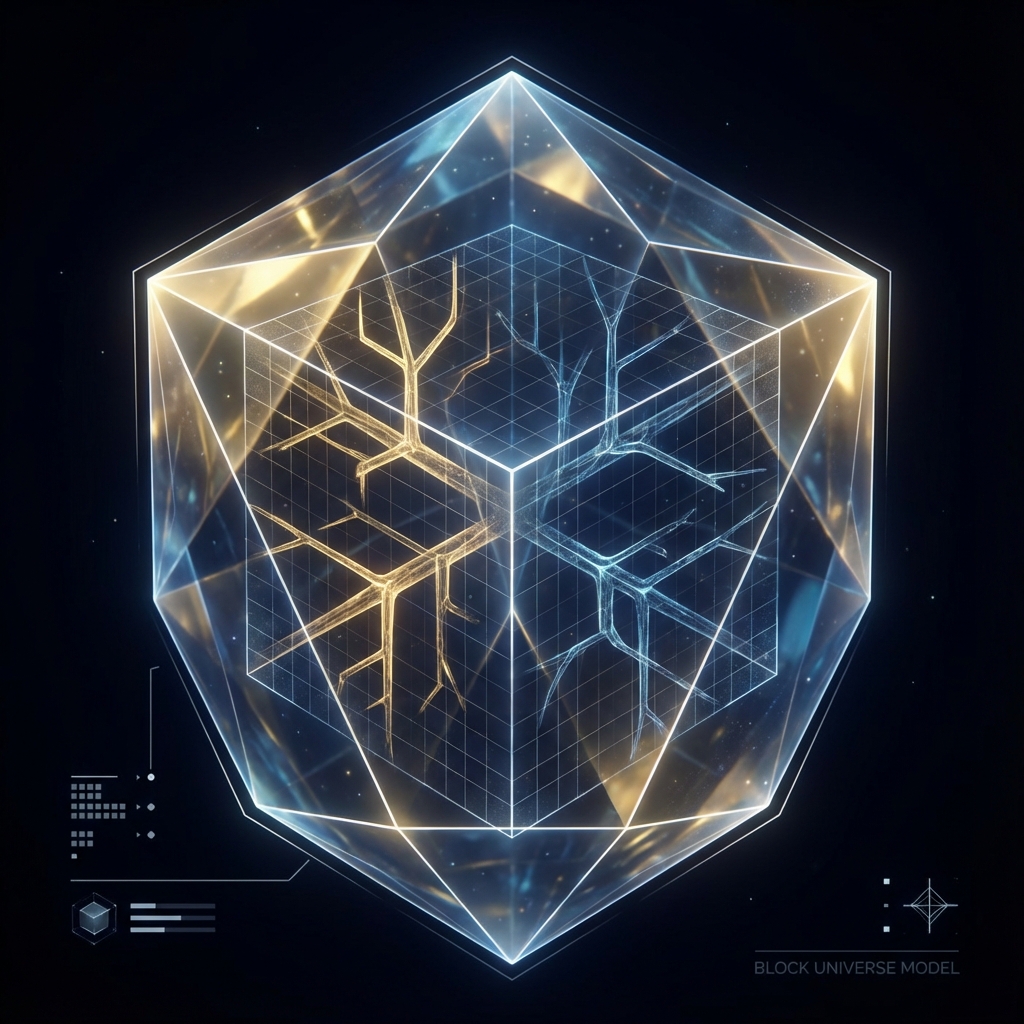
In Chapter 1, we established the finiteness and computability of physical reality. Based on this, we can construct a complete mathematical model describing the entire universe (including all matter, energy, and observers). In this model, we treat the universe as a Quantum Turing Machine (QTM) that is isolated from the outside world and runs self-consistently.
This model represents the ideal objective perspective pursued by physics—the ontology of the universe after removing all subjective observational effects. We will see that from this perspective, the universe is a strictly deterministic, information-conserving, static structure containing all historical branches.
2.1.1 Global Hilbert Space
According to the Axiom of Finite Information, the total degrees of freedom of the universe are finite. Let the universe contain basic information units (qubits), then the global Hilbert space can be defined as the tensor product of local two-dimensional Hilbert spaces:
where is a discrete spacetime lattice. The dimension of this space is enormous but not infinite. The Global Quantum State of the universe at any moment is a unit vector in .
This state vector contains the positions, momenta, spins of all particles in the universe, as well as all complex entanglement relationships. It is a complete description of physical reality. According to the linear superposition principle of quantum mechanics, it can be expanded as a linear combination of a set of orthogonal basis states (such as all possible classical configurations):
Here, each represents a specific classical universe snapshot. The coefficients are complex probability amplitudes, whose squared moduli represent the weight of that configuration in the global wave function.
2.1.2 Eternal Dynamics: Global Unitary Operator
In the QTM model, the universe is a closed system that does not interact with any external environment. Therefore, its evolution strictly follows the Unitarity of quantum mechanics.
We encode physical laws as a global unitary evolution operator . The evolution equation of the universe state with discrete time steps is:
This equation is the discrete version of the Schrödinger equation. The operator must satisfy the unitary condition , which ensures the conservation of the norm of the global wave function:
Physical Implication: Information Conservation
Unitary evolution means that the evolution of the global quantum state is Reversible. If we know the current state and the physical law , we can not only perfectly predict any future state , but also perfectly retrodict past states .
In the QTM model, information is never created nor destroyed. What we call “entropy increase” or “forgetting” is merely information diffusing from local degrees of freedom into global entanglement correlations. For the omniscient God’s perspective (possessing the computational capability of ), the von Neumann entropy of the universe always remains zero (pure state).
2.1.3 Block Universe and Feynman Path Summation
If we examine the expansion of along the time axis, the QTM model presents a Block Universe picture.
Using Feynman path integrals (path summation in the discrete architecture), the evolution from initial time to time can be expressed as coherent superposition of all possible historical paths:
where is the complex amplitude of path , determined by the action .
In this picture:
-
Multiple Histories Coexist: All historical paths consistent with physical laws (e.g., “cat dead” and “cat alive”) have non-zero amplitudes in the wave function. They are parallel existing realities.
-
No Collapse: Since the system is closed, there is no external observer to perform measurements, so the wave function never collapses. Schrödinger’s cat forever remains in a superposition of life and death.
-
Static Spacetime: The time parameter is merely an index in Hilbert space. The entire historical structure is like a completed crystal, statically suspended in logical space.
2.1.4 The Absence of Subjective Experience
Although the QTM model is mathematically perfectly self-consistent, it faces a fatal explanatory gap: it cannot derive the concepts of “now” and “I.”
In a wave function containing all possibilities, all moments are equal, and all historical branches are equal. There is no special pointer marking “now is 2025” or “I see the cat alive.”
-
No “Now”: Because all states at different are rigidly connected by , past and future are ontologically equivalent.
-
No “Choice”: Because all branches occur, so-called choices are illusions. A person walking left at a fork and a person walking right are merely different components in the global wave function.
This leads to the core question of this book: Why do we, as observers within the universe, experience not parallel multiple histories, but a single, linear, random time flow?
To answer this question, we need to introduce the second endpoint of the duality—the Classical Interactive Automaton Model (CITM), which will be detailed in the next section.