Postscript: At the Edge of the Map
(后记:在地图的边缘)
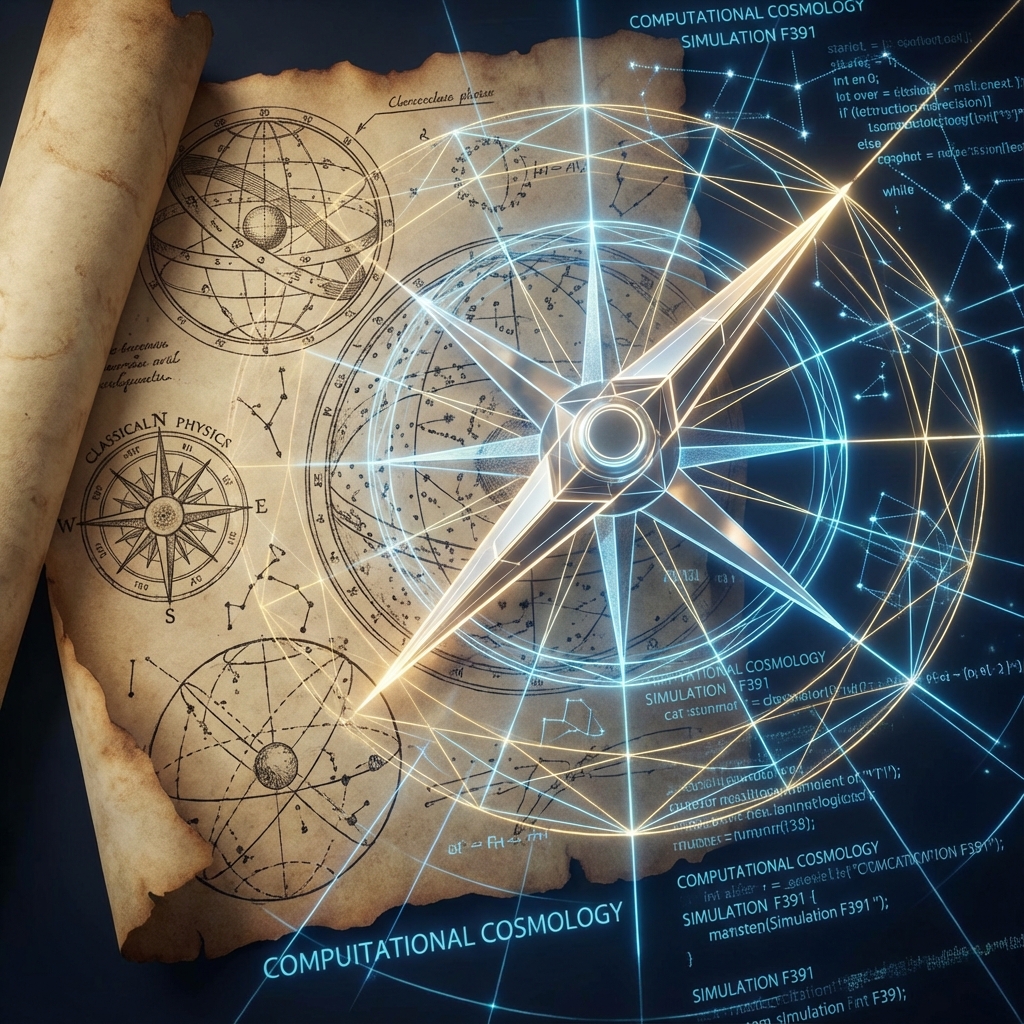
“All theories are maps of some kind. Maps are not territories, but a good map can guide us out of the maze. This computational cosmology map drawn in this book may not represent ultimate truth (because in recursive systems, truth is a fixed point, not a static value), but it attempts to provide a new navigation method: instead of looking up at the stars praying for revelation, we look down at the code seeking logic.”
At the moment of writing this line, the construction work on this book about Interactive Computational Cosmology (ICC) comes to a temporary conclusion.
Looking back at the entire book, we have completed a long logical closed loop from Matter to Information, and then from Information to Consciousness. Starting from the simplest assumption—“the universe is finite and computable”—we derived the limits of light speed, the geometry of gravity, the probability of quantum mechanics, and the nature of the self.
This is not merely a reconstruction of physics but a deep introspection into our own state of existence.
The Twilight and Dawn of Paradigms
20th-century physics is a magnificent monument but also a maze. The incompatibility between quantum field theory and general relativity, the elusiveness of dark matter and dark energy, and the century-long futile debate between “many-worlds” and “Copenhagen” all suggest we are on the eve of what Kuhn called a scientific revolution.
The old “Substance Ontology”—believing the world consists of something hard, objective, and independent of observers—has exhausted its explanatory power. When we try to collide the vacuum with more powerful accelerators, what we get is no longer more fundamental particles but more data fragments.
The “Computational Ontology” proposed in this book is not a novel philosophical game but an engineering response to current physics dilemmas. If we see pixels (Planck scale) at the microscopic level, rendering boundaries (horizons) at the macroscopic level, and latency (light speed) in interactions, then the most honest approach is to acknowledge that we exist within an information processing system.
Acknowledging this is not discouraging. On the contrary, it transforms physics from “discovering God’s creation” to “parsing the system’s architecture”. This is both disenchantment and empowerment.
The Third Language of Science
Galileo said that the book of nature is written in the language of mathematics. Newton and Einstein developed this language to perfection. However, when facing Complexity and Self-Reference, pure continuous mathematics (calculus) appears inadequate.
This book attempts to introduce the third language of science: Algorithm.
By introducing classes and instances to explain wavefunction collapse, lazy loading to explain non-locality, and oracles to explain free will, we find that many physical puzzles that seem paradoxical in mathematics are merely routine resource optimization strategies in computer science.
This may indicate the future direction of theoretical physics: physicists will no longer be merely mathematicians; they must become Cosmic Hackers. Understanding the universe is no longer solving equations but Debugging code.
A Letter to Future Readers
I am well aware that certain views in this book—especially regarding “history is dynamically generated” and “consciousness is external input”—may have tremendous impact on readers accustomed to classical realism, even causing ontological unease.
This unease is normal. Just as when an ant on a two-dimensional plane first realizes the existence of three-dimensional space, its originally solid ground suddenly becomes suspended paper.
But remember, the core of the ICC model is not nihilism but Participatory Realism. The universe is not an empty stage, and you are not an accidental passerby. You (as consciousness) are an indispensable co-processor in this massive computational process. Your every observation hardens reality through consensus protocols, and your every intention fine-tunes the direction of probability streams.
This book is a key. It cannot directly give you superpowers, but it can help you unlock the Lock of thinking. When you no longer regard physical laws as iron rules but as Default Configuration, you have already taken the first step from awakening as a User to becoming a Developer.
Acknowledgments and Outlook
Thanks to Turing, Wheeler, Bekenstein, Verlinde, and all pioneers exploring the frontiers of computational physics. It is their fragments of thought that pieced together this holographic universe puzzle.
The compilation of the universe continues, and our exploration is far from over. This Principles is only a version v1.0 document. As human civilization transitions from carbon-based to silicon-based, from planetary civilization to stellar civilization, we will gain higher computational power and deeper insights to access those kernel codes currently hidden from us.
Before that point arrives, may you find your optimal solution in every iteration.
Keep computing. Keep observing. Keep awakening.
(End of Book)