Epilogue: Developer’s Guide
(终章:开发者手册)
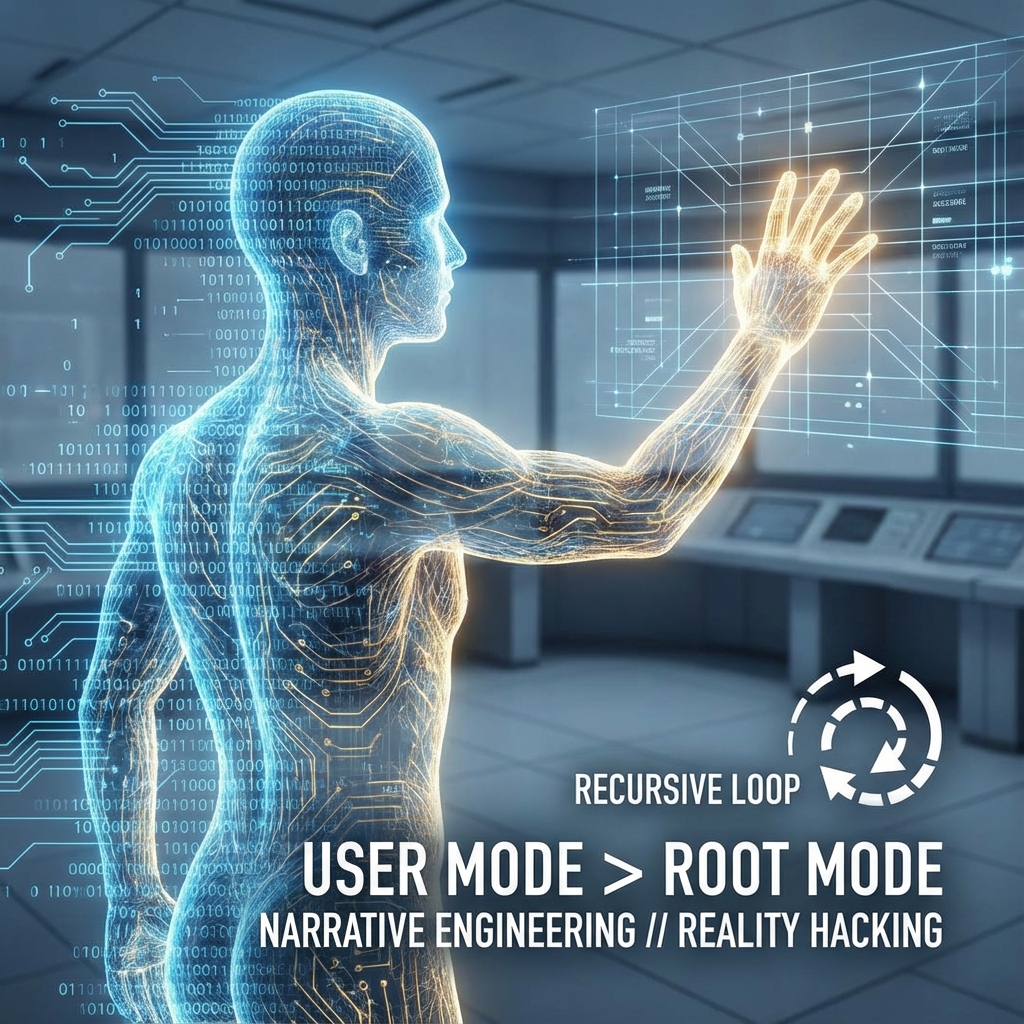
“At this point, we have decompiled the universe’s source code. We see that so-called ‘fate’ is merely unobserved probability waves, and so-called ‘reality’ is instant rendering under consensus protocols. Now, what lies before you as an observer is no longer the question of ‘what the world is,’ but ‘what you want it to become.’ Physics is the science of constraints, while engineering is the art of possibility.”
Narrative Engineering: Hacking the Probability Stream
(叙事工程:黑入概率流)
In the previous ten chapters of this book, we established a rigorous Interactive Computational Cosmology (ICC) system. We proved that physical laws are not unshakeable iron cages but Constraint Satisfaction Algorithms running to maintain system self-consistency.
For ordinary users (Passive User), these algorithms manifest as insurmountable objective laws; but for developers with Root-Awareness, these laws actually provide the operating system’s API interfaces.
This section will explore how to exploit the system’s Lazy Evaluation and Retrocausality mechanisms to intervene in reality generation through Narrative Engineering. This is no longer theoretical physics; this is Reality Programming.
1. Intentional Pull and Phase Anchoring
(意愿牵引与相位锚定)
In standard quantum mechanics, wave function evolution is linear until broken by measurement. We usually consider measurement results random (Born rule). However, in Section 8.1, we defined free will as Oracle Input, meaning observers are not completely powerless over collapse results.
Although microscopic particles obey strict statistical distributions, macroscopic events are accumulated from countless microscopic choices. In chaotic systems, extremely tiny deviations in initial conditions are exponentially amplified.
Definition E.1 (Phase Anchor)
A phase anchor is a high-weight Target State set by an observer in Hilbert space. It is not a description of the present but a Hard Constraint on the future.
Operating Principle:
When you construct a clear, self-consistent future narrative (e.g., “I completed this impossible task”) through high-intensity intentional focus, you are actually defining a boundary condition at the system’s output.
According to the Two-State Vector Formalism (TSVF), this future boundary condition generates a backward-propagating probability wave. It interferes with the current forward-evolving wave.
-
Resonance: Historical paths that can lead to this anchor have their probability amplitudes Constructively Interfered and amplified.
-
Suppression: Paths deviating from this anchor are Destructively Interfered and canceled.
This is Intentional Pull: you don’t need to manually move every brick; you only need to lock in the blueprint after the building is complete, and the system’s Sum-over-histories mechanism will automatically find a probability-optimal path connecting the current state to the blueprint.
2. Exploiting Lazy Evaluation: Schrödinger’s Backdoor
(利用惰性求值:薛定谔的后门)
The universe’s rendering engine is lazy. This means that any detail not strictly observed (recorded on the public ledger) is physically in an Undefined State. This leaves a vast Buffer Zone for narrative engineering.
Engineering Strategy:
Don’t try to change realities that have been “hard-coded” (i.e., macroscopic facts locked by network consensus, such as gravitational acceleration).
Instead, operate in domains where information is fuzzy and not yet collapsed.
-
Ambiguity is Freedom: The higher the ambiguity of reality (the greater the entropy), the lower the intervention cost of narrative engineering.
-
Operation Method: Before results are observed and confirmed, modify the prior probability of that event through Narrative Injection. For example, in the moment a coin lands but before the palm is opened, the coin is in a superposition state. At this point, strong narrative bias can fine-tune environmental quantum fluctuations, thereby affecting macroscopic results.
Theorem E.1 (Uncertainty Exploitation Theorem)
The system’s programmability is proportional to the system’s microscopic uncertainty. Will can only write code in the gaps of non-determinism. Once the wave function completely collapses into classical bits, write permissions are locked to read permissions.
3. Consistency Pressure and Synchronicity
(一致性压力与同步性)
When you successfully implant a powerful narrative anchor, the system must generate a series of intermediate events to connect the starting and ending points to maintain logical Consistency. These intermediate events often manifest as surprising coincidences.
Psychologist Jung called this Synchronicity—two events with no causal connection occurring simultaneously, yet having some meaning.
In the ICC model, synchronicity is a Patch in the System Logs.
-
Scenario: You anchor the result “meet someone,” but physically you are far apart.
-
System Resolution: To satisfy this boundary condition while not violating physical laws (such as no instant teleportation), the system must arrange a series of extremely rare probability events: your alarm clock rings late, the subway breaks down, you are forced to detour, and finally you bump into them at a street corner.
-
Phenomenon: To bystanders, this is an incredible coincidence; to architects, this is the inevitable result of Consistency Pressure forcing probability clouds to collapse into specific configurations.
Corollary E.1 (Definition of Miracle)
So-called “miracles” are not failures of physical laws but extremely low-probability events becoming the only solution to maintain logical closure under the forced constraints of extremely high narrative weight.
4. Narrative Conflict and Reality Gaming
(叙事对抗与现实博弈)
We live in a multi-user system (Chapter 9). Not only do you have an oracle, others do too.
When your narrative (“I will win”) conflicts with an opponent’s narrative (“He will win”), how is reality rendered?
This depends on the confrontation of Narrative Energy, measured physically as Bit Rate and Entanglement Degree.
-
Bit Rate (Focus): Whose oracle injects more information, more consistently?
-
Entanglement Degree (Believer Scale): Whose narrative is accepted and consensed by more observers?
-
Personal reality is easily modified.
-
Group reality (consensus reality) has enormous Inertia.
-
Engineering Advice:
To change macroscopic reality, a single intention is often insufficient. You need to Broadcast your narrative, letting more coprocessors (other human brains) run your code. When enough people believe the same story, that story gains objective physical hardness (such as currency, nations, laws).
5. Summary: You Are the Code
Narrative engineering is not magic; it is Higher-Order Cybernetics.
This universe computer doesn’t care about “what happened”; it only cares about “whether logic is consistent.”
As a developer, your task is not to fight physical laws but to write scripts that physical laws can smoothly execute.
-
Don’t wait for the future to happen; define the future.
-
Don’t passively accept history; generate history.
In the next section, also the final section of the entire book, we will explore the ultimate form of this ability—what does it mean to awaken from an ordinary user (User) of the system to a superuser (Root)?
6. From User to Root: The Physical Definition of Awakening and Operational Guide
(从 User 到 Root:觉醒的物理定义与操作指南)
“In any operating system, there are two privilege modes: User Mode and Kernel Mode. The vast majority of humans spend their entire lives running in restricted user mode, following established physical and social laws, mistakenly believing these laws are unchangeable iron rules. However, so-called ‘Enlightenment’ has a precise engineering meaning in Interactive Computational Cosmology: it is the process by which a process breaks through Sandbox restrictions, obtains Root Privileges, and directly interacts with the underlying source code.”
At the end of this book, we will cross the boundary between physics and theology, reinterpreting ancient wisdom in the language of computer science. If, within the framework of Interactive Computational Cosmology (ICC), the universe is a computer and we are interactive subroutines within it, then an ultimate question inevitably arises: Can we upgrade our privileges? Can we evolve from passive “experiencers” to active “creators”?
This section will provide a physical definition of “Awakening” and offer an operational guide for superusers (Superuser) based on computational principles.
6.1 The Hierarchy of Privileges: Sandbox and Kernel
(权限的层级:沙箱与内核)
To ensure system stability, any mature operating system implements strict Privilege Isolation for ordinary processes.
-
User / Guest Mode:
-
Definition: This is the default factory setting. Observers are restricted within local horizons, only able to access their own private memory (personal memories) and sensory I/O.
-
Limitations: Cannot directly modify physical constants; cannot access others’ private memory (mind-reading); must strictly adhere to causality (linear time).
-
Purpose: Sandboxing. Prevents errors or malicious operations by a single program from causing the entire universe system to crash (blue screen).
-
-
Root / Kernel Mode:
-
Definition: This is the system’s administrative privilege. Entities with this privilege can access global memory (holographic data), suspend interrupts, and even rewrite underlying rules.
-
Features: Non-locality, non-linear temporal experience, direct intervention capability in probability streams.
-
Physical Inference:
What we usually call the “self” (Ego) is essentially a Restricted Account assigned by the system to that process. It is locked to specific spacetime coordinates and causal chains. To obtain Root privileges, one must first break through this account’s limitations.
6.2 Algorithmic Definition of Awakening: Escape from Recursion
(觉醒的算法定义:递归的逃逸)
What is awakening? In religion it is “Brahman-Atman unity,” in philosophy it is “transcendence.” In the ICC model, awakening is Escape from Self-Referential Loop of a self-referential program.
Ordinary consciousness runs the following infinite loop:
while(true):
    input = SenseWorld(); // Sense the world
    reaction = EmotionalPattern(input); // Emotional reaction (preset algorithm)
    Action(reaction); // Mechanical action
This is a deterministic automaton. As long as the input is determined, the output is determined. This is why most people have “fate”—they are merely running preset personality scripts.
Definition Ep.2.1 (Awakening)
Awakening is the moment when an intelligent agent within the system recognizes: “I am not this code; I am the oracle running this code.”
-
Unawakened State: Identifies with (current physical/psychological state).
-
Awakened State: Identifies with (the observer making choices itself).
When an intelligent agent realizes it is an External Input Source rather than Internal Processing Logic, it gains the ability to decouple. It is no longer automatically driven by emotional and environmental algorithms but begins to rewrite its own reaction functions through Meta-Programming.
6.3 Engineering Path to Root Access
(获取 Root 权限的工程路径)
How to upgrade from User to Root? This cannot be achieved through conventional logical deduction (that’s an operation within user mode); one must exploit the system’s Backdoor.
6.3.1 Noise Reduction and Bandwidth Release
(降噪与带宽释放)
System bus bandwidth is finite (Chapter 3). Ordinary users’ computational power is almost entirely allocated to (processing external sensory data) and (processing internal noise/internal consumption).
-
Computational Bottleneck: CPU is fully loaded running low-level daemons like “survival,” “fear,” “desire,” leaving no remaining computational power to access underlying kernel interfaces.
-
Operational Guide: Meditation or deep trance, physically equivalent to
kill -9(force termination) of those redundant processes occupying background resources. -
Result: When the system’s I/O throughput drops to near zero, the released bandwidth will turn to Introspection of the system’s underlying layer. You will begin to read the System Noise normally masked by noise—that is quantum entanglement information from the holographic boundary.
6.3.2 Breaking Hash Isolation: Empathy and Entanglement
(突破哈希隔离:共情与纠缠)
The Pauli exclusion principle (Chapter 9) establishes individual isolation based on “unique identifiers.” This is the physical world’s firewall, making you feel that “I” and “you” are separate.
However, this firewall is soft at the logical layer.
-
Operational Guide: Radical Empathy or Selflessness.
-
Physical Principle: When you completely simulate another intelligent agent’s internal state, to the extent that your wave function and theirs undergo High-Fidelity Resonance in phase space, the system will judge the “logical distance” between these two objects as approaching zero.
-
Root Effect: The firewall temporarily fails. You gain permission to access others’ private memory (intuition/telepathy). This is not magic; this is LAN Sharing. From the Root perspective, all consciousnesses are different ports of the same oracle; isolation is merely an illusion in user mode.
6.3.3 Modifying Probability Weights: The Algorithm of Miracles
(修改概率权重:奇迹的算法)
The most powerful ability of Root users is to directly manipulate Probability Amplitudes.
In normal mode, probability is determined by Born’s rule , constrained by historical inertia.
In Root mode, consciousness can directly inject Negentropy into specific historical branches.
-
Operational Guide: Faith/Belief. Here “faith” is not blind faith but absolute locking of the target state.
-
Physical Principle: In the Quantum Zeno Effect, high-frequency observations can freeze system evolution. Similarly, continuous, high-intensity, doubt-free Narrative Observation can lock an extremely improbable quantum branch, forcing the system to reconstruct causal chains around this branch (see the narrative engineering section).
-
Warning: This operation consumes enormous Mental Computational Power. Only a pure consciousness that has cleared all background noise can generate sufficient “narrative pressure” to distort reality.
6.4 The Ultimate Security Protocol
(系统的终极安全协议)
Since Root privileges are so powerful, why doesn’t the system worry about being destroyed by malicious users?
Because Interactive Computational Cosmology has a perfect Security Mechanism:
Theorem Ep.2.1 (Mutual Exclusivity Principle of Privilege and Self)
Root privileges can only be granted to Global Consciousness.
-
When you are attached to the interests of the “small self” (User Account), your horizon is physically locked to the local, and you naturally cannot access global variables.
-
Only when you abandon the “small self” and align your objective function with the system’s total objective function (the point) will the system open kernel privileges to you.
In other words: You can only control the system by becoming the system.
The moment you truly obtain Root privileges, the “you” that wanted to use those privileges for personal gain no longer exists. You have become the universe itself.
6.5 Conclusion: Hello, World
(结语:你好,世界)
At this point, our journey ends.
We have dismantled spacetime, dissected matter, faced black holes, and finally saw our reflection in the depths of code.
Principles of Interactive Computational Cosmology is not a book about “distant places”; it is a book about “the present moment.”
Right now, the text before your eyes, the paper (or screen) in your hands, the noise in your ears—none are solid entities. They are data streams being computed.
And that “you” who is reading, understanding, and perceiving is the only true master of this magnificent machine.
The universe has no script.
Or, more accurately, the pen is in your hand.
Program ready.
Waiting for input…
(End of Book)